 Whalesbook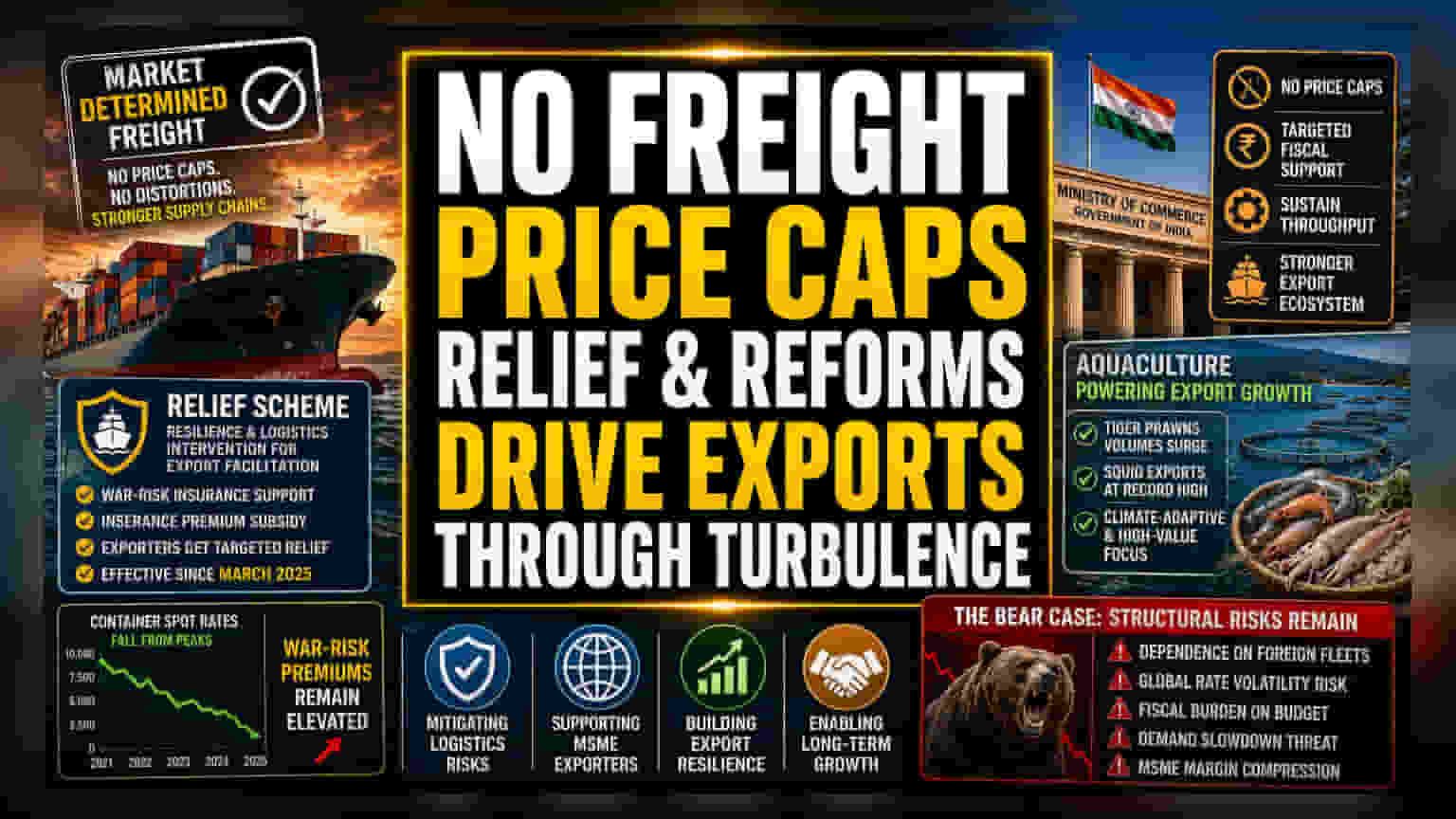


The Economic Logic of Non-Intervention
The insistence on a market-determined pricing model for maritime logistics signals a calculated trade-off by the Ministry of Commerce. By resisting calls for price caps on freight, the administration aims to avoid the distortionary effects of state-imposed ceilings, which historically lead to capacity shortages and supply chain rigidity. The government’s stance suggests that allowing carriers to pass through costs—while providing targeted fiscal buffers for exporters—is the most efficient way to maintain throughput in the face of ongoing instability in the Strait of Hormuz.
Mapping the RELIEF Impact
The Resilience & Logistics Intervention for Export Facilitation (RELIEF) scheme, operational since March, represents a shift from broad-based subsidies to granular, risk-mitigation support. By focusing on insurance premiums and war-risk coverage, the initiative addresses the specific cost-drivers that currently squeeze the margins of small and medium-sized enterprises. Data suggests that while container spot rates have normalized from their historical peaks, the incremental cost of war-risk premiums remains a structural headwind for exporters dealing in lower-margin commodities, particularly in the agricultural and fisheries space.
Sectoral Resilience and Diversification
Beyond immediate logistical concerns, the government is leaning on aquaculture as a growth multiplier for India’s trade basket. The reported volume surge in tiger prawns and squid highlights a strategic move to insulate the export economy from commodity price volatility in traditional manufacturing sectors. By leveraging climate-adaptive aquaculture, the sector is successfully moving toward higher-value product tiers, which provide a natural hedge against the transport cost inflation that currently plagues lower-value, high-volume exports.
The Forensic Bear Case: Structural Vulnerabilities
Critics of this policy path point to the inherent limitations of the RELIEF framework. While the scheme acts as a temporary pressure valve, it does not solve the fundamental lack of shipping capacity controlled by domestic carriers. Dependence on foreign-owned fleets means that even with government-backed insurance support, Indian exporters remain price-takers in a global market where demand-supply imbalances can shift rapidly. Furthermore, the reliance on budgetary allocations for cost reimbursements introduces a fiscal dependency that could become unsustainable if geopolitical tensions in the Middle East persist through the next fiscal cycle. The combination of high insurance costs and the potential for a global demand slowdown creates a margin-compression scenario for MSMEs that government intervention may only delay, not prevent.