

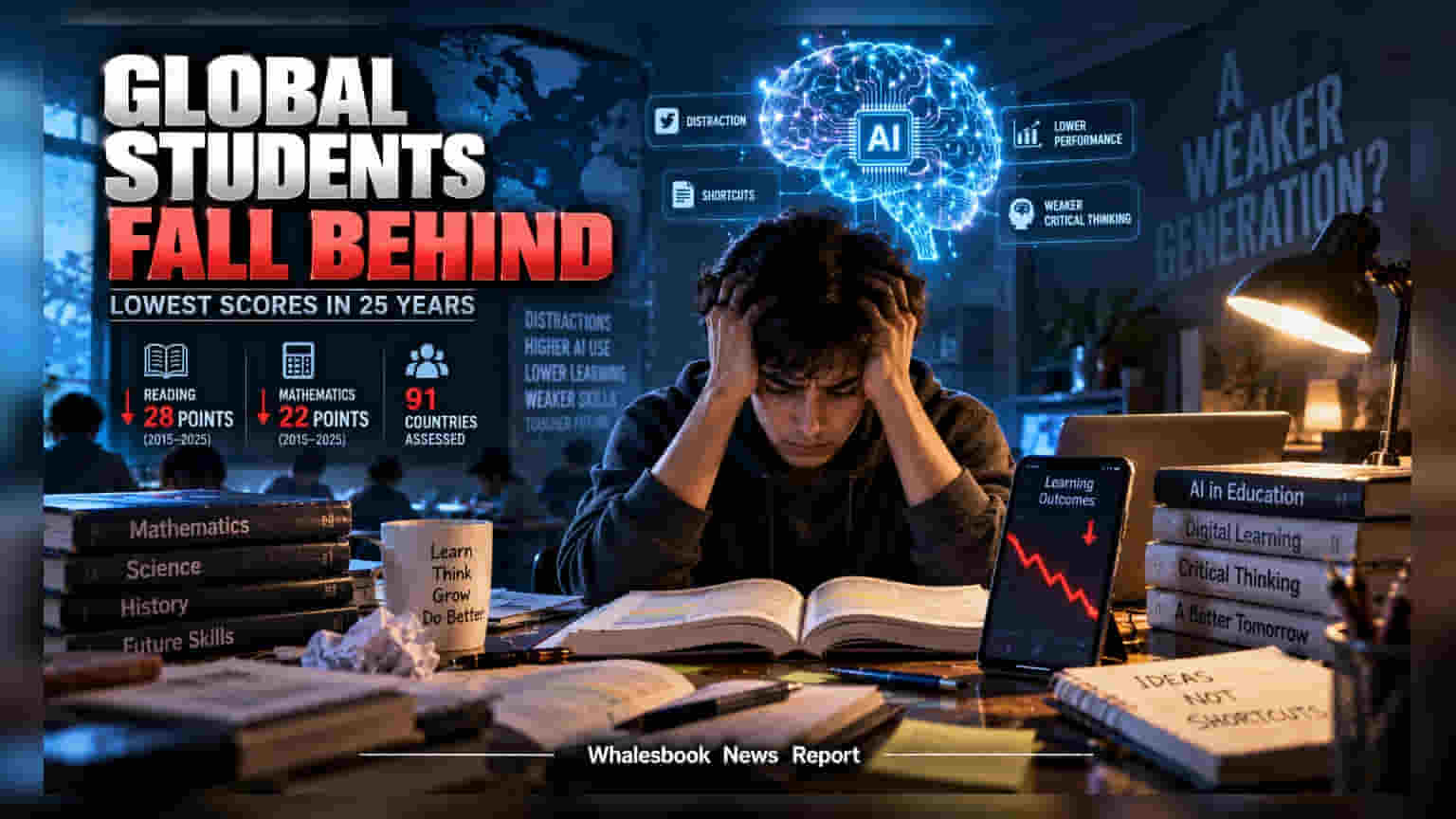
The latest OECD report reveals that student performance in reading and math has dropped to 25-year lows globally, driven by digital distractions and AI misuse. While India did not participate in this specific cycle, the findings highlight a critical need for changes in education efficiency and digital tool integration that may influence future education and EdTech strategies.
The latest results from the Programme for International Student Assessment (PISA), released by the Organisation for Economic Co-operation and Development (OECD) on September 8, 2026, show a concerning global trend in student performance. Across 91 countries, 15-year-olds have recorded their lowest math and reading scores in 25 years. Between 2015 and 2025, reading scores dropped by 28 points, while mathematics performance fell by 22 points.
The report identifies several factors behind this decline, with the misuse of digital tools and artificial intelligence (AI) being key contributors. Nearly 30% of students reported being distracted by technology during science lessons. Furthermore, the report highlights an 'AI divide,' where students using AI for schoolwork without proper guidance often perform worse than their peers. While India did not participate in the 2025 PISA cycle, the report provides important context for anyone tracking the education and EdTech sector, as it highlights systemic efficiency issues rather than a lack of funding.
The Shift in Education Spending and Efficiency
A critical takeaway from the OECD data is that increased national spending on education does not always lead to better student outcomes. The report indicates that once cumulative spending per student crosses the $85,000 threshold, the correlation with higher performance weakens significantly. This suggests that the current global education crisis is less about the amount of money spent and more about how instruction is delivered and how digital tools are integrated into the classroom.
For the Indian education and EdTech sector, this distinction is vital. As India continues to implement the National Education Policy (NEP) 2020, the focus is increasingly shifting toward learning outcomes, foundational literacy, and the quality of digital integration. Companies operating in the space are increasingly moving away from simple content delivery toward platforms that focus on measurable academic improvement and cognitive development.
Challenges for the Future Workforce
The report warns that the decline in critical thinking and complex problem-solving skills could have long-term economic consequences. A workforce with weaker foundational literacy may struggle to adapt to rapid changes in the global economy. This creates an indirect pressure on educational institutions and training providers to overhaul curricula to emphasize critical analysis over rote memorization or reliance on automated tools.
Investors monitoring the education sector may look for how companies and schools adapt to these findings. The primary monitorables will be how institutions manage the balance between digital integration and student engagement, the effectiveness of AI-based tools in classrooms, and whether future educational models can reverse the trend of declining student performance. As the global debate on education quality intensifies, policy decisions regarding teacher shortages and digital curriculum standards will likely remain at the forefront of the industry's evolution.