

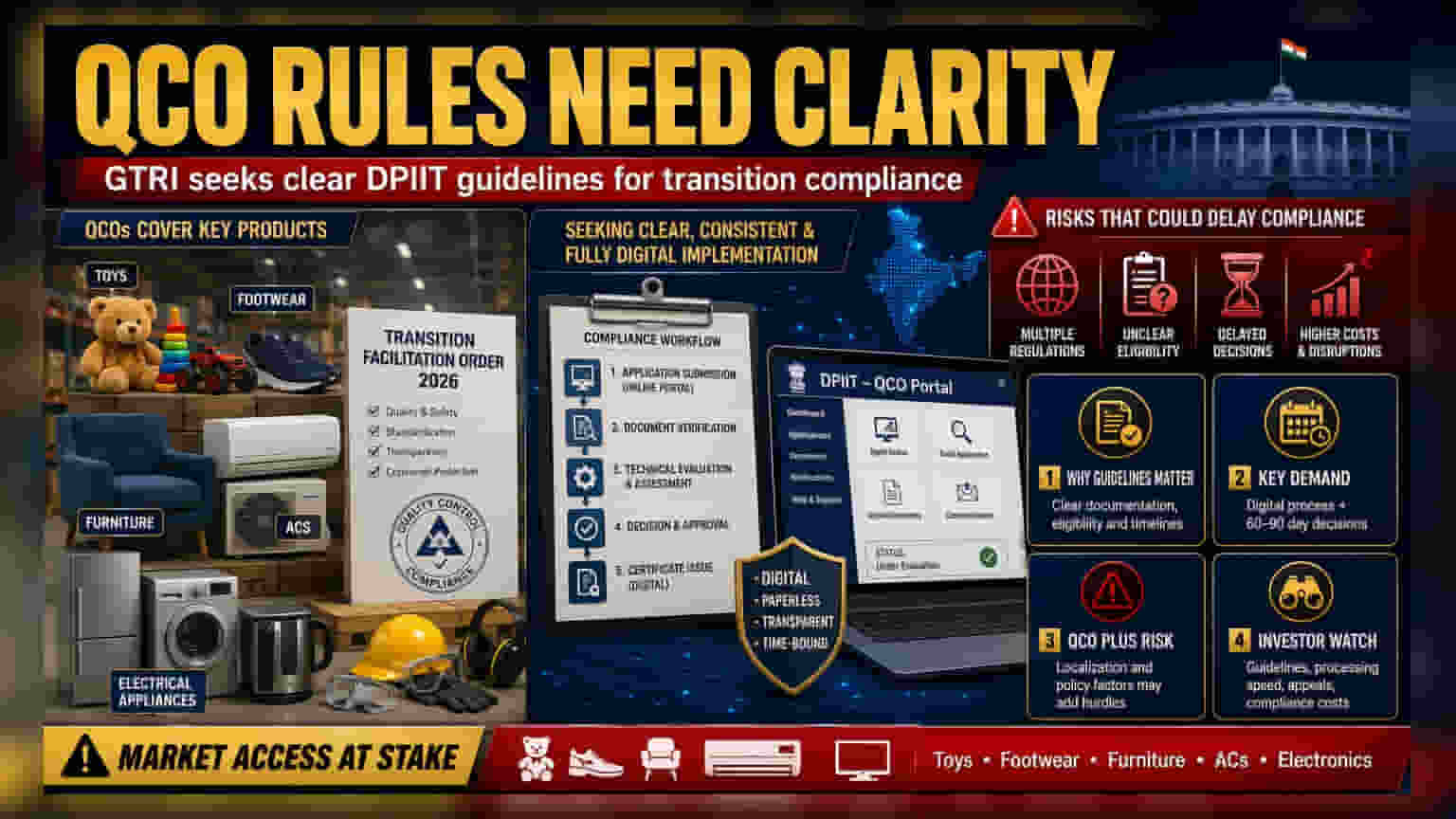
The Global Trade Research Initiative has urged the DPIIT to release clear, digital, and time-bound guidelines for the new Transition Facilitation Order, 2026. This reform aims to simplify compliance for products like toys and electronics, but experts warn that unclear implementation or hidden localization requirements could create new trade barriers for manufacturers and importers.
What Happened
The Global Trade Research Initiative (GTRI) has requested the Department for Promotion of Industry and Internal Trade (DPIIT) to issue comprehensive operational guidelines for its newly introduced Transition Facilitation (Quality Control) Order, 2026. The government recently introduced this alternative compliance pathway to help businesses navigate the existing Quality Control Orders (QCOs) that apply to goods such as toys, footwear, furniture, air conditioners, and personal protective equipment.
While the goal of this reform is to reduce the operational delays often associated with mandatory factory inspections by the Bureau of Indian Standards, the think tank has highlighted that the success of this pathway depends entirely on how it is implemented. GTRI is advocating for a fully digital application process with fixed service-level timelines, suggesting that decisions on applications should be made within 60 to 90 days to ensure business continuity.
Why Clarification Matters For Businesses
Quality Control Orders act as a gatekeeper for the Indian market, mandating that products meet specific quality standards before they can be sold. For companies in sectors like consumer durables, electronics, and lifestyle goods, the certification process is a critical factor in supply chain management. If the rules for this new "transition" path remain vague, businesses may face uncertainty regarding whether they can import or manufacture goods on time.
Clear guidelines on documentation, evaluation methods, and eligibility are essential for companies to plan their inventory and production cycles. Without these, businesses—particularly those reliant on imported components or foreign manufacturing—may struggle with planning, which could lead to supply shortages or inventory build-ups if certifications are delayed.
The Risk of a "QCO Plus" System
One of the primary concerns raised by industry observers is that the new mechanism might inadvertently create a more complex regulatory environment, sometimes referred to as a "QCO Plus" system. GTRI has noted that the review committee, chaired by the DPIIT, may evaluate applications not just on technical quality standards, but also on factors like localization and industrial policy.
For investors, this shift is significant. If compliance for market access becomes tied to deeper industrial policy requirements or localization commitments, it could alter the competitive landscape. Furthermore, the restriction that only companies incorporated under India's Companies Act, 2013, are eligible to apply could exclude foreign manufacturers that do not have a registered local entity, potentially limiting their ability to bring certain products to the Indian market.
What Investors Should Track
Investors with exposure to sectors heavily impacted by QCOs, such as consumer electronics, furniture, and toys, should monitor the following areas:
- The official, detailed guidelines released by the DPIIT, which will clarify the actual requirements for the new certification pathway.
- The speed at which the government processes applications once the system goes live, as this will determine if the reform truly reduces the regulatory burden.
- Whether the government introduces an appeal mechanism for rejected applications, which would provide companies with a safety net for business disputes.
- Management commentary from companies in these sectors regarding their compliance costs and ease of market access under the new framework.