

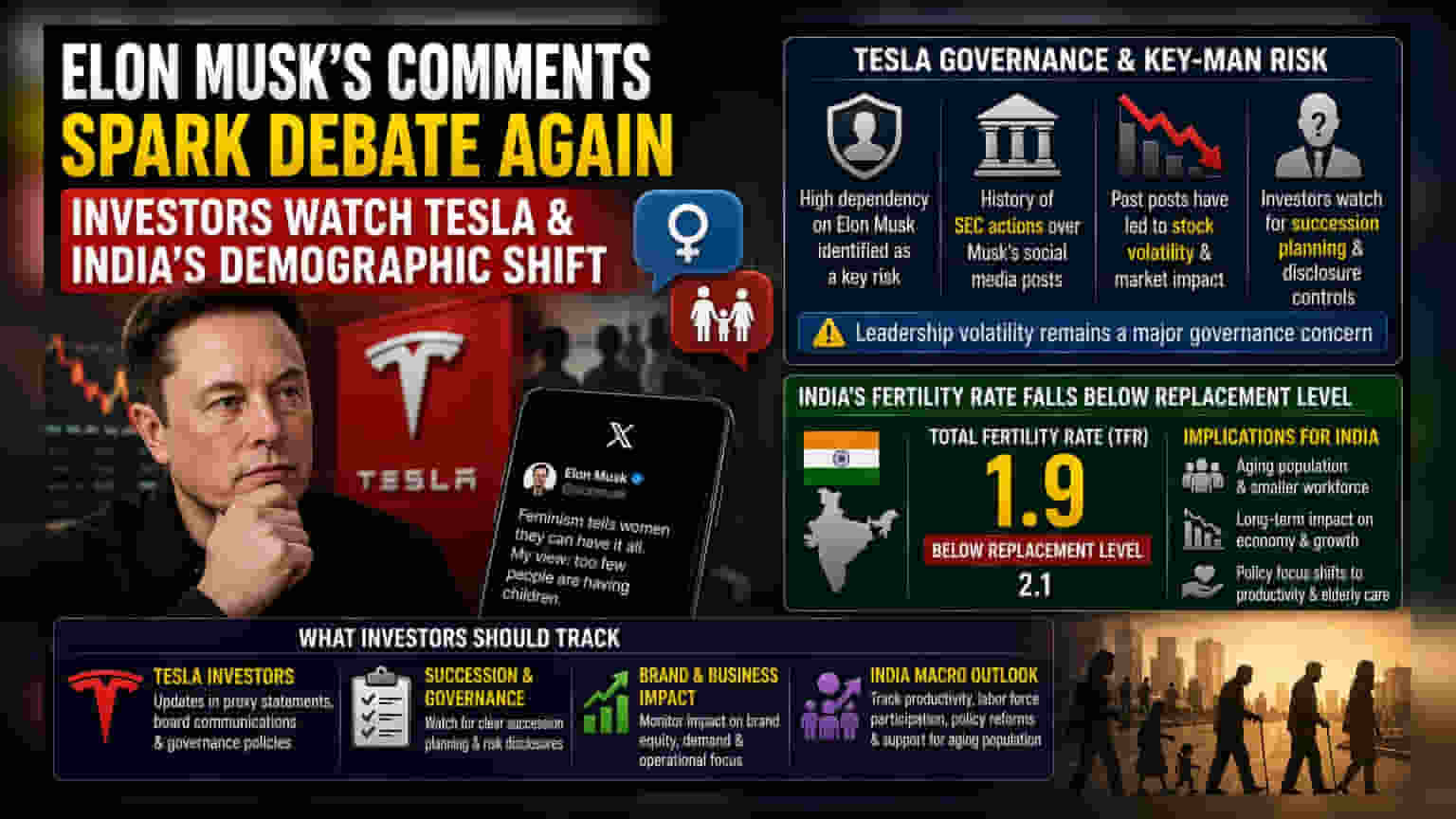
Tesla CEO Elon Musk has faced fresh criticism for recent comments on social issues, renewing investor discussions around 'key-man' governance risk. Separately, his past remarks on India's declining fertility rate highlight a significant macro-economic shift, as recent data confirms India's TFR has dropped to 1.9, falling below the replacement level of 2.1.
What Happened
Tesla CEO Elon Musk has triggered a new wave of public debate following his recent comments on X regarding feminism and women's choices around child-rearing. While the remarks sparked widespread criticism, for stock market investors, the event draws attention back to the governance structure of Tesla and the ongoing 'key-man' risk associated with its leadership. This follows Musk’s earlier attention-grabbing comments on India’s demographics, where he noted declining birth rates in the country. Recent official data now confirms that India’s Total Fertility Rate (TFR) has indeed dropped to 1.9, officially falling below the replacement level of 2.1 required to keep a population stable.
The Governance and Key-Man Risk
For investors, the primary concern when high-profile CEOs engage in controversial social media activity is corporate governance. Tesla has historically faced scrutiny regarding its reliance on Musk’s personal brand and vision. Tesla’s own regulatory filings have previously identified the company's high dependency on Musk as a significant risk factor.
Past regulatory actions, including settlements with the U.S. Securities and Exchange Commission (SEC) over Musk’s social media posts that affected Tesla’s stock price, have established a track record of market volatility linked to his communication style. Investors typically monitor how such public controversies impact brand equity, customer perception, and the company's ability to maintain focus on core business operations.
Why India’s Fertility Data Matters
While Musk’s comments on social issues are largely a matter of brand management, his observation regarding India’s fertility rate touches on a long-term economic fundamental. Official reports from the Office of the Registrar General and Census Commissioner show that India’s TFR has hit 1.9, signaling a shift toward an aging demographic profile.
For investors, this demographic transition is a critical long-term factor. A lower fertility rate typically correlates with a future decline in the working-age population and an increase in the elderly population. This shift creates long-term implications for sectors ranging from healthcare and pension funds to consumer goods and housing. As a country moves toward a smaller workforce, the economic challenge shifts from managing population growth to enhancing productivity and navigating changing consumption patterns.
What Investors Should Track
For Tesla investors, the focus remains on whether corporate governance policies can effectively mitigate risks arising from leadership volatility. Watch for updates in proxy statements or board communications regarding succession planning and disclosure controls.
For broader macro analysis, investors monitoring the Indian market should track how policymakers and companies adapt to the reality of below-replacement fertility. Important monitorables include labor productivity improvements, government initiatives to support aging populations, and potential policy changes aimed at encouraging workforce participation. Demographic trends are slow-moving but foundational, making them essential for long-term investment horizon planning.