 Whalesbook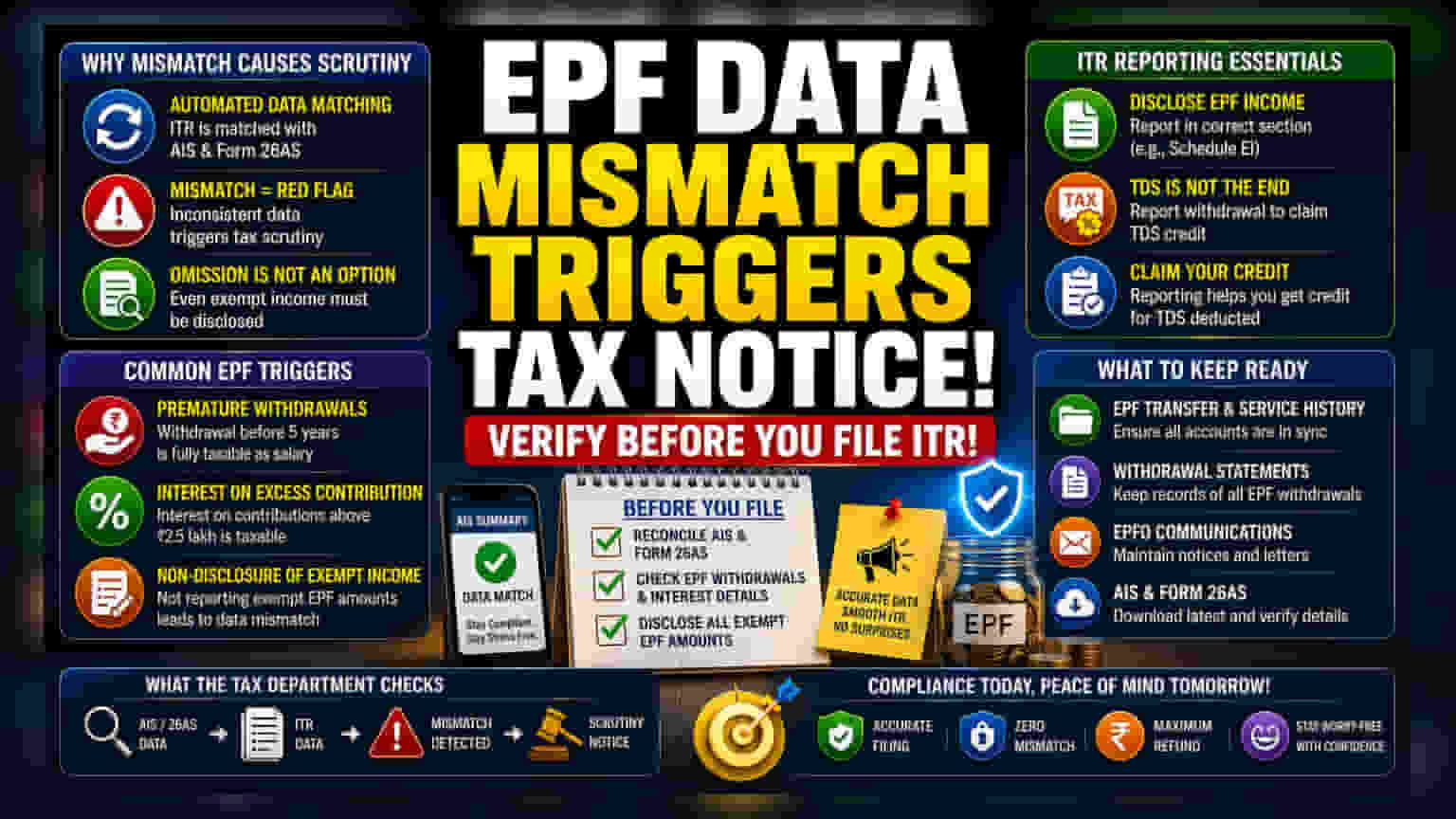


Taxpayers filing their ITR for AY 2026-27 need to verify EPF details against their AIS and Form 26AS to avoid automated tax notices. The Income Tax Department is flagging inconsistencies, especially regarding premature withdrawals and high-value contributions.
What Happened
Taxpayers filing their Income Tax Return for the Assessment Year 2026-27 are facing a stricter compliance environment regarding Employees' Provident Fund (EPF) transactions. The Income Tax Department is increasingly relying on automated data matching to identify discrepancies in filed returns. When the information provided by an individual in their ITR does not match the details recorded in the Annual Information Statement (AIS) or Form 26AS, it can trigger a formal notice for scrutiny. This has made the process of verifying EPF data before final submission more critical than ever.
Why Data Mismatch Triggers Scrutiny
The central issue lies in the synchronization between the EPFO database and the Income Tax system. The AIS acts as a comprehensive summary of financial transactions. When a taxpayer submits an ITR, the tax department's automated processing system compares the reported income and exempt categories against the AIS. If the taxpayer omits or misreports an EPF-related transaction that appears in the AIS, the system flags the return as inconsistent. This often occurs because taxpayers may assume that if an amount is exempt or if taxes were already deducted at the source, it does not require detailed reporting in the return. This assumption is a common reason for receiving inquiries from the tax authorities.
Common Areas That Flag Returns
Several specific scenarios often lead to scrutiny. One major area involves premature EPF withdrawals. If a taxpayer withdraws their provident fund balance before completing five years of continuous service, the entire amount typically becomes taxable as salary income. If the taxpayer fails to report this as income and instead claims it as an exempt withdrawal, it creates a direct conflict with the data reported by the EPFO to the tax department. Another critical area is the taxability of interest on large contributions. Contributions exceeding Rs 2.5 lakh in a financial year attract tax on the interest earned on the excess amount. If this interest component is not accurately calculated and reported under the correct head of income, it becomes a visible error for the tax department.
The Importance of Pre-Filing Reconciliation
To minimize the risk of receiving a notice, taxpayers may benefit from a thorough reconciliation process before hitting the submit button. This involves downloading the latest AIS from the income tax portal and comparing every entry with personal records. Even for income that is legally exempt, such as mature EPF withdrawals, it is usually necessary to disclose the amount in the designated section of the ITR, such as Schedule EI, which covers exempt income. Failing to disclose these figures, even when they do not attract tax, leaves an incomplete picture in the return that the tax department's software may view as a suppression of information.
Understanding TDS and Reporting
Taxpayers often confuse the deduction of Tax Deducted at Source (TDS) with the final discharge of tax liability. When TDS is deducted on an EPF withdrawal, it is merely an advance payment of tax. Reporting the withdrawal in the ITR is necessary not only to verify the taxability of the transaction but also to claim credit for the TDS that has already been deducted. Without reporting the transaction, the taxpayer cannot claim this credit, and the mismatch between the TDS appearing in Form 26AS and the absence of the corresponding income in the ITR stands out as a clear discrepancy.
What Investors May Monitor Next
As the tax filing season progresses, the key for taxpayers is ensuring that all employment-related documentation is in order. This includes maintaining clear records of EPF transfer history, especially when moving between jobs, to ensure that multiple accounts are correctly represented. Taxpayers may also keep their withdrawal statements and official communications from the EPFO ready to substantiate their claims if needed. The primary goal for taxpayers is to align their filings with the data already available to the authorities to ensure a smooth processing of their return.