

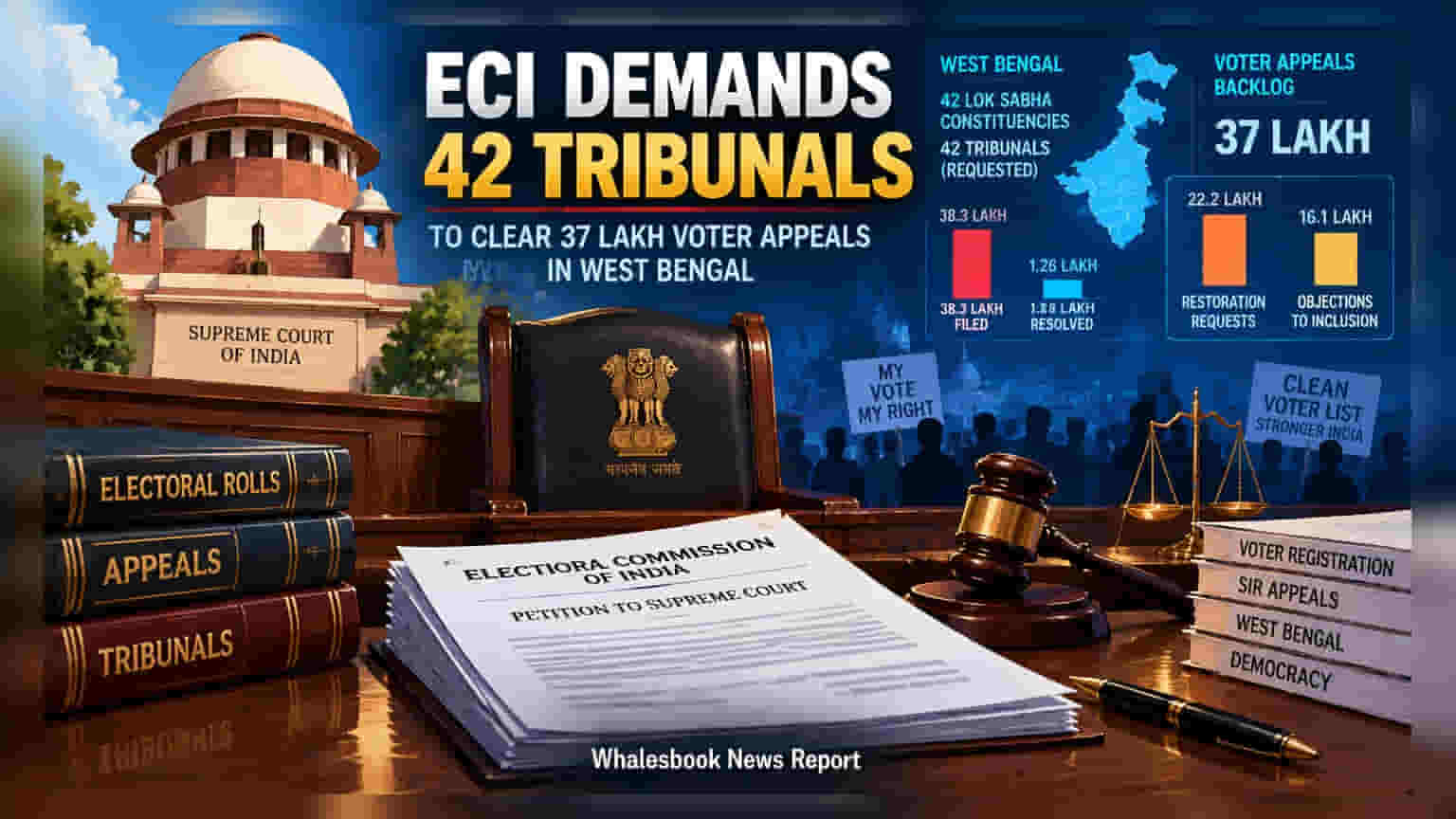
The Election Commission of India has moved the Supreme Court to expand West Bengal’s appellate tribunals from 19 to 42. This follows a massive backlog of 37 lakh appeals filed after the Special Intensive Revision of electoral rolls. The request aims to expedite pending disputes over voter inclusions and deletions, addressing a significant administrative bottleneck that has drawn ongoing scrutiny regarding electoral process integrity.
The Election Commission of India (ECI) has submitted a formal request to the Supreme Court seeking to scale up its adjudicatory capacity in West Bengal. The poll body has proposed replacing the current network of 19 appellate tribunals with 42, ensuring one tribunal for each of the state's 42 Lok Sabha constituencies. This expansion is designed to manage a mounting backlog of approximately 37 lakh appeals arising from the Special Intensive Revision (SIR) of electoral rolls.
The scale of the backlog highlights significant friction within the state’s electoral registration process. According to the ECI, roughly 38.3 lakh appeals have been filed, while only 1.26 lakh cases have been resolved so far. These appeals are divided into two primary categories: approximately 22.2 lakh requests are from individuals seeking the restoration of their names after deletion, and 16.1 lakh cases involve objections against the inclusion of certain names on the voter list.
The ECI's push for more tribunals comes amid sustained debate regarding the integrity of the revision process in West Bengal. The commission has firmly defended the revision exercise, rejecting claims that it has engaged in systematic disenfranchisement. It clarified that the deletions were intended to purge ineligible entries, specifically targeting individuals categorized as dead, shifted, absent, or duplicates.
For investors and observers of the business environment, this administrative bottleneck is a notable development. Efficient electoral and administrative processes are foundational to state-level governance and political stability, which in turn influence policy-making and the climate for infrastructure and industrial development. The high volume of litigation regarding voter registration indicates a complex administrative challenge that requires resolution to ensure operational certainty.
The Supreme Court’s response to this petition and the subsequent timeline for clearing these 37 lakh appeals will be the next major monitorable. Efficient resolution of these disputes would address a significant administrative hurdle, potentially easing concerns regarding the state's voter roll accuracy and the speed of electoral oversight ahead of future election cycles.