

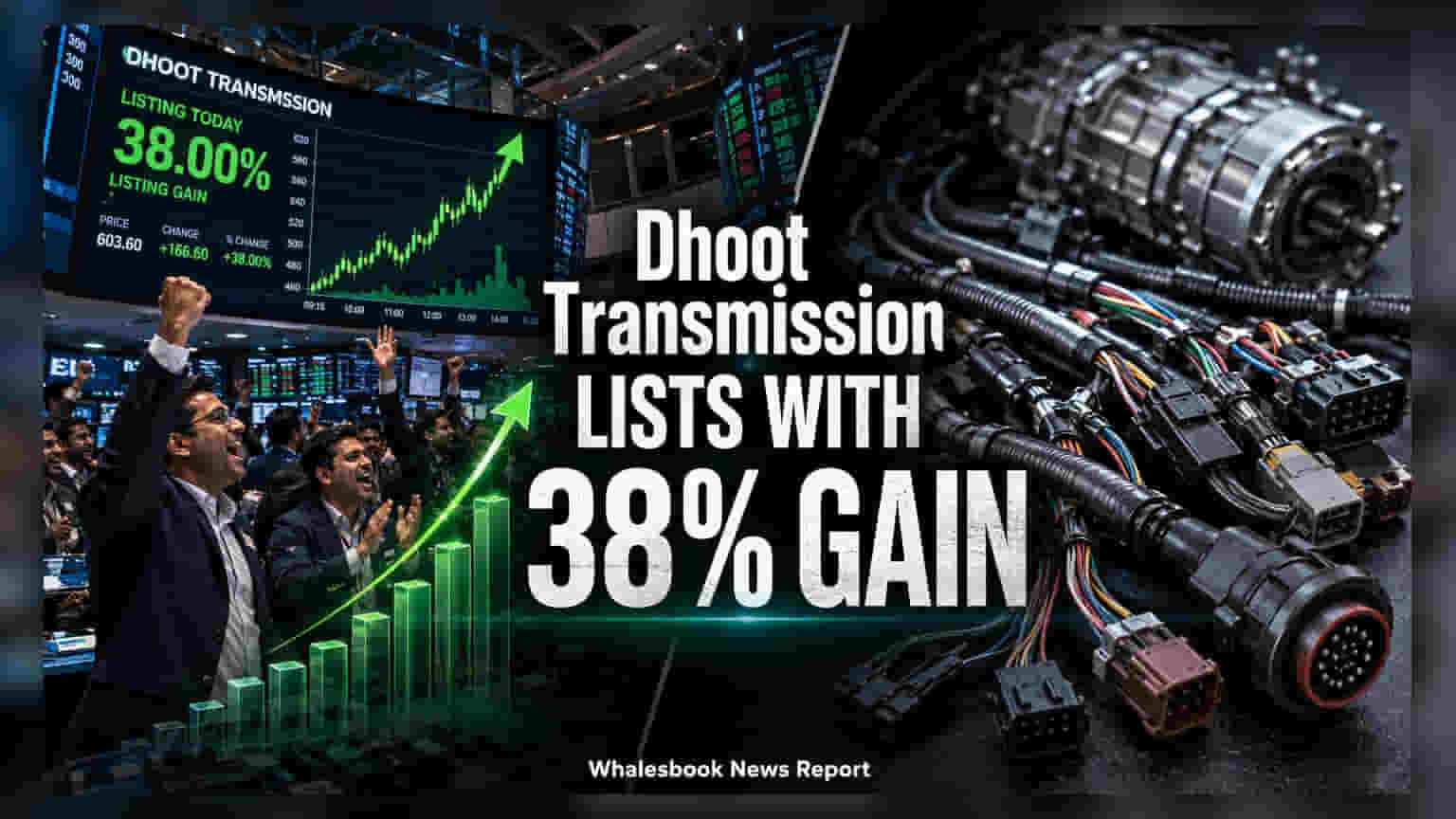
Dhoot Transmission shares listed on the stock exchanges today at ₹1,200, delivering a 37.7% return for IPO investors. The company's ₹3,067 crore issue saw massive interest, oversubscribed over 74 times. Investors will now focus on how the firm manages its new funds to reduce debt and execute growth plans in the auto components sector.
Dhoot Transmission Ltd. made a strong entry into the public market today, August 17, 2026, with its shares listing at ₹1,200 on the National Stock Exchange (NSE). This represents a 37.7% premium over the company's initial public offering (IPO) price of ₹871 per share. On the Bombay Stock Exchange (BSE), the stock opened at ₹1,193.80, reflecting similar investor confidence.
The public issue, which concluded on August 12, generated significant demand, with the total offering being oversubscribed 74.21 times. High institutional interest was a key driver, with the Qualified Institutional Buyer (QIB) portion booked 212.92 times, and Non-Institutional Investors (NII) portion subscribed 51.93 times. The ₹3,067 crore IPO included a fresh issue of ₹1,400 crore and an offer for sale (OFS) of ₹1,666.89 crore.
Business Context and Use of Funds
Dhoot Transmission is primarily engaged in the manufacturing of wiring harnesses and electrical components, supplying both to automotive and non-automotive sectors. The fresh capital raised from the IPO is earmarked for key financial goals, including the reduction of existing debt and the financing of business expansion and potential acquisitions. Reducing debt is generally viewed as a positive move for financial stability, but the company's ability to integrate future acquisitions effectively will be a key performance indicator for shareholders.
Sector Dynamics and Risks
While the market debut was successful, the company operates in the capital-intensive automotive component industry. Its performance is closely tied to the production cycles of automotive Original Equipment Manufacturers (OEMs). A shift toward electric vehicles (EVs) creates both opportunities and challenges for component suppliers, requiring constant innovation and adaptation. Additionally, the company is susceptible to fluctuations in raw material prices, such as copper and plastics, which are essential for its wiring harness products. Unfavorable price movements in these commodities can compress profit margins if the company is unable to pass on the costs to its customers.
Investor Monitorables
Moving forward, investors will likely track the company's progress on its debt reduction targets and the execution of its expansion projects. The management's ability to maintain healthy profit margins amidst changing raw material costs and the competitive pressure in the automotive component space will be crucial. Future quarterly results will provide more clarity on how the company is utilizing the newly raised capital to drive operational efficiency.