

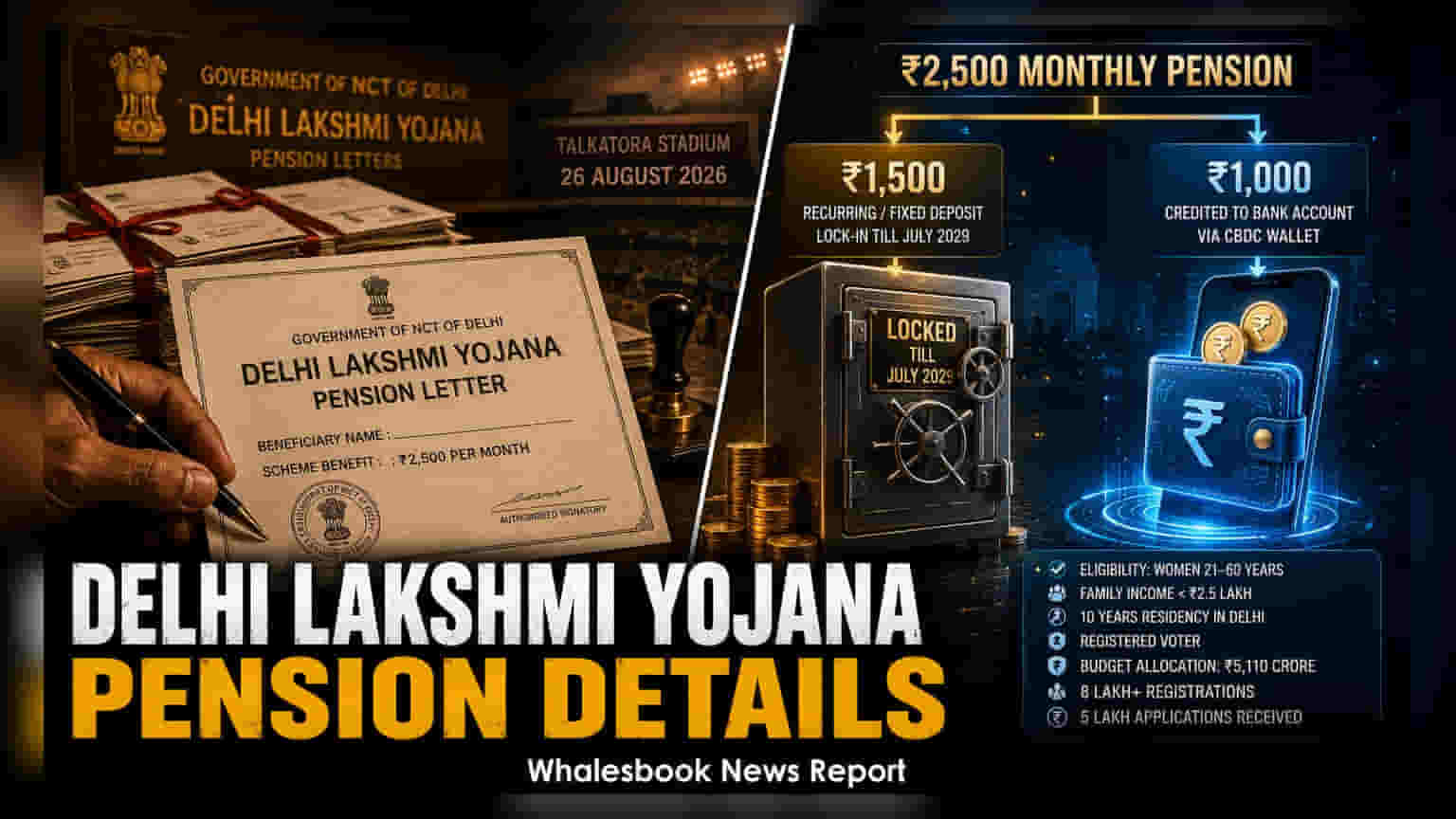
The Delhi government will begin issuing official pension letters for the Delhi Lakshmi Yojana on August 26, with monthly payouts commencing September 1. Supported by a ₹5,110 crore budget allocation, the scheme has attracted over 8 lakh registrations. This initiative focuses on long-term savings and immediate liquidity, with its success heavily dependent on efficient administrative verification.
The Delhi government is preparing to distribute official pension letters for the Delhi Lakshmi Yojana on August 26 at Talkatora Stadium. This event marks the operational start of a major welfare initiative, with monthly financial benefits of ₹2,500 set to be disbursed to eligible beneficiaries starting September 1.
The scheme’s financial structure is designed with a dual-focus on immediate liquidity and long-term savings. Out of the monthly ₹2,500 payment, ₹1,500 is designated for a recurring or fixed deposit account with a lock-in period running until July 2029. The remaining ₹1,000 will be credited directly to the beneficiary's bank account linked to a Central Bank Digital Currency (CBDC) wallet, providing immediate cash access.
From a fiscal perspective, the Delhi administration has allocated ₹5,110 crore for this scheme in the 2026-27 budget. The rollout has seen significant public interest, with the official portal recording over 8 lakh registrations and 5 lakh formal applications since its launch on August 1. The scheme targets women aged between 21 and 60, provided their annual family income is below ₹2.5 lakh and they meet specific criteria, including a 10-year residency in Delhi and registered voter status.
Operational Risks and Administrative Hurdles
While the scheme aims for broad coverage, the primary concern for stakeholders is the speed of implementation. The eligibility criteria are strict, excluding those who pay income tax, own four-wheelers, or are government employees. This requires extensive verification by district-level committees to prevent errors or misuse of funds. Any delay in processing these verifications could push back the actual disbursement timeline for many applicants.
Furthermore, the long-term impact on the state budget will depend on the sustainability of the ₹5,110 crore allocation. Investors and analysts generally track such large-scale welfare programs for their effect on state fiscal deficits and their potential to influence local consumption patterns. The effectiveness of the payout mechanism, particularly the split between locked savings and cash transfers, will be a key monitorable in the coming months.
As the government moves to the distribution phase, the next important update for beneficiaries and observers will be the successful processing rate of the submitted applications. The progress of these district-level committees in verifying the 5 lakh pending applications will determine how quickly the scheme reaches its full projected beneficiary base.