

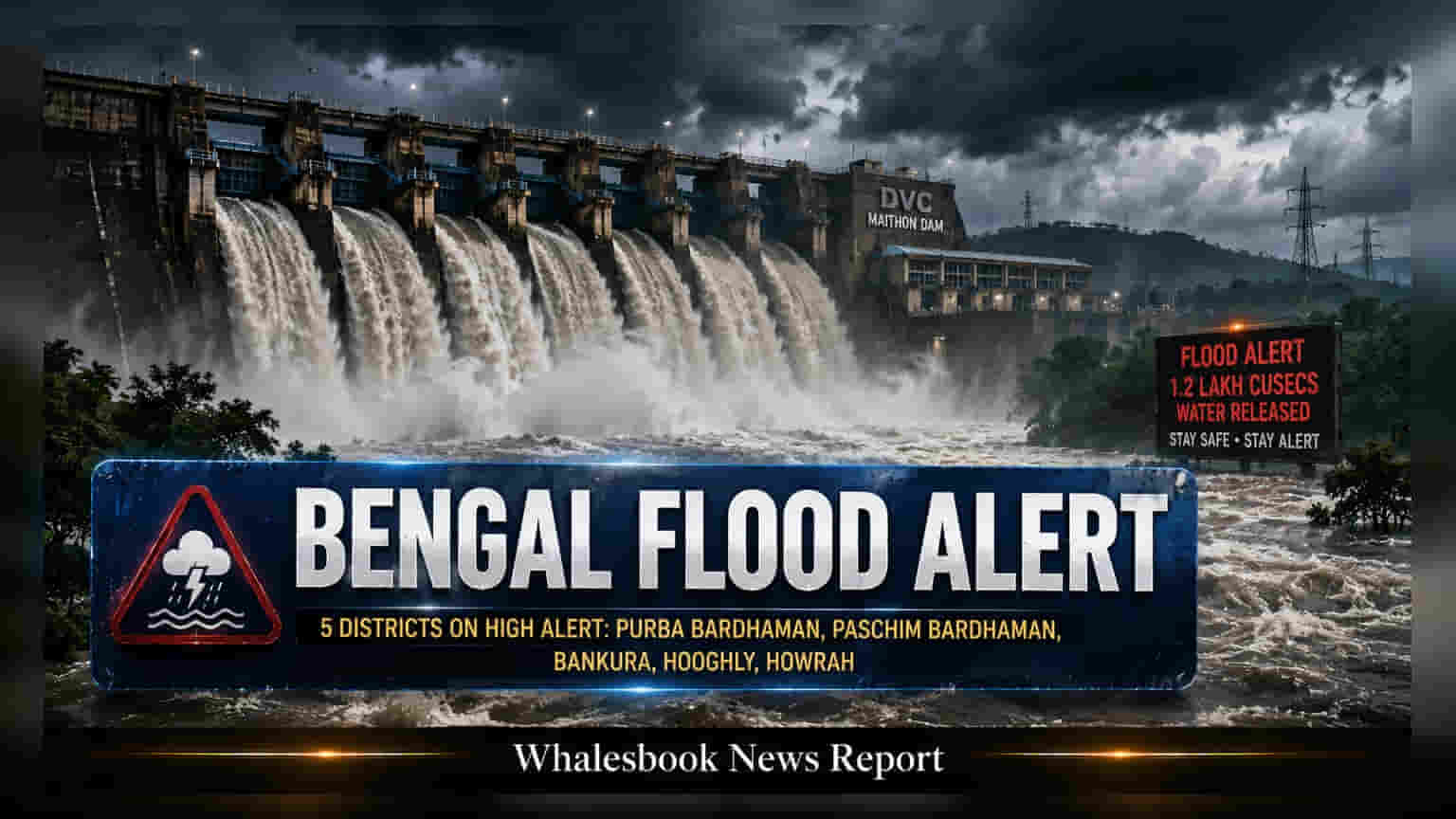
The Damodar Valley Corporation has discharged 1.2 lakh cusec of water from its Maithon and Panchet dams due to heavy rainfall. Local authorities in five West Bengal districts, including Bankura and Hooghly, are on high alert for potential flooding. This release is a mandatory safety measure to prevent structural pressure on the reservoirs from heavy inflows.
The Damodar Valley Corporation (DVC) has released 1.2 lakh cusecs of water from its Maithon and Panchet reservoirs following heavy rainfall in the catchment areas. This operational decision has prompted local authorities in West Bengal to issue flood alerts across five districts: Purba Bardhaman, Paschim Bardhaman, Bankura, Hooghly, and Howrah.
The water release is a safety measure taken to manage intense inflows arriving from the Tenughat dam in Jharkhand and to maintain the structural integrity of the reservoirs. The decision was finalized by the Damodar Valley Reservoir Regulation Committee, which oversees operations and includes representatives from the West Bengal state government, to prevent uncontrolled overflow during the monsoon cycle.
Water management in the Damodar basin has historically been a point of friction between the state administration and the central body. The West Bengal government has previously expressed concerns regarding the timing and volume of water releases during peak monsoon periods. The corporation maintains that its releases are calibrated based on joint technical assessments to balance reservoir capacity with downstream safety, avoiding the more severe risks associated with potential dam failure.
For readers monitoring the entity, it is important to note that the Damodar Valley Corporation is a statutory body established under the DVC Act of 1948, under the Ministry of Power, Government of India. It is not a publicly traded company and does not have shares listed on the NSE or BSE. The corporation plays a central role in regional power generation and flood control. Its financial profile is generally stable, supported by its role as a government-backed entity. Its bonds, which are used to fund capital-intensive infrastructure, often carry a sovereign guarantee from the Government of India, resulting in high credit ratings.
Despite its strong credit profile, the corporation faces historical financial challenges, including payment delays from state-owned distribution companies (discoms), such as the Jharkhand Bijli Vitran Nigam Limited (JBVNL). These outstanding dues can occasionally create pressure on the corporation's cash flow, although its systemic importance generally ensures continued operational stability.
Looking ahead, local administrations have been instructed to monitor riverbanks and ensure the safety of residents in vulnerable areas. The most critical update for the coming days will be real-time rainfall data in the upper catchment regions, which will determine whether discharge rates need to be adjusted further.