

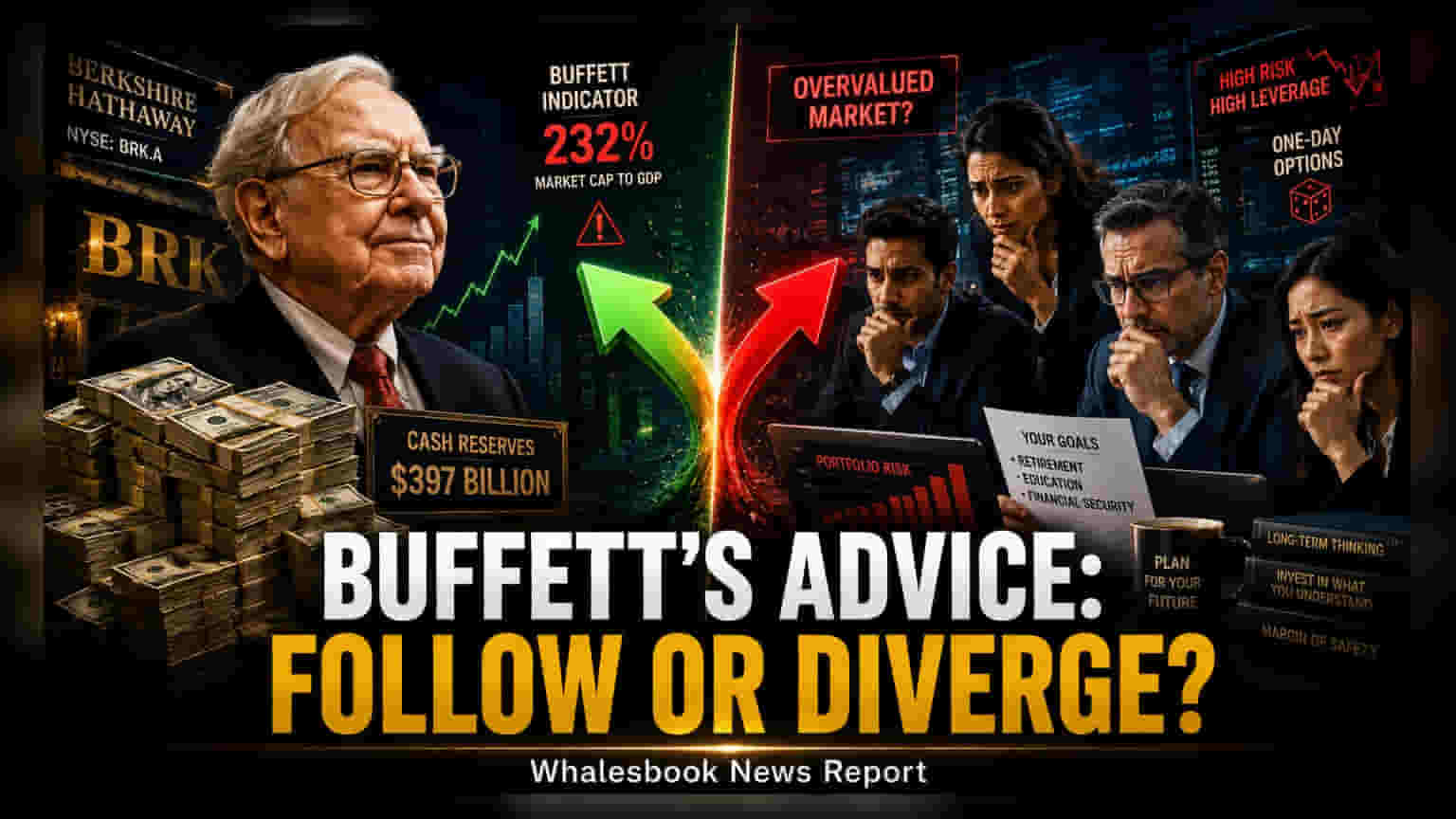
While Warren Buffett's long-term investing principles are widely respected, financial advisors caution investors against blindly copying his specific stock picks. With market valuations currently hitting historical highs, experts suggest focusing on personal financial goals rather than mimicking institutional portfolio moves, which may not suit individual risk profiles.
Warren Buffett remains a towering figure in the world of finance, yet financial advisors are increasingly urging retail investors to separate his investment philosophy from his specific portfolio moves. While many professionals endorse his core principles—such as the value of long-term holding and investing in companies that one understands—they warn that mirroring his exact trades can lead to poor outcomes for individual investors.
The caution comes at a time when traditional market valuation metrics are sounding alarms. The 'Buffett Indicator,' a ratio that compares the total value of the stock market to the country's GDP, has reached approximately 232% in 2026. This metric is often used to signal when the stock market might be overvalued relative to the economy. Financial advisors note that during such periods of high valuation, retail investors who blindly follow institutional moves may be taking on more risk than they realize.
Institutional investors like Berkshire Hathaway operate with a vastly different set of constraints than the average person. Advisors point out that a trade that makes sense for a massive conglomerate with billions in capital may not be suitable for an individual managing their own retirement savings or personal wealth. The time horizon, tax implications, and risk capacity of a retail investor are rarely the same as those of a large corporation, making 'copy-trading' a potentially dangerous strategy.
Adding to the complexity is the current state of the market, which Buffett himself has described as resembling a 'casino.' He has publicly expressed concern over the rise of speculative, high-leverage trading behaviors, such as the popularity of one-day options. While Buffett remains chairman and continues to influence Berkshire Hathaway’s direction, the company has recently built up a massive cash pile of nearly $397 billion. Advisors suggest that while holding cash is a strategic move for a company of Berkshire's size, average investors who keep too much capital in cash risk losing purchasing power to inflation over the long term.
Ultimately, the consensus among wealth advisors is that investors should focus on building a strategy tailored to their own financial objectives rather than treating stock-picking legends as a template. The disconnect between institutional needs and individual goals remains the biggest risk for those who attempt to replicate the portfolio of an investment icon without considering their own unique financial standing.