 Whalesbook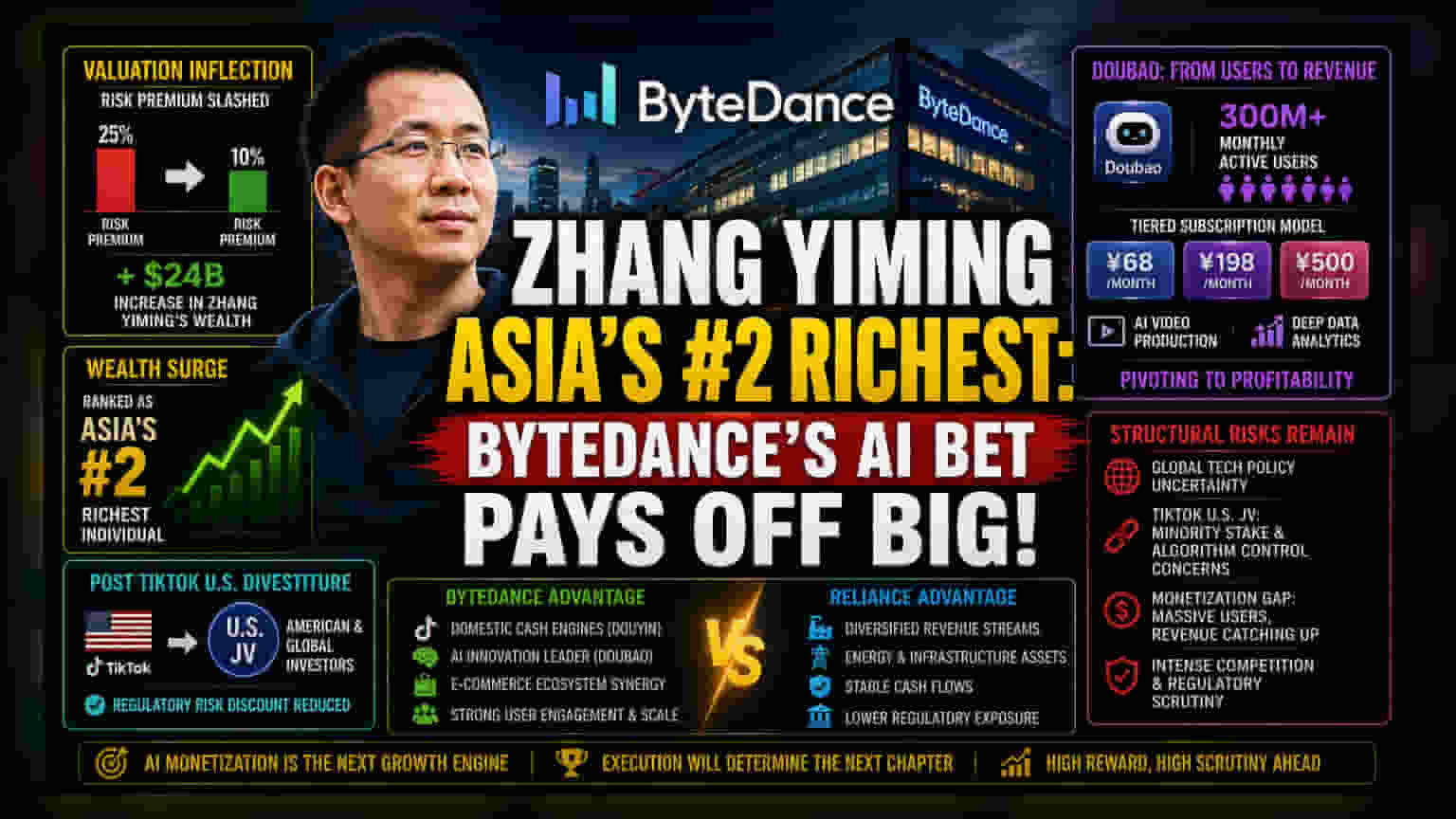


The Valuation Inflection Point
The ascendancy of Zhang Yiming to the position of Asia’s second-richest individual signals a fundamental shift in how institutional investors perceive ByteDance’s post-divestiture structure. Following the successful, albeit contentious, spin-off of TikTok’s U.S. business into a joint venture controlled by American and global investors in early 2026, the market has begun to aggressively unwind the regulatory risk discounts that previously depressed the company's private-market valuation. On June 2, the risk premium applied by major indices was slashed from 25% to 10%, a adjustment that directly contributed to a $24 billion expansion in Zhang’s estimated personal wealth. This market re-evaluation mirrors a broader trend where ByteDance is being priced less as a regulatory pariah and more as a multi-modal AI powerhouse, supported by the robust performance of its domestic cash-generating engines.
AI Monetization: From User Growth to Revenue
While the market’s enthusiasm is bolstered by the resolution of U.S. regulatory uncertainty, ByteDance’s long-term sustainability hinges on the commercialization of Doubao. Currently, the company is transitioning its AI strategy from aggressive, subsidized user acquisition to a tiered subscription model. Having scaled to over 300 million monthly active users, Doubao is now testing price points ranging from RMB 68 to RMB 500 per month. This move represents a structural pivot in the Chinese AI market, where developers are abandoning 'growth-at-all-costs' strategies in favor of proving profitability amidst rising inference and computational costs. By integrating these advanced capabilities into the broader Douyin e-commerce ecosystem, ByteDance is attempting to monetize productivity-focused features, such as automated video production and deep data analytics, which command higher premiums than standard consumer-facing chatbots.
Structural Risks and the Competitive Divide
Despite the optimism surrounding its valuation, ByteDance faces significant structural hurdles that contrast with the diversified, asset-heavy model of competitors like Reliance Industries. Unlike Reliance, which derives stability from energy and infrastructure, ByteDance remains sensitive to the volatility of global tech policy. Furthermore, the TikTok U.S. joint venture, while satisfying statutory divestiture requirements, leaves the company with a minority stake and persistent questions regarding long-term algorithmic control. Observers also point to the 'monetization gap'—the disparity between Doubao's massive user scale and its actual revenue generation—as a potential drag on future growth. While ByteDance’s private-market secondary trading has shown resilience, the company must now reconcile its high-growth AI aspirations with the necessity of maintaining margins in a highly competitive and increasingly scrutinized sector. The path to maintaining its status as Asia's wealthiest private entity rests on the successful, friction-free adoption of its new paid AI tiers.