 Whalesbook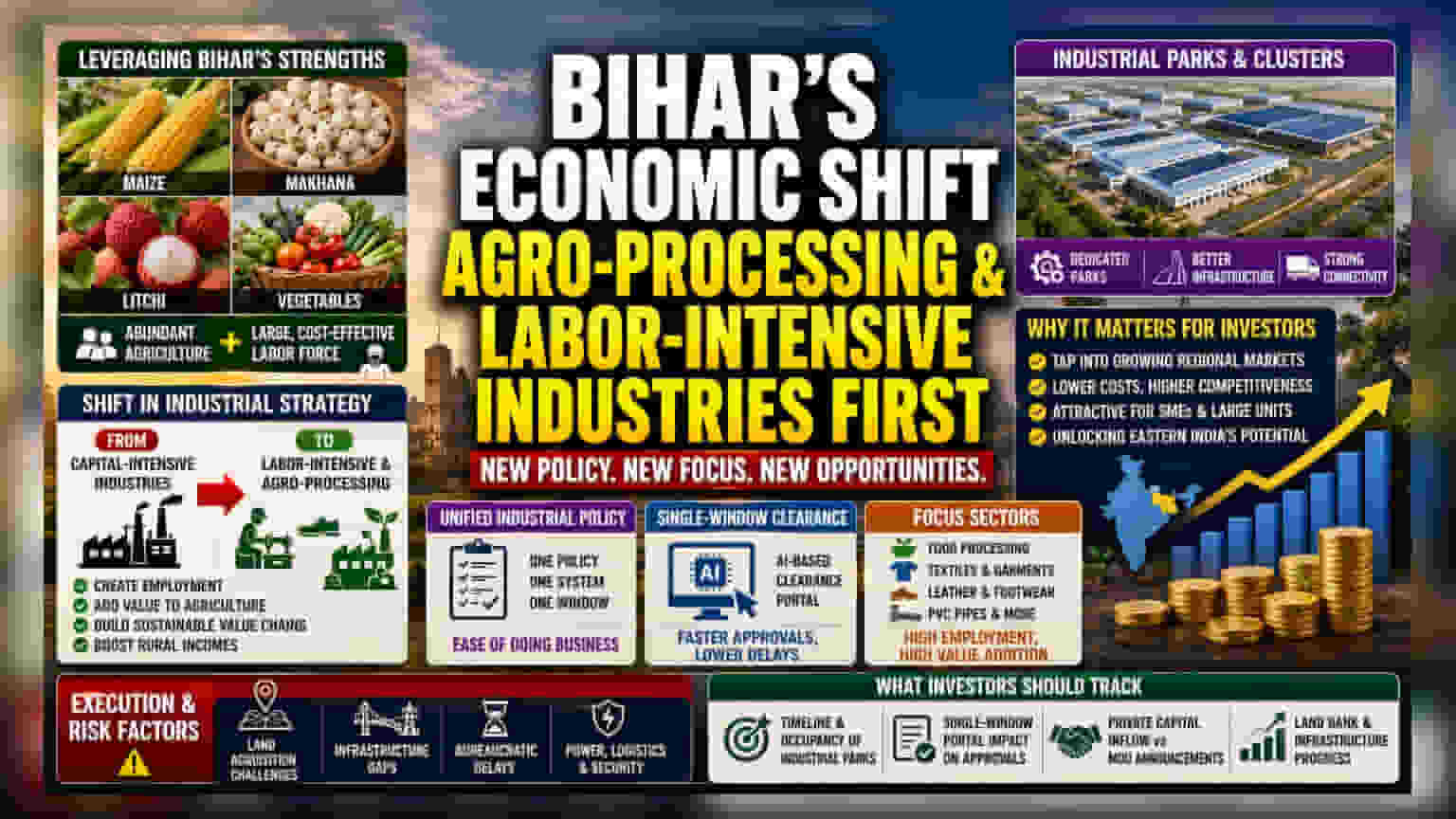


What Happened
The Bihar government has unveiled a strategic shift in its economic development plan, moving away from capital-intensive sectors to prioritize agro-processing and labor-intensive manufacturing industries. This new direction aims to leverage the state’s natural strengths, specifically its agricultural produce—such as maize, makhana, litchi, and vegetables—and its large, cost-effective labor force. To support this transition, the state is developing a unified industrial policy that seeks to replace disparate sector-specific guidelines with a streamlined, single-window approval system. This initiative includes plans for AI-based clearance portals and the creation of dedicated industrial parks, with the state aiming to reduce the time required for investment proposals to be approved. Recent government approvals have already signaled this push, with several industrial projects sanctioned in sectors like food processing, garment manufacturing, and PVC pipe production.
Why This Matters For Investors
For investors, this shift represents an attempt by Bihar to build an industrial ecosystem from the ground up, focusing on sectors that offer high employment potential and value addition. By targeting textiles, leather, footwear, and agro-processing, the state is positioning itself to capture supply chain shifts where labor costs and availability are primary competitive advantages. The move toward a unified industrial policy and single-window clearance is a direct response to past concerns about administrative delays. If effectively implemented, these reforms could lower the cost of doing business, making the state a more attractive destination for small and medium-sized enterprises (SMEs) and large manufacturing units alike, potentially unlocking new regional markets in Eastern India.
The Shift in Industrial Strategy
Bihar’s strategy acknowledges that attempting to compete in capital-intensive industries—like semiconductor fabrication or heavy manufacturing—requires a different set of infrastructure and investment foundations that are currently in development. Instead, the focus on agro-processing and branded, processed exports aims to create a sustainable value chain. By moving from raw crop production to processing, grading, and specialized storage, the state hopes to increase rural incomes and create local employment. This cluster-based approach, involving the development of dedicated industrial zones, is intended to solve the recurring issues related to land availability and connectivity that have previously limited large-scale industrialization in the region.
The Execution and Risk Factor
While the policy intent is clear, the real-world impact for investors will depend on execution. Historically, Bihar has faced significant structural bottlenecks, including difficulties in land acquisition, infrastructure gaps, and complex bureaucratic procedures. Investors often monitor these factors closely, as project delays can lead to cost overruns and lower-than-expected returns. Furthermore, the success of these new industrial parks depends on more than just land allocation; it requires consistent power supply, reliable logistics, and a secure environment. While the government has emphasized a transition from a 'gatekeeper' to a 'facilitator' mindset among its bureaucracy, investors will likely assess whether these administrative changes lead to tangible, on-the-ground progress in project commissioning.
What Investors Should Track
Investors may monitor several key indicators as the state implements this new strategy. First, the timeline for setting up the proposed mega industrial parks and the actual occupancy rates of these parks will be crucial. Second, progress on the single-window clearance portal and whether it successfully reduces the time taken for project approvals will be a direct indicator of improved ease of doing business. Finally, tracking the actual inflow of private capital versus the announcements made in the form of Memorandums of Understanding (MoUs) will provide a clearer picture of the strategy’s success. Any updates on land bank availability and the status of large-scale infrastructure projects, such as improvements to road and rail connectivity in industrial corridors, will also be important for gauging long-term viability.