

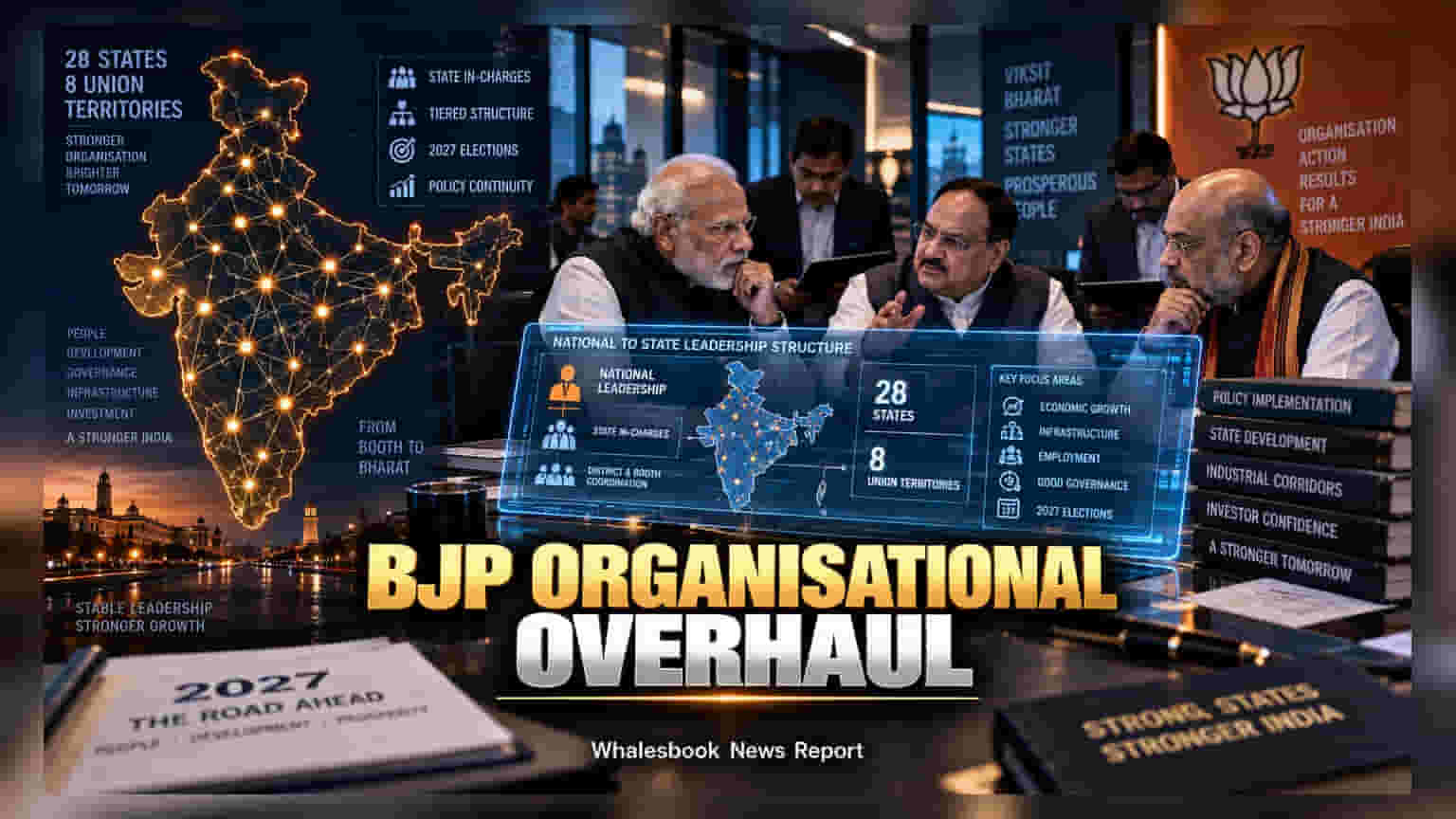
The Bharatiya Janata Party has appointed new in-charges across 28 states and 8 Union Territories to prepare for the 2027 assembly elections. This organizational change aims to improve ground-level coordination and policy implementation as the party targets key states. Investors often track political stability and leadership continuity, as these factors influence economic policy predictability and infrastructure development timelines.
The Bharatiya Janata Party has completed a major organizational overhaul, establishing a new tiered leadership structure across 28 states and eight Union Territories. Under the guidance of party president Nitin Nabin, this move assigns senior national leaders to manage state-level operations. The strategy is designed to ensure seamless coordination as the party begins its preparations for the 2027 assembly elections, which are considered crucial for maintaining political momentum and policy continuity.
From an investor perspective, organizational stability within a ruling party is often viewed as a proxy for predictable policy-making. When national parties streamline their state-level leadership, the market often monitors whether this leads to more efficient implementation of central schemes and industrial corridor projects. With critical states like Uttar Pradesh, Gujarat, Maharashtra, and Delhi approaching upcoming electoral cycles, the focus remains on how these administrative teams will manage regional economic challenges and infrastructure spending.
Key leadership assignments include Vinod Tawde for Uttar Pradesh, Smriti Irani for Haryana and Chhattisgarh, and Ram Madhav for Tamil Nadu and Uttarakhand. The decision to assign leaders to states outside their home regions is a strategic shift aimed at bringing fresh perspectives to local operational hurdles. For instance, the deployment of multi-layered teams in key industrial states indicates a move toward a more distributed, mobile leadership model. This is intended to address governance gaps that could otherwise delay state-level capital expenditure projects.
Historically, the lead-up to significant election cycles in India is often associated with a focus on populist spending or an increase in government-funded infrastructure projects. While these initiatives can provide a short-term boost to sectors such as construction, cement, and basic engineering, they also require careful tracking of state fiscal health. Investors typically assess whether these organizational changes will lead to improved project execution or if the focus will shift toward welfare-oriented spending as the election date approaches.
Another significant aspect of this restructuring is the increased focus on gender and generational balance within the party's executive roles. Leaders such as Vanathi Srinivasan, Bansuri Swaraj, and Sangeeta Yadav have been given prominent responsibilities. This balancing act between organizational veterans and newer faces is designed to retain institutional knowledge while preparing the party for future challenges. The ability to manage this transition while maintaining focus on regional governance will be a key factor for observers of the Indian political and economic scene.
The most important factor for investors to track in the coming months will be the policy trajectory in these key states. As these new state in-charges settle into their roles, the focus will shift to their influence on state-level budgets, policy implementation, and the handling of long-term investment projects. Any changes in regional industrial policy or delays in execution will be reflected in the performance of sectors heavily exposed to government contracts and state-led development plans.