

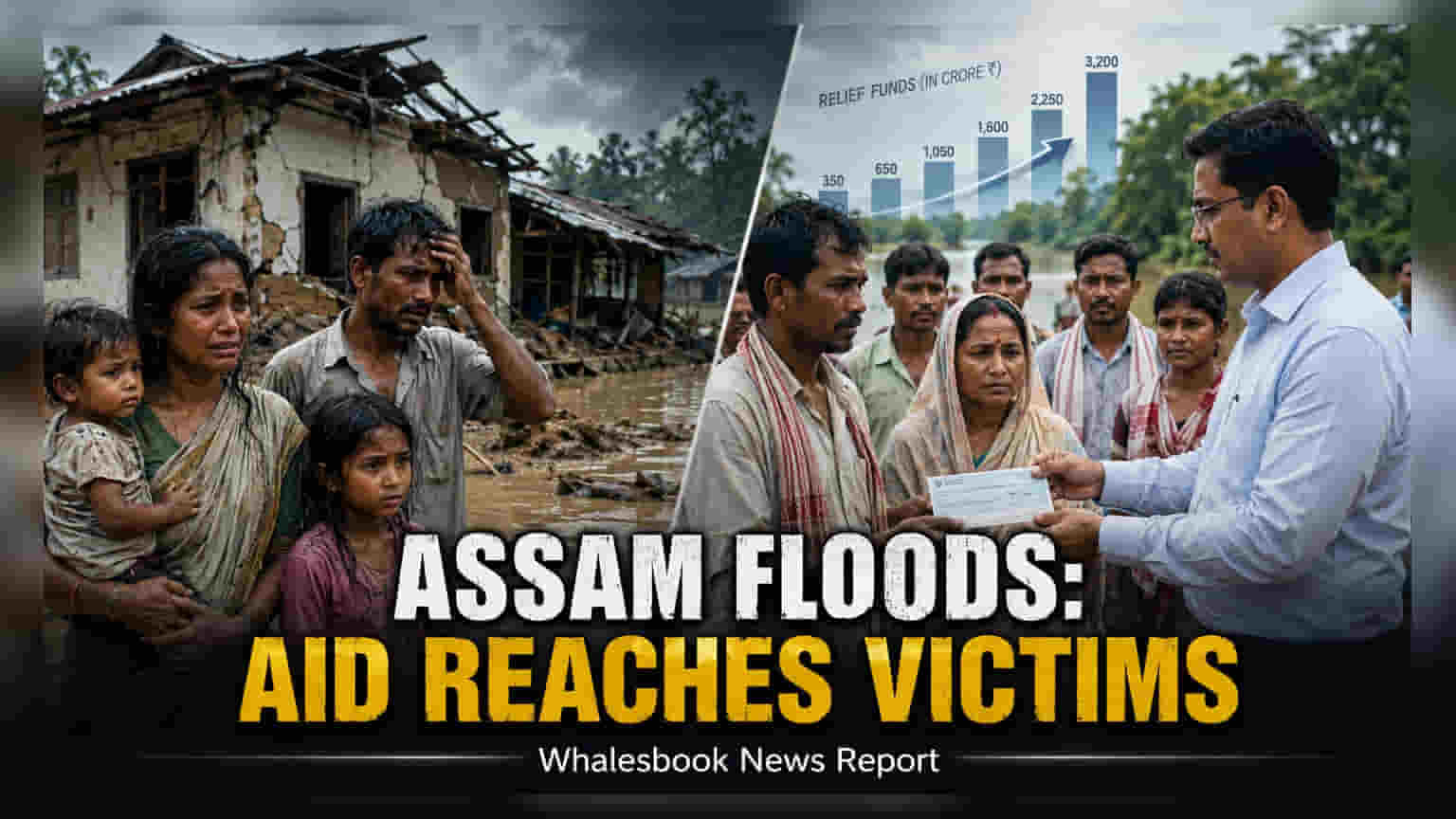
The Assam government has begun distributing interim relief of ₹75,000 per household to families whose homes were severely damaged by recent floods. While the number of affected residents has decreased to 1.36 lakh, relief operations remain active across five districts, including Sivasagar and Jorhat, as authorities manage recovery efforts.
The Assam government has initiated the distribution of financial aid to families devastated by the recent floods. Chief Minister Himanta Biswa Sarma personally oversaw the launch of these interim relief payments from Dibrugarh. Families whose homes have suffered severe damage are now receiving a total package of ₹75,000 per household, which includes an initial component of ₹15,000 alongside other supplementary aid.
While the flood situation is showing signs of slow improvement, the human and economic toll remains significant. The total death toll from this wave of flooding has reached 85, following three new casualties reported in the Sivasagar district on Sunday. Official data indicates that while the total number of affected individuals has declined from roughly 1.8 lakh on Saturday to 1.36 lakh as of Monday, the impact remains concentrated in specific regions.
Sivasagar continues to be the most severely affected area, with over 55,000 residents still displaced. Other impacted districts include Charaideo, where approximately 40,000 people are affected, and Jorhat, with over 22,000 residents impacted. The state administration is currently operating 54 relief camps and distribution centers to house 13,771 displaced individuals.
The economic impact extends beyond residential damage, as agricultural activities have been severely disrupted. Currently, 15,422 hectares of agricultural land across the state remain submerged under floodwaters. This prolonged waterlogging poses a challenge to local farmers, potentially affecting crop yields in the upcoming harvest season. Furthermore, water levels in major river systems remain a concern, with the Dhansiri River reported to be flowing above the danger mark at Numaligarh in the Golaghat district.
Authorities are focusing their efforts on immediate rehabilitation and the management of relief camps in the hardest-hit districts of Sivasagar, Charaideo, Jorhat, Golaghat, and Dhemaji. The state government is expected to continue its oversight of these operations as water levels gradually recede. Investors and residents will be tracking the progress of these rehabilitation efforts, as well as any subsequent government announcements regarding further disaster mitigation and agricultural support for the affected regions.