

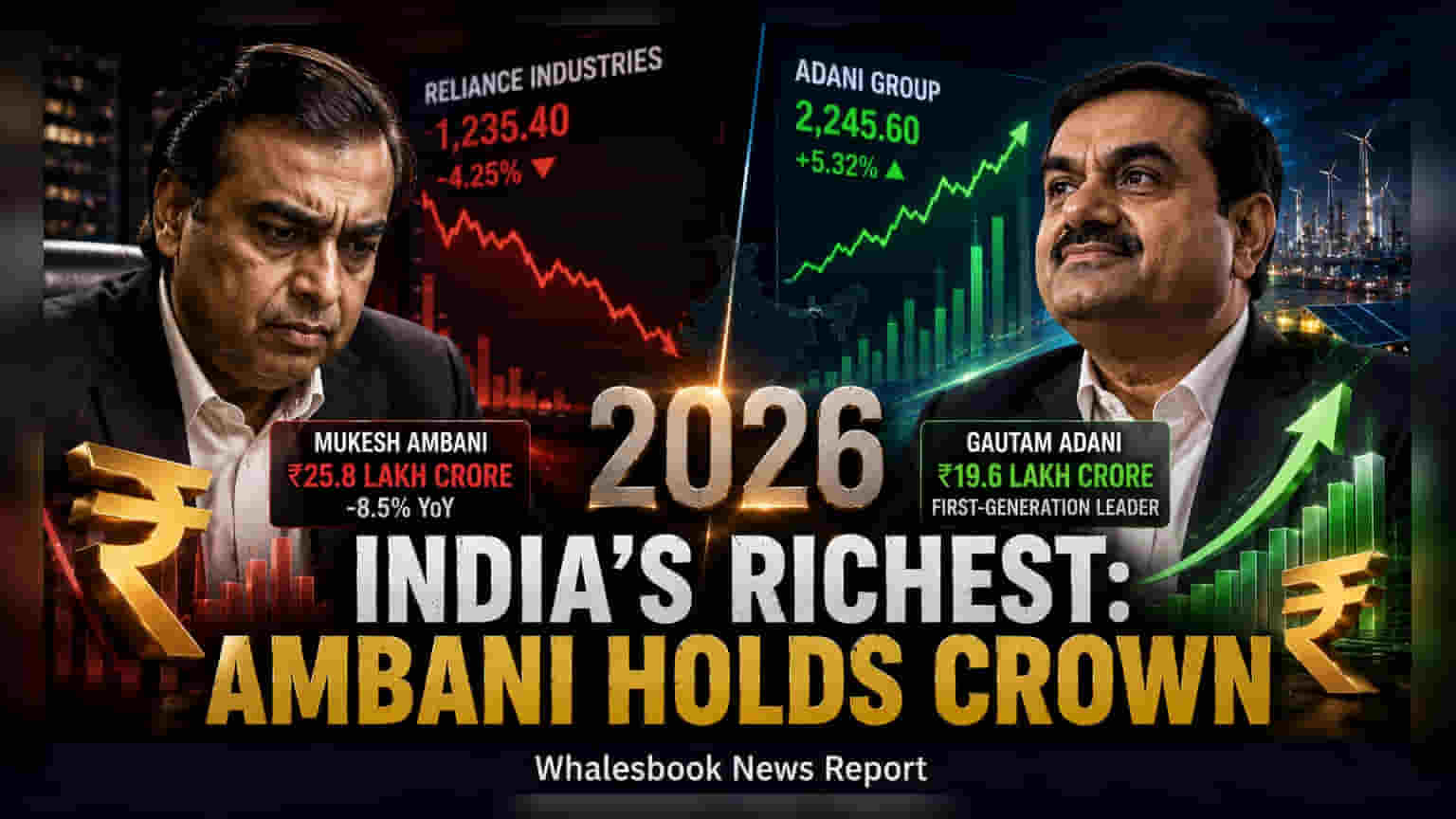
The Ambani family holds its position as India’s wealthiest business dynasty with a net worth of ₹25.8 lakh crore, according to the 2026 Barclays Private Clients Hurun India list. Despite the top ranking, the family’s wealth fell by 8.5%, reflecting market volatility affecting Reliance Industries and broader energy sector pressures.
The Ambani family continues to be India's wealthiest business dynasty, maintaining the top spot in the 2026 Barclays Private Clients Hurun India Most Valuable Family Businesses list. The family’s combined business valuation stands at ₹25.8 lakh crore. However, this figure marks an 8.5% decline compared to the previous year, highlighting the sensitivity of large conglomerate valuations to market conditions.
The drop in wealth reflects the recent stock market fluctuations faced by Reliance Industries, which forms the primary source of the family’s valuation. Since the family’s wealth is largely derived from their stake in publicly traded companies, any shift in the stock price directly impacts the estimated net worth. During 2026, the company has navigated a complex environment shaped by global energy price volatility and changing margins in the petrochemical sector, which remains a key business pillar.
Following the Ambani family, the Gautam Adani family ranks as the wealthiest among first-generation enterprises with a valuation of ₹19.6 lakh crore. Other significant family business leaders include the Sunil Bharti Mittal family of the telecom giant Airtel, with a fortune of ₹12.1 lakh crore, and the Kumar Mangalam Birla family, whose businesses are valued at ₹8.14 lakh crore. These rankings reflect the massive scale of top family-led conglomerates, with the top 300 businesses collectively worth ₹138 lakh crore, or roughly $1.46 trillion.
For investors, the valuation of such large business houses is closely tied to the operational performance of their flagship entities. Reliance Industries, for instance, faces ongoing monitoring regarding its profit margins in the energy segment and the competitive landscape in its retail and digital service ventures. External risks, such as geopolitical tensions in West Asia impacting crude oil supply and pricing, have consistently created headwinds for the energy sector throughout the year.
While the Ambani family remains at the helm of India's wealthiest, the 8.5% decline serves as a reminder of how macro-economic factors and sector-specific challenges can influence even the largest balance sheets. Investors looking at these groups typically monitor quarterly financial results, capital expenditure plans, and the successful execution of new projects in retail and green energy, as these are the primary drivers of long-term value creation beyond current market valuations.