 Whalesbook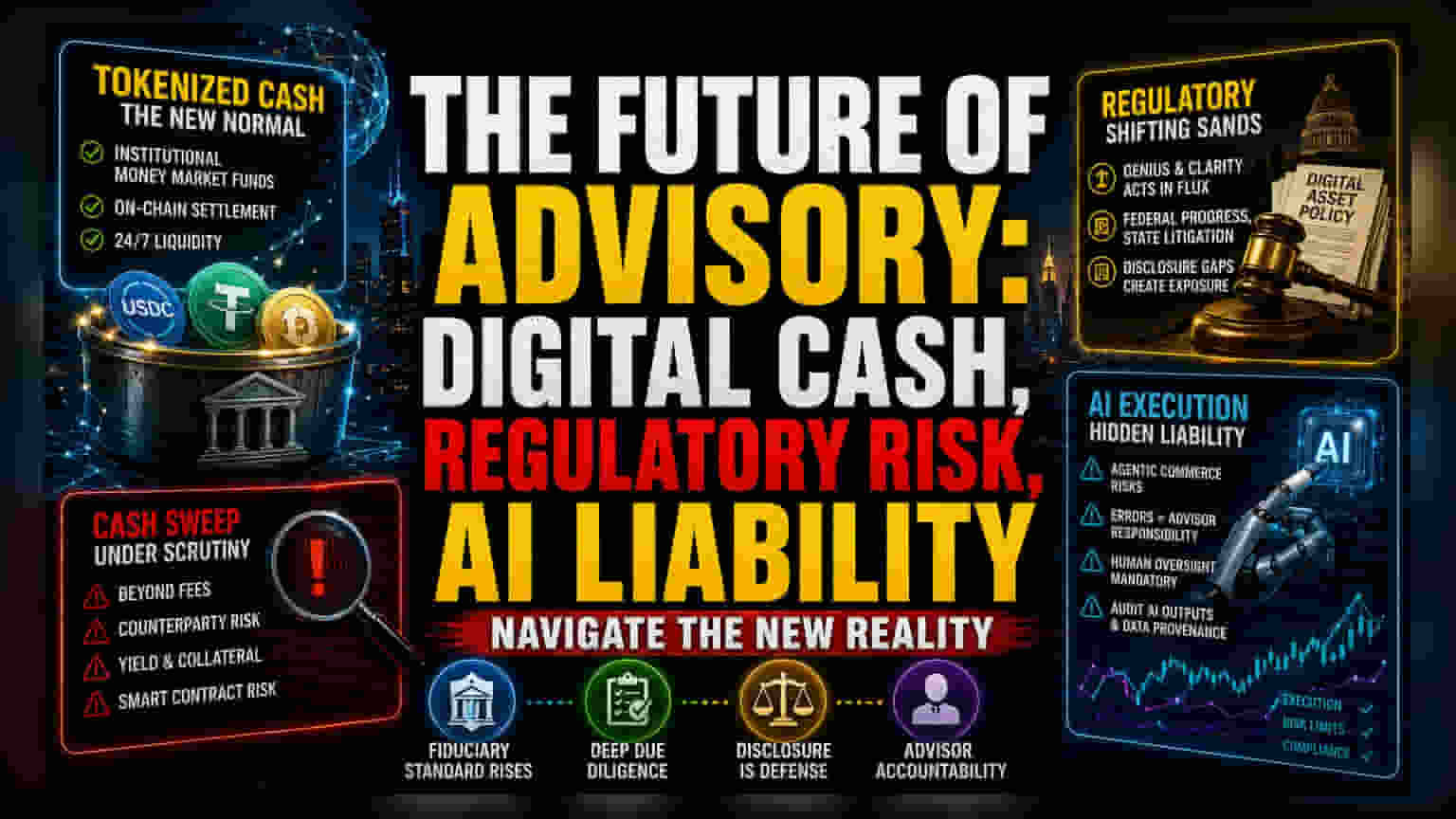


The Fiduciary Threshold in a Tokenized Economy
The financial services industry is witnessing a structural transformation in client asset management, forcing a departure from legacy oversight models. As tokenized money market funds from institutional giants gain traction, the primary challenge for advisors is no longer merely performance evaluation, but the forensic analysis of provider infrastructure. The integration of stablecoins and on-chain settlement systems necessitates a level of technical literacy that standard compliance training often fails to provide, shifting the burden of proof toward the advisor when recommending digital asset products.
The Erosion of Neutrality in Cash Management
Recent regulatory precedents suggest that cash management is no longer a peripheral function. Historical scrutiny directed at major brokerage firms confirms that authorities are looking beyond fee structures to the underlying mechanism of cash sweeps. While institutional tokenization offers superior liquidity and settlement speed compared to traditional vehicles, it introduces complex counterparty risks and proprietary control issues. Advisors operating under the assumption that these assets are functional equivalents to cash-on-deposit are leaving themselves exposed. A rigorous evaluation now requires explicit mapping of how stablecoin yield is derived, the robustness of the underlying collateral, and the specific technological vulnerabilities of the issuer’s smart contracts.
Regulatory Volatility and the Disclosure Gap
Legislative attempts to codify digital asset frameworks, such as the GENIUS and CLARITY Acts, have inadvertently created a vacuum of uncertainty. The danger lies in the disconnect between federal progress and aggressive state-level litigation. Advisors who rely on generalized regulatory assumptions face significant exposure if their internal disclosures do not account for jurisdictional friction. The shift toward a more defined regulatory environment does not preclude enforcement; it merely changes the nature of the target. Compliance manuals must now explicitly state the limitations of their regulatory intelligence, forcing a move away from the speculative marketing of crypto-based portfolios toward a model of strict empirical disclosure.
The Hidden Liability of AI Execution
Beyond market risks, the implementation of AI-enabled trading platforms introduces a new vector of institutional liability. The use of agentic commerce for trade execution brings unresolved questions regarding error recovery and programmable compliance. If an AI-driven interface fails to execute within the bounds of a client's risk tolerance, the responsibility for that breakdown remains firmly with the advisor, regardless of the software provider’s claims. Organizations must transition from passive adoption to active auditing of AI outputs. This includes documenting the provenance of training data, establishing human-in-the-loop validation for automated recommendations, and ensuring that operational resilience standards meet the threshold required by international monetary watchdogs.