

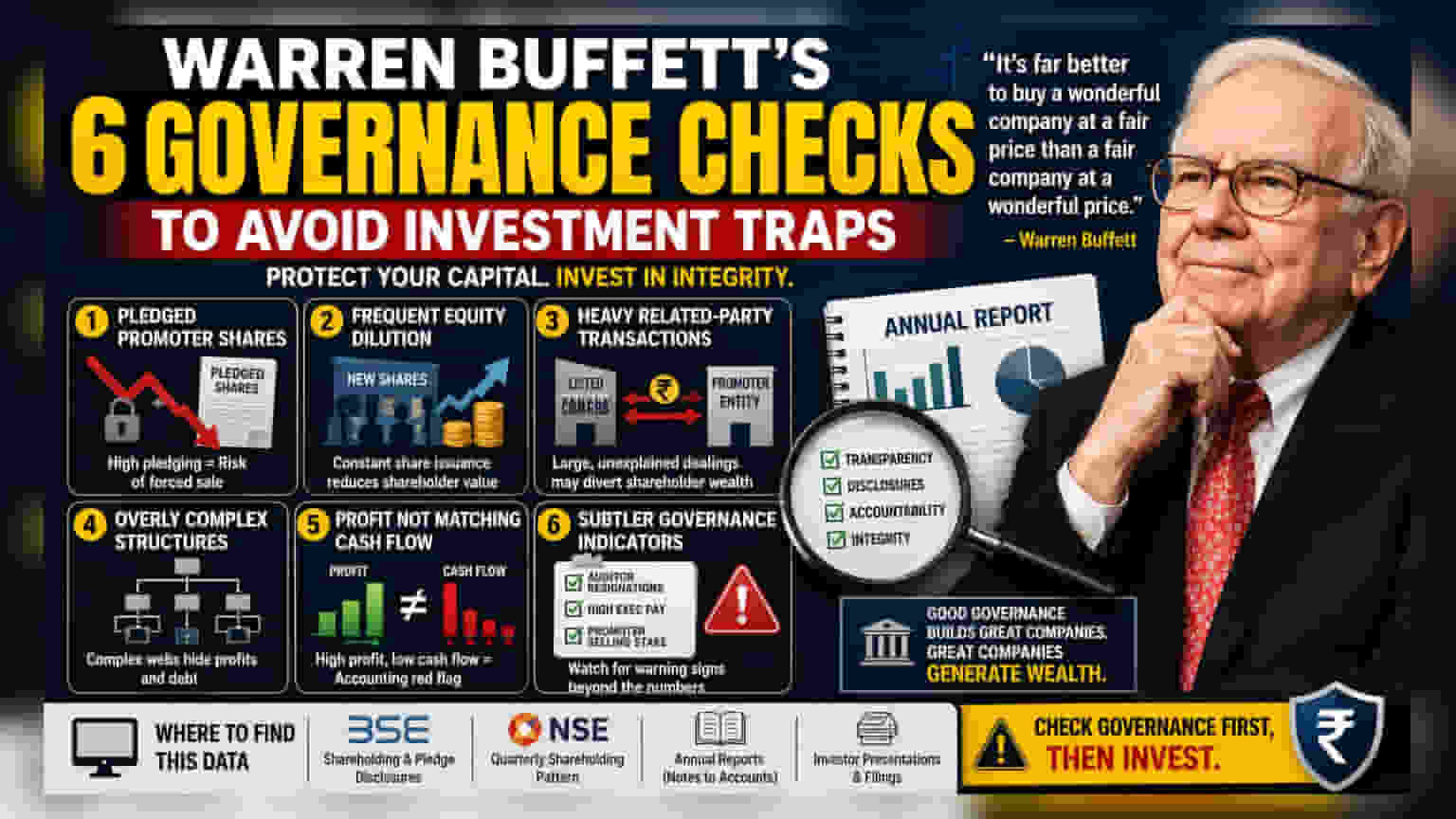
Warren Buffett’s investment principles emphasize that management integrity is just as important as profitability. For Indian investors, learning to spot red flags like pledged shares, frequent equity dilution, and questionable related-party transactions is crucial for protecting capital from potential governance traps.
Protecting Capital Through Governance Checks
Warren Buffett has long maintained that investing in a company is, fundamentally, an investment in its people. His philosophy argues that even the most profitable business can become a poor investment if the management lacks integrity. For Indian retail investors, the challenge lies in assessing this "character" from a distance. While institutional investors may have direct access to management, retail participants must rely on publicly available data to separate high-quality businesses from those with weak governance.
The Checklist for Indian Investors
To identify potential traps, investors can look at specific indicators in annual reports, investor presentations, and exchange filings. These six areas often serve as early warnings for governance issues:
1. Pledged Promoter Shares
When promoters pledge their shares to lenders, they use their equity as collateral to raise loans. If the company’s stock price falls significantly, lenders may force a sale of these shares to recover their money. This can lead to a sharp decline in the share price. Investors can check the extent of pledged shares through disclosures on stock exchanges like the BSE and NSE.
2. Frequent Equity Dilution
Companies that frequently issue new shares to raise capital may be signaling that they are unable to generate sufficient cash internally. While raising funds for growth is normal, a pattern of constant dilution can reduce the value for existing shareholders. It is worth checking if a company has consistently increased its share count over several years.
3. Heavy Related-Party Transactions
Related-party transactions involve dealings between the listed company and other businesses owned or controlled by the promoters or their family members. While some transactions are legitimate, large and poorly explained payments to these entities can be a sign that funds are being siphoned out of the listed company. These deals must be disclosed in the annual report's "Notes to Accounts."
4. Overly Complex Corporate Structures
Companies with a tangled web of subsidiaries, step-down companies, and cross-holdings can be difficult to analyze. This complexity often makes it harder for investors to track where the actual profit is generated or where the debt is hidden. Simple, transparent business models are generally easier for investors to evaluate.
5. Profit Not Matching Cash Flow
There should be a reasonable link between reported net profit and the cash flow generated from operations. If a company consistently reports high profits on paper but fails to collect cash from customers or keeps recording high receivables, it may point to accounting issues. Healthy businesses typically convert their profits into actual cash.
6. Subtler Governance Indicators
Several other factors can signal deeper problems. These include frequent auditor resignations, unusually high executive salaries compared to the company’s profit, or a pattern of promoters selling their stake in the company. Such events often warrant a closer look at the company’s management practices before making an investment decision.
Where To Find This Data
Indian investors can access this information through official sources. Annual reports are the most detailed resource, offering insights into management commentary, related-party deals, and auditor reports. Additionally, platforms like the BSE and NSE websites provide quarterly shareholding disclosures, which highlight promoter pledging and changes in ownership. By combining these facts with standard financial analysis, investors can better assess whether the management is a trustworthy steward of their capital.