

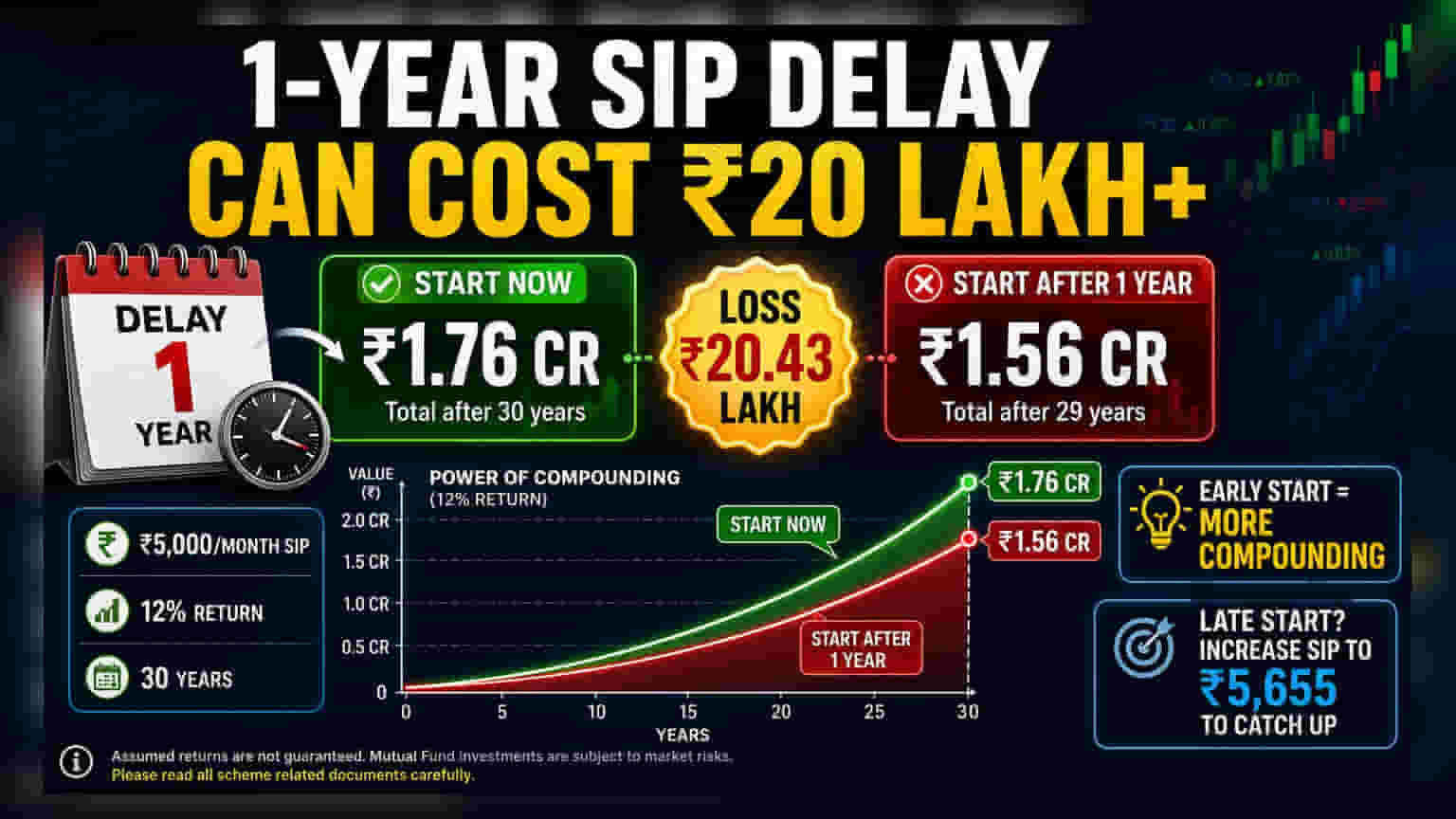
Missing just the first year of a 30-year SIP can lead to a shortfall of over Rs 20 lakh in your final portfolio value. This happens because the money you invest earliest has the most time to grow through compounding. Understanding this 'cost of delay' is essential for anyone building long-term wealth.
The Hidden Cost of Delaying SIPs
Many investors view Systematic Investment Plans (SIPs) as a regular monthly habit, similar to paying a utility bill. However, looking at the mathematics of long-term investing, the timing of your first payment is far more critical than subsequent installments. A recent analysis shows that missing just the first year of a 30-year investment plan can create a massive gap of over Rs 20 lakh in your final corpus.
The Math Behind The Missing Rs 20 Lakh
To understand why this happens, consider an investor putting away Rs 5,000 every month into a mutual fund expected to deliver a 12% annual return. Over a period of 30 years, that investment accumulates to approximately Rs 1.76 crore.
Now, imagine an investor who decides to wait just one year before starting. They invest the same Rs 5,000 monthly, but they only have 29 years for the money to grow. Their final amount drops to roughly Rs 1.56 crore. The difference between these two scenarios is about Rs 20.43 lakh.
Crucially, the investor who started late only missed out on investing Rs 60,000 during that first year. Yet, the cost to their final wealth is over 33 times that amount. This highlights that the "cost of delay" is not just the missed principal, but the decades of lost compounding on that principal.
Why That First Year Matters Most
In the world of investing, compounding works like a snowball rolling down a hill. The longer it rolls, the more snow it picks up. Your earliest investments are the "seed" that rolls down the hill for the longest time.
When you invest in the first year, that money has 30 years to grow. It earns returns, and then those returns earn more returns. By the time you reach the final decade of your investment journey, the base of your investment is much larger. This is why the gains in the last five years of a long-term SIP can often exceed the total wealth built in the first two decades combined. By skipping the start, you deny your portfolio the benefit of this acceleration.
How To Catch Up If You Started Late
If you have already missed the start, the situation is not irreversible. The deficit can be bridged, though it requires a higher monthly commitment.
Research indicates that if you missed the first year of a Rs 5,000 monthly SIP, you could aim to close that Rs 20 lakh gap by increasing your monthly investment by roughly Rs 655 for the remaining 29 years. By investing Rs 5,655 instead of Rs 5,000, you can catch up to the target corpus. The key takeaway for investors is that time is a limited resource in wealth creation, and when time is lost, it must be compensated with a higher savings rate.
What Investors Should Track
For anyone managing a long-term portfolio, the most important monitorable is consistency. While market volatility is normal, delaying your entry is often more damaging than temporary market dips. Investors may find it useful to:
- Prioritize starting as early as possible, even with a smaller amount.
- Review their SIP amount annually to account for income growth or to make up for any gaps.
- Remember that the value of an SIP lies in the duration of the investment rather than just the frequency of the payments.