

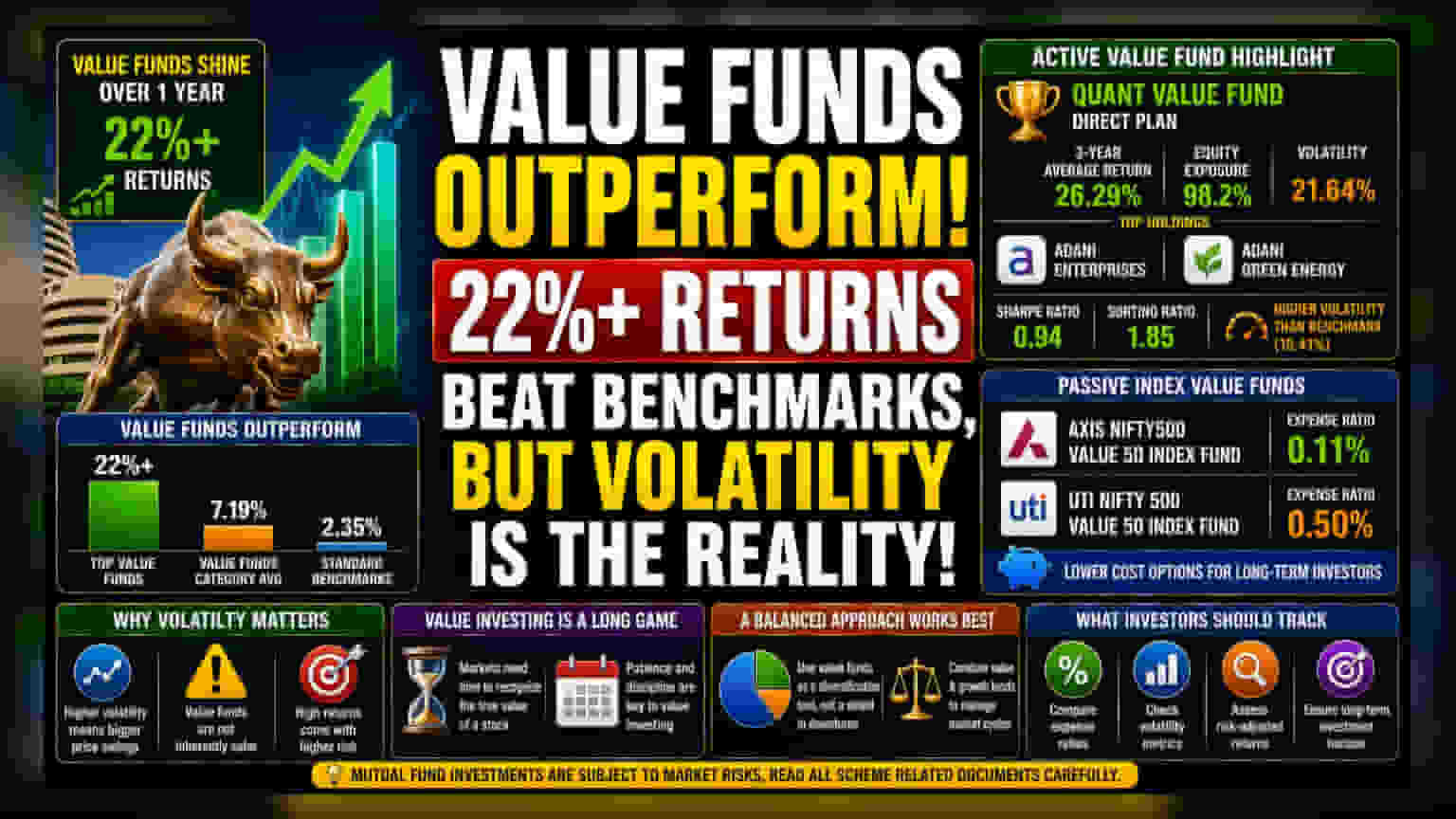
Select value-oriented mutual funds have delivered returns exceeding 22% over the past year, beating standard category benchmarks. While these gains are notable, the sector shows a clear divide between active and passive strategies. Investors should understand the risks, specifically higher volatility, before allocating to these funds for the long term.
What Happened
Value-oriented mutual funds have recently shown strong performance, with several funds delivering returns above 22% over the past year. This performance has notably outpaced the broader value fund category average, which sat at 7.19%, and standard benchmarks that returned roughly 2.35%. This trend suggests that strategies focusing on undervalued stocks have successfully identified market opportunities that the broader index missed.
Active Versus Passive Strategies
The market for value funds is currently split between active management and passive index strategies. Active funds, like the Quant Value Fund-Direct Plan, aim to beat the market through specific stock selection. This fund has shown a 3-year average return of 26.29% and maintains a high equity exposure of 98.2%, with top holdings including Adani Enterprises and Adani Green Energy.
On the other hand, passive index funds are gaining traction due to their lower cost structure. Investors can choose between various options like the Axis Nifty500 Value 50 Index Fund, which carries a lower expense ratio of 0.11%, or the UTI Nifty 500 Value 50 Index Fund, which has an expense ratio of 0.50%. These funds track specific value-focused indices rather than relying on a fund manager's active stock picking.
Why Volatility Matters
While returns in the value segment have been high, investors must consider the risk profile. Value funds are not inherently safer than other categories. For instance, data indicates the Quant Value Fund carries a volatility level of 21.64%, which is higher than the 15.41% seen in its benchmark. A higher volatility rating means the fund's price can fluctuate more sharply. While this fund has achieved a Sharpe ratio of 0.94 and a Sortino ratio of 1.85—indicating strong returns for the risk taken—it is essential to realize that this performance comes with wider price swings.
What Investors Should Track
Value investing is a long-term game. Markets often take time to realize the actual worth of a stock, so patience is a key requirement for anyone entering this space. Experts suggest that investors should treat value funds as a diversification tool rather than a way to avoid market downturns. A balanced portfolio that includes both value-oriented and growth-oriented funds can help manage different market cycles. Before choosing a fund, compare the expense ratios, check the fund's volatility metrics, and ensure the investment horizon aligns with a long-term goal.