

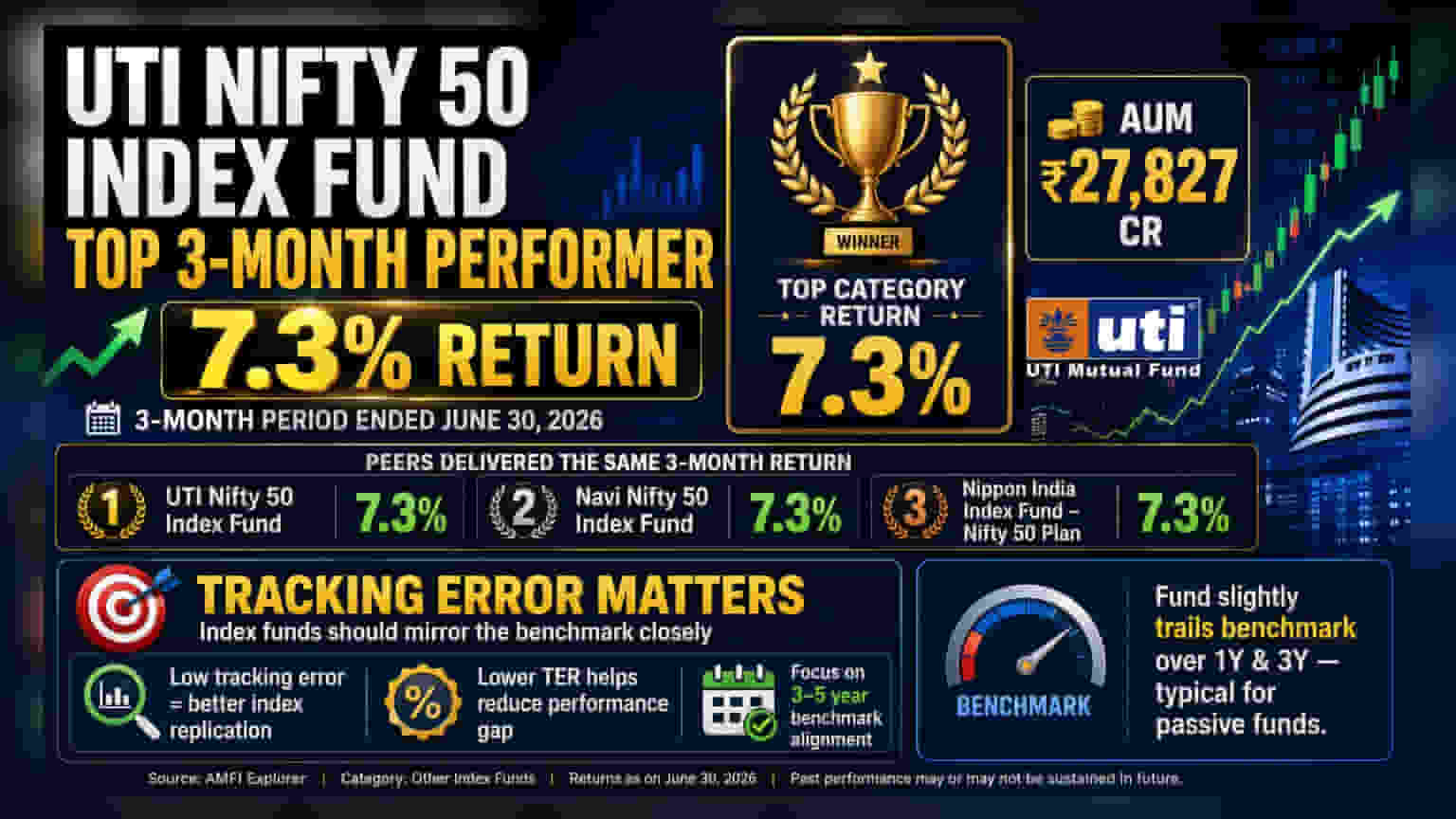
UTI Nifty 50 Index Fund led the category with a 7.3% return over the last three months. While short-term gains are visible, investors in index funds should prioritize low tracking error over outperformance to ensure the fund accurately mimics the Nifty 50 benchmark.
What Happened
UTI Nifty 50 Index Fund has emerged as the top performer in its category over the three-month period ending June 30, 2026, delivering a return of 7.3%. The fund shares this position with other prominent peers like Navi Nifty 50 Index Fund and Nippon India Index Fund-Nifty 50 Plan, which also recorded identical 7.3% returns. With an assets under management (AUM) of approximately Rs 27,827 crore, the UTI fund remains the largest index fund in this category.
The Real Goal: Tracking Error vs. Returns
While short-term returns often grab attention, they are not the primary metric for evaluating an index fund. The primary objective of an index fund is to replicate the performance of its underlying benchmark—in this case, the Nifty 50—as closely as possible.
Investors should pay closer attention to the "tracking error." This is a measure of how much a fund's performance deviates from its benchmark index. A lower tracking error indicates that the fund is doing a better job of mirroring the index. Because index funds have unavoidable costs such as expense ratios and transaction fees, they are generally expected to perform slightly below the benchmark, rather than outperform it. Therefore, a fund that "beats" the benchmark in the short term might be experiencing a tracking deviation rather than superior management.
Long-Term Benchmark Alignment
Data over longer periods offers a clearer picture of how the fund fulfills its mandate. Over the past one and three years, the UTI Nifty 50 Index Fund has slightly trailed its benchmark. This is a common characteristic of index funds, as management fees and portfolio rebalancing costs create a slight performance gap.
For example, over the one-year and three-year periods, the fund lagged the benchmark by 0.3 percentage points and 0.4 percentage points, respectively. This small difference is typical for passive products and reflects the cost of maintaining the fund's portfolio to mirror the 50 stocks in the Nifty 50 index.
What Investors Should Track
When evaluating index funds, investors may look beyond short-term percentage gains.
First, monitor the tracking error over time. A fund with a consistently low tracking error is generally more efficient at its core job of copying the market.
Second, compare the total expense ratio (TER) of the fund. Lower costs usually lead to a smaller performance gap against the benchmark.
Finally, focus on the consistency of the fund’s performance relative to the index over three to five years, rather than reacting to short-term fluctuations. Since the goal is passive exposure to the market, simplicity and cost-efficiency are often more important than short-term performance charts.