

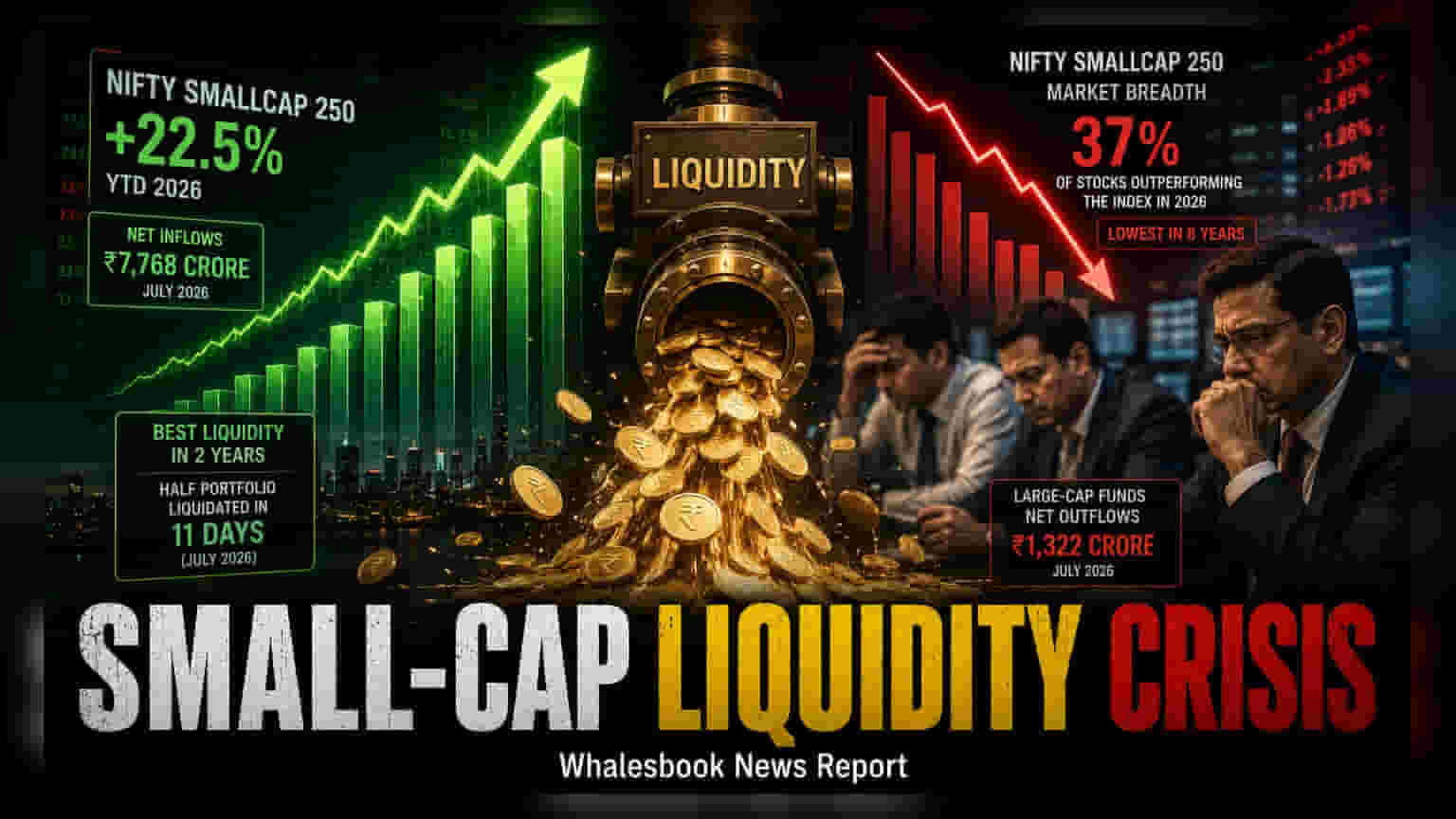
Small-cap mutual funds recorded a two-year best in portfolio liquidity in July 2026, with average exit times dropping to 11 days. Despite receiving ₹7,768 crore in net inflows, investors should note that market performance has become concentrated, with only 37% of Nifty SmallCap 250 stocks currently outperforming the index, marking an eight-year low in market breadth.
Small-cap mutual funds in India have recorded their best liquidity levels in two years, even as investor interest in the segment remains strong. Data for July 2026 shows that the average time required for a fund to liquidate half of its portfolio dropped to 11 days. This is a noticeable improvement from previous periods, suggesting that fund managers are currently better equipped to handle redemptions or adjust their portfolios as needed.
The segment attracted net inflows of ₹7,768 crore during July, highlighting a strong appetite for small-cap exposure among investors. This trend contrasts sharply with large-cap mutual funds, which faced net outflows of ₹1,322 crore during the same month, marking their first outflow in 30 months. This shift indicates that many investors are actively moving capital toward the potential of smaller, high-growth companies despite the inherent volatility associated with the segment.
However, while liquidity metrics have improved, a deeper look at the market reveals a potential area of caution for investors: concentration risk. Although index levels appear robust, market breadth has narrowed significantly. Only 37% of the stocks within the Nifty SmallCap 250 index have outperformed the benchmark so far in 2026. This is the lowest level of market participation observed in eight years.
This trend means that a large portion of the recent performance gains in small-cap funds is being driven by a relatively small group of top-performing stocks. When market performance relies on a narrow set of companies, the overall portfolio can become more vulnerable to volatility if those specific stocks face selling pressure. While fund managers often maintain liquidity by holding cash or more stable assets, the underlying concentration means that the total fund return is being heavily influenced by a limited number of successful bets.
For investors, the focus should extend beyond just the total fund size or recent returns. It is useful to examine how much of a fund's performance is driven by a handful of stocks versus a broader, diversified selection. As the sector continues to see high inflows, fund managers face the ongoing challenge of deploying new capital into quality businesses without overpaying for high-momentum stocks. Future updates on portfolio concentration and the performance breadth of the broader index will be important indicators of the segment's underlying health.