

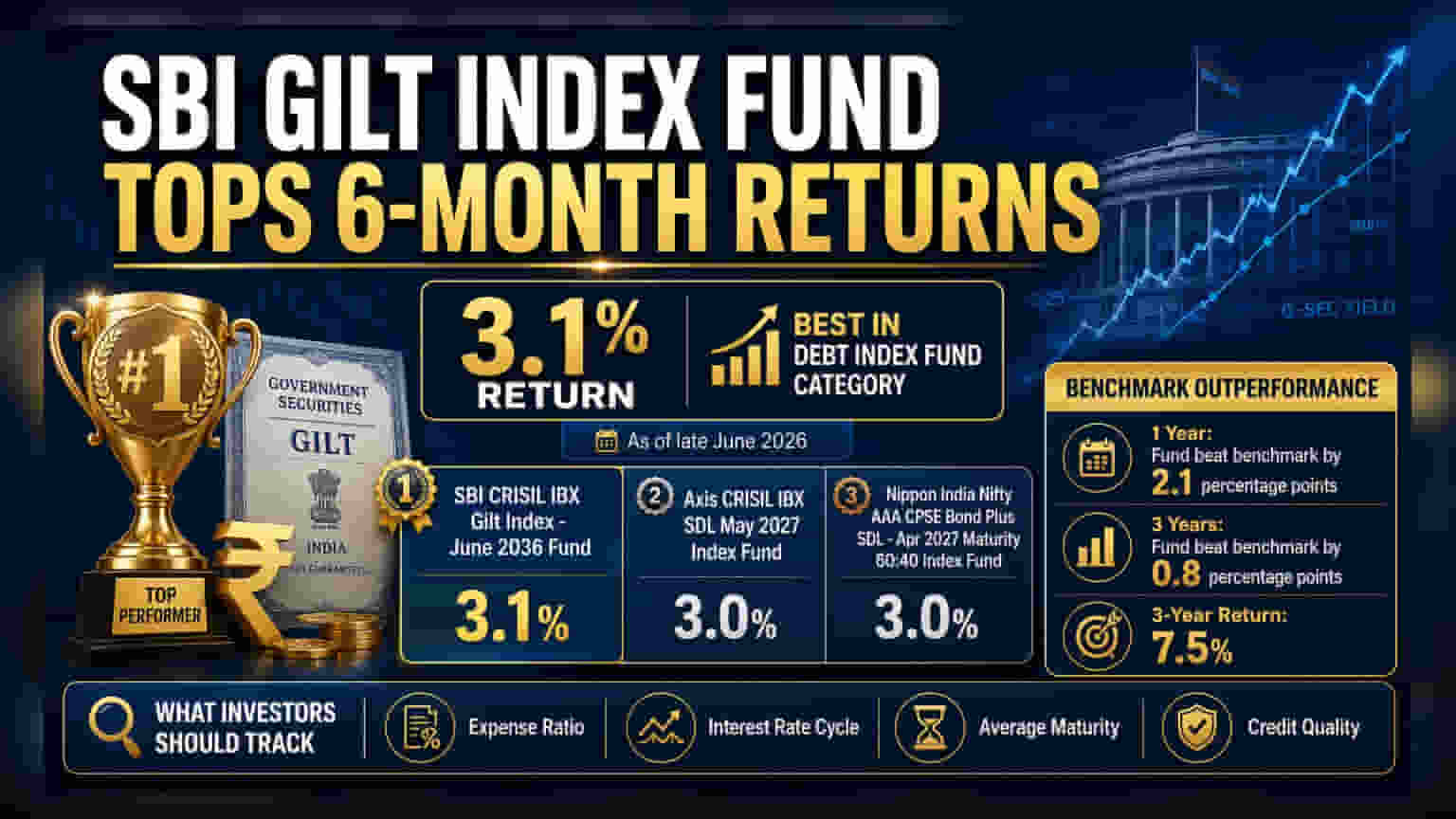
The SBI CRISIL IBX Gilt Index - June 2036 Fund has emerged as the top performer among large debt index mutual funds, delivering a 3.1% return over six months. While it outperformed its peers and benchmark, investors should consider long-term performance trends rather than focusing solely on short-term gains.
What Happened
The SBI CRISIL IBX Gilt Index - June 2036 Fund has recorded the highest return in the debt-oriented index mutual fund category over the past six months, according to data compiled as of late June 2026. The fund delivered a 3.1% return during this period. This ranking only considers index funds with assets under management (AUM) exceeding Rs 1,500 crore, highlighting its performance among the larger funds in this segment.
Peer Performance Comparison
The fund’s performance placed it ahead of several notable competitors. The Axis CRISIL IBX SDL May 2027 Index Fund and the Nippon India Nifty AAA CPSE Bond Plus SDL - Apr 2027 Maturity 60:40 Index Fund both recorded returns of 3.0% over the same six-month period. While the SBI fund secured the top spot, the gap between the top performers remained narrow.
Performance Against Benchmark
Beyond comparing returns with peers, the fund has also demonstrated performance relative to its underlying benchmark index. On a one-year basis, the fund outperformed its benchmark by 2.1 percentage points, with the benchmark returning 2.3%. Over a three-year period, the fund also exceeded its benchmark by 0.8 percentage points, with the benchmark delivering a 6.7% return.
Long-Term Track Record
While the six-month return highlights recent performance, investors often look at longer periods to gauge consistency. Over a three-year timeframe, the SBI CRISIL IBX Gilt Index - June 2036 Fund delivered a 7.5% return. It is important to note that performance leadership can shift based on the time period measured. For instance, the Kotak Nifty SDL Apr 2032 Top 12 Equal Weight Index Fund led the performance charts over the one-month period with a 2.4% return, showing that short-term leadership is not always permanent.
What Investors Should Track
When evaluating debt index funds, investors may look at several factors beyond recent returns. First, they should check the fund's expense ratio, which directly impacts net returns. Second, since these funds track specific government or corporate bonds, understanding the interest rate cycle is important, as bond prices generally fall when interest rates rise and vice versa. Finally, investors should review the fund's average maturity and credit quality to understand the risk associated with the underlying securities. Comparing returns over multiple time horizons, such as one, three, and five years, rather than just a few months, provides a more reliable picture of how a fund performs across different market conditions.