

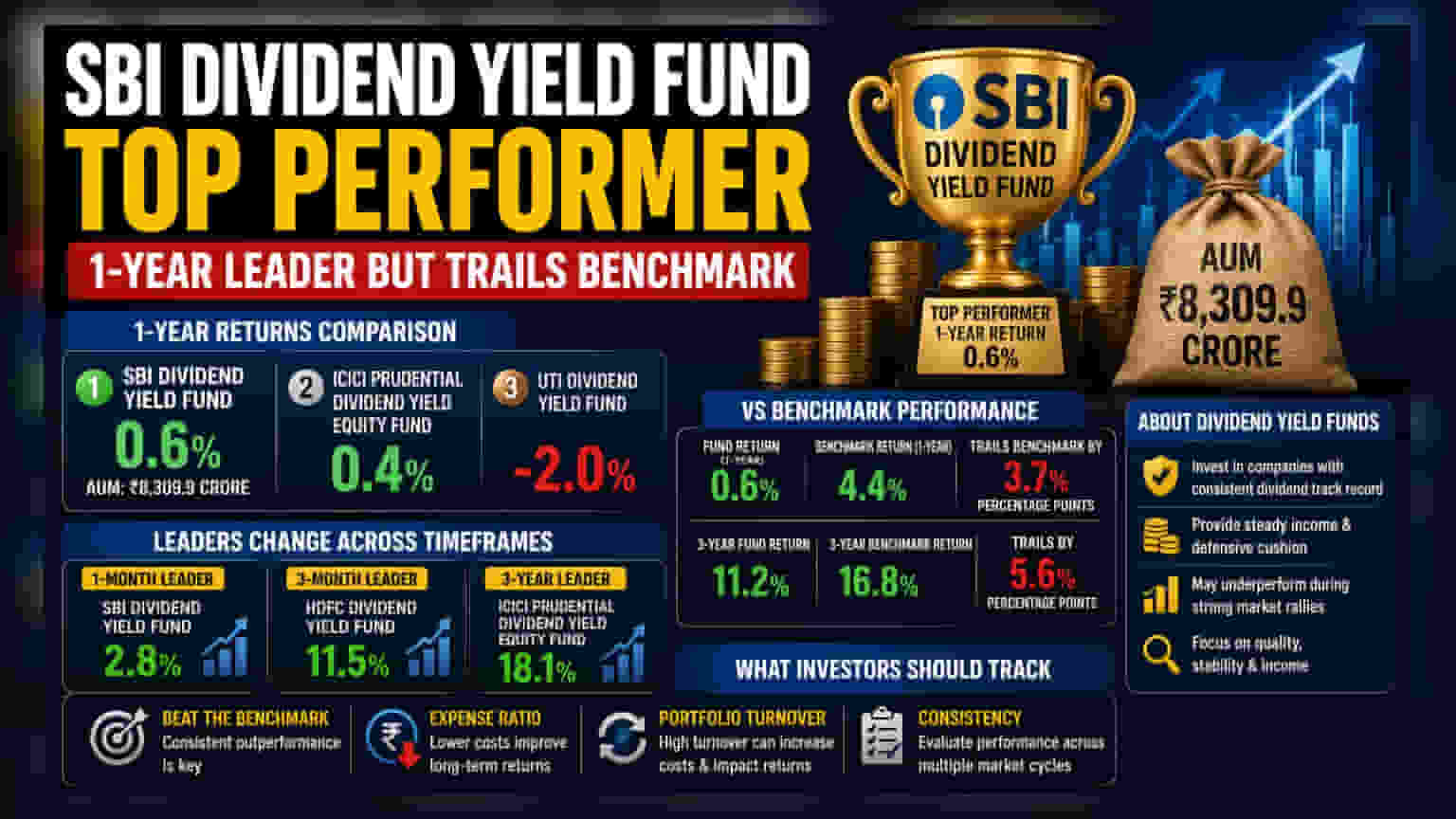
The SBI Dividend Yield Fund has recorded the highest one-year returns among dividend-focused mutual funds, delivering 0.6%. Despite leading the category, the fund has consistently trailed its benchmark over both one-year and three-year periods. Investors should note that leadership shifts frequently across timeframes, with other funds like HDFC and ICICI Prudential taking the lead in different investment windows.
What Happened
The SBI Dividend Yield Fund has been identified as the top performer within the dividend-yield mutual fund category over the past year, delivering a 0.6% annual return. As of June 30, the fund manages a significant corpus of Rs 8,309.9 crore, making it one of the larger players in this space among funds with at least Rs 1,500 crore in assets under management (AUM).
While it leads the rankings, the performance gap between peers is tight. For instance, the ICICI Prudential Dividend Yield Equity Fund posted a 0.4% return over the same period, while the UTI Dividend Yield Fund recorded a negative return of 2.0%.
Why Benchmark Performance Matters
For investors, the most critical data point is not just the absolute return, but how the fund performed against its designated benchmark. A mutual fund manager’s primary role is to outperform the index (benchmark) they track.
The SBI Dividend Yield Fund has struggled to achieve this, trailing its benchmark by 3.7 percentage points over the one-year period, during which the benchmark itself rose by 4.4%. This underperformance is not limited to the short term; looking back at the three-year horizon, the fund trailed its benchmark by 5.6 percentage points, with the benchmark delivering a 16.8% return.
When a fund consistently underperforms its benchmark, investors must consider whether the active management strategy—which typically comes with higher fees compared to passive index funds—is providing the expected value.
Shifting Leadership Across Timeframes
Performance in the mutual fund industry is rarely static, and this is clearly visible in the dividend yield category. While the SBI Dividend Yield Fund leads the one-month returns with a 2.8% gain, the leadership changes when looking at different horizons.
The HDFC Dividend Yield Fund took the top spot over a three-month period, delivering an 11.5% return. Meanwhile, over a three-year timeframe, the ICICI Prudential Dividend Yield Equity Fund emerged as the leader with an 18.1% return. This pattern highlights why investors should avoid judging a fund solely on its recent, short-term performance. Market volatility often causes one fund to lead for a few months, only to be overtaken as market conditions change.
Understanding Dividend Yield Funds
Dividend yield funds primarily invest in companies that have a history of paying regular dividends. These companies are often mature, cash-rich, and financially stable. The idea is that these stocks offer a defensive cushion during market downturns because the dividends provide a steady income stream, even if the stock price does not rise significantly.
However, these funds often struggle to keep pace during market rallies where growth stocks (which may not pay high dividends) tend to lead. This structural limitation is often why these funds can sometimes trail broader market benchmarks that include high-growth sectors.
What Investors Should Track
Investors looking at dividend yield funds should monitor more than just the return percentages. Key aspects to observe include the fund manager’s ability to consistently beat the benchmark, the expense ratio (the cost of managing the fund), and the portfolio turnover ratio (how often the manager buys and sells stocks). A high turnover ratio can indicate frequent trading, which might not always benefit long-term returns.