

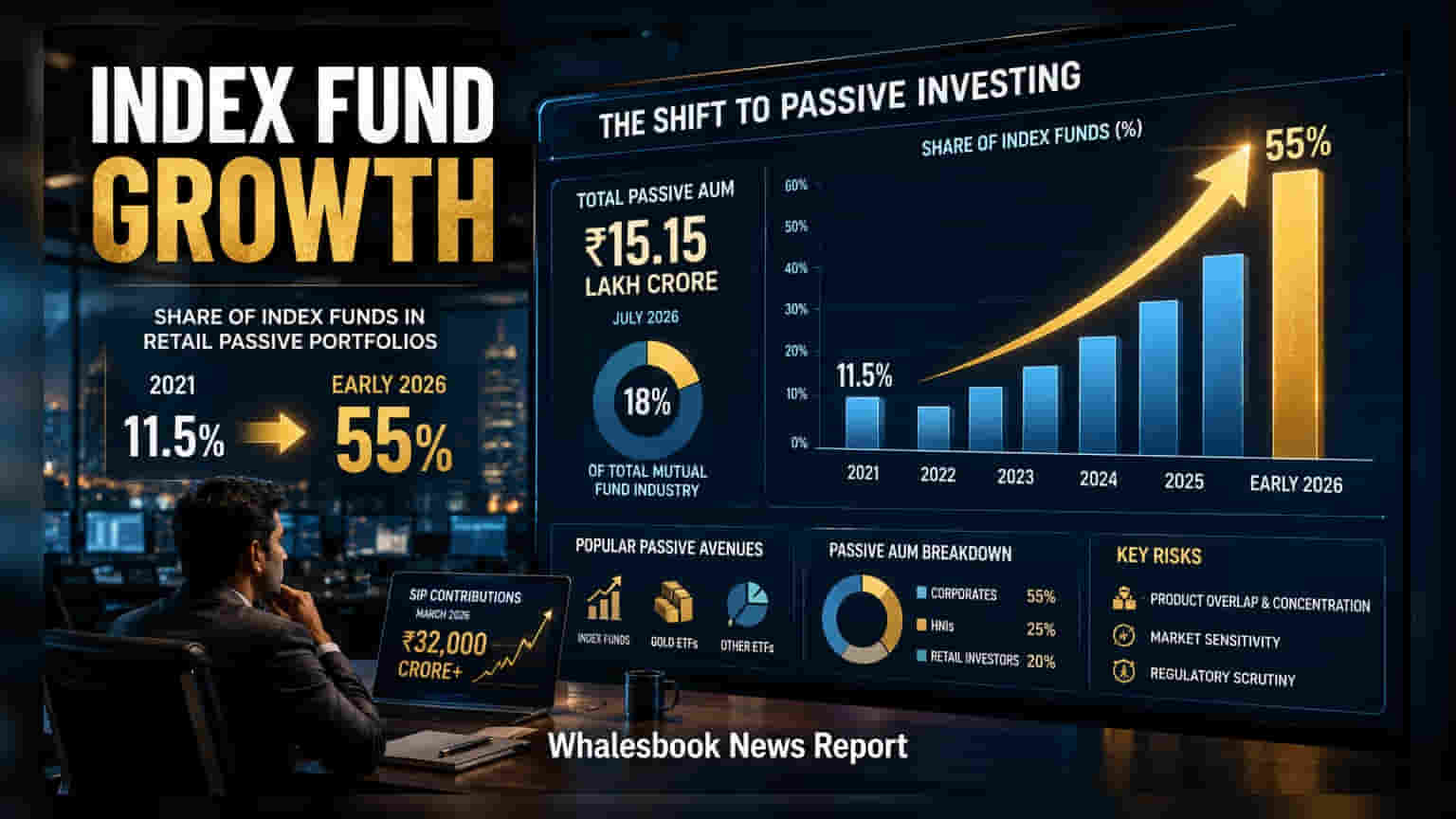
Retail investors are increasingly moving toward index funds, with their share in passive investments rising significantly over the last five years. Total passive assets under management reached ₹15.15 lakh crore by July 2026, supported by strong monthly SIP inflows. While this reflects a preference for low-cost, rule-based investing, regulators are now evaluating ways to manage the growing number of similar fund offerings to prevent investor confusion.
The Indian mutual fund industry is witnessing a clear change in how retail money is being invested. Over the past five years, retail investors have increasingly pivoted toward index funds, which are designed to track specific market benchmarks rather than picking individual stocks. Data shows that the share of index funds within retail passive investment portfolios has risen from 11.5 percent in 2021 to 55 percent by early 2026.
This shift highlights a broader move in the industry toward passive investing, where total assets under management reached approximately ₹15.15 lakh crore by July 2026, accounting for 18 percent of the total mutual fund industry. This growth has been supported by a steady rise in monthly Systematic Investment Plan (SIP) contributions, which surpassed ₹32,000 crore in March 2026. Many investors are now prioritizing cost-efficiency, transparency, and the predictable nature of rule-based strategies over traditional active fund selection.
Diversification and Institutional Trends
While equity index funds have captured most of the new interest, retail participants are also exploring other passive vehicles. Gold ETFs, for instance, have seen a steady increase in popularity as a way to diversify portfolios using commodity-backed instruments. Despite the rapid growth in retail participation, institutional players—specifically corporates—continue to hold the largest portion of passive assets. However, this dominance is gradually tapering as High Net-worth Individuals (HNIs) and retail investors increase their share of total assets.
Regulatory and Market Risks
The rapid expansion of passive funds has brought new challenges that investors should note. One primary concern is the proliferation of similar index-tracking products. Because many funds track the same few indices, there is a risk of excessive concentration, where money is focused on a limited number of large-cap stocks or specific themes. This can increase the portfolio's sensitivity to sudden changes in those specific stocks.
Furthermore, the Securities and Exchange Board of India (SEBI) is reportedly evaluating limits on the number of new passive fund launches per category. The regulator is concerned that too many similar options could cause confusion, potentially leading investors to select products without fully understanding their underlying structure.
Another point for investors to consider is market sensitivity. As retail participation in passive funds grows, the overall market may become more sensitive to retail sentiment during periods of volatility. While passive funds offer a disciplined way to invest, they do not provide protection against market downturns. The long-term success of this trend will depend on whether these funds continue to deliver on their promise of transparency and low costs, and how the regulatory environment evolves to manage the high volume of new product offerings.