

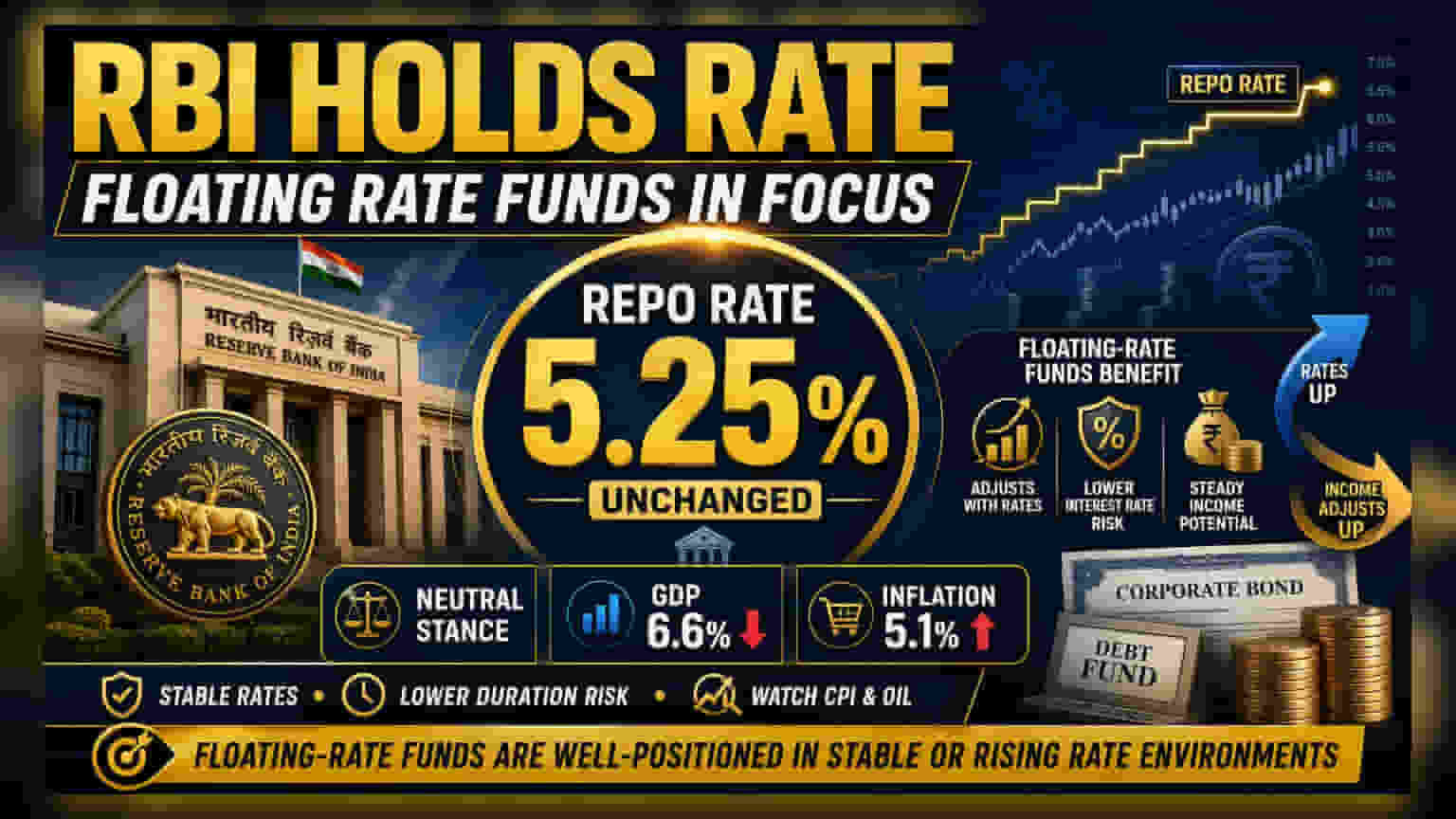
The Reserve Bank of India has maintained the repo rate at 5.25% with a neutral policy stance, balancing inflation concerns against slower growth. This pause signals a potential end to the rate-cut cycle, drawing attention to floating-rate mutual funds as a tool for managing interest rate risk in a stable environment.
What Happened
The Reserve Bank of India (RBI) has kept the policy repo rate unchanged at 5.25% in its latest Monetary Policy Committee meeting. The central bank also maintained a neutral stance, signaling that it is keeping a close watch on future economic data before taking any further action on rates. Alongside this, the RBI revised its GDP growth projection for the 2026-27 fiscal year downwards to 6.6%, while raising its inflation forecast to 5.1%. These revisions reflect concerns over supply chain issues, global market volatility, and rising food and fuel costs.
The RBI's Neutral Stance Explained
A neutral policy stance means the central bank is neither actively trying to lower rates to boost growth nor raising them to curb inflation. By holding rates steady, the RBI is essentially taking a "wait and watch" approach. For investors, this suggests that the era of rapid interest rate cuts may have ended for now. Because the inflation outlook remains uncertain, the central bank is not under immediate pressure to pivot, creating a stable but cautious environment for debt markets.
Understanding Floating Rate Funds
In an environment where interest rates are stable or potentially rising, many investors look toward floating-rate mutual funds. Unlike traditional fixed-income funds, which hold bonds with fixed interest payments, floating-rate funds invest in debt instruments where the interest rate resets periodically.
When the broader market interest rates rise, the coupon (interest) on these floating-rate instruments also increases, which helps the fund earn more income without needing to sell its holdings. Additionally, these funds often have lower duration risk, meaning they are less sensitive to the sudden price drops that can affect long-term bond funds when interest rates fluctuate.
Several large funds operate in this space, such as the ICICI Prudential Floating Interest Fund, which manages ₹7,567 crore and focuses heavily on AAA-rated debt. The Kotak Floater Rate Fund, with ₹3,128 crore in assets, also prioritizes high-quality papers with low interest-rate sensitivity. Similarly, the Aditya Birla Sun Life Floating Rate Fund manages ₹13,455 crore and uses short-to-medium-term corporate debt strategies to manage risk.
The Risk Factor
While floating-rate funds offer benefits in stable or rising rate cycles, they are not risk-free. If the central bank eventually decides to cut rates, the yield on these floating-rate instruments may fall, potentially lowering the returns for investors compared to other debt categories. Furthermore, investors should pay close attention to the credit quality of the underlying assets. While many major funds focus on AAA-rated securities, debt funds inherently carry the risk that the companies issuing the debt might face repayment difficulties. Evaluating the credit rating of a fund's portfolio is essential before making any decisions.
What Investors Should Track
The primary monitorable for debt investors will be the upcoming consumer price index (CPI) inflation data and global oil price trends, as these heavily influence the RBI's future decisions. Investors should also watch for management commentary from mutual funds regarding any changes in portfolio duration or credit strategy. Additionally, keeping an eye on the Monetary Policy Committee’s meeting minutes will provide deeper insight into how the central bank views the current economic growth slowdown versus the rising inflation estimates.