

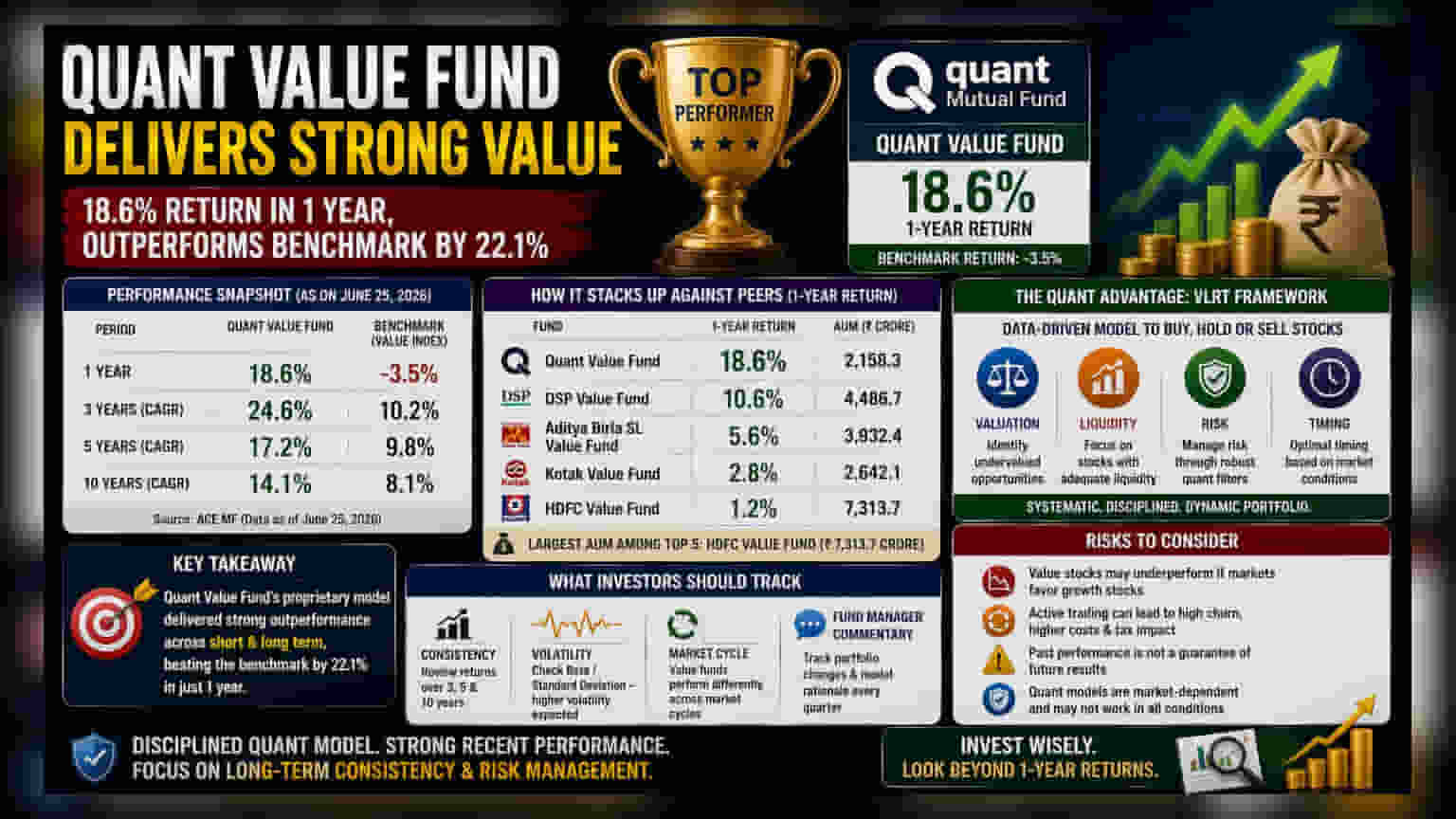
Quant Value Fund has delivered an 18.6% return over the past year, outperforming its benchmark and several peers in the value category. While these short-term gains are significant, investors should understand the fund's unique, data-driven investment approach and the inherent risks associated with value-oriented and high-turnover portfolios.
What Happened
Quant Value Fund has emerged as a top performer among value-oriented mutual fund schemes, recording a 18.6% return over the past one-year period. This performance notably outpaced the scheme’s benchmark, which saw a decline of 3.5% during the same timeframe. The fund’s strong showing is not limited to the short term, as it has also demonstrated a 24.6% return over a three-year period, according to data from ACE MF as of June 25, 2026.
Understanding The 'Quant' Strategy
Unlike traditional value funds that might rely solely on manual stock picking by fund managers, Quant Mutual Fund utilizes a proprietary framework known as 'VLRT.' This model stands for Valuation, Liquidity, Risk, and Timing.
The strategy involves using data to determine when to buy, hold, or sell stocks. Because this approach is highly systematic, the fund may frequently change its portfolio composition. This is different from a 'buy-and-hold' value strategy. For investors, this means the fund can be more active, which can lead to higher volatility compared to more conservative value funds.
How It Stacks Up Against Peers
In the competitive landscape of value mutual funds, performance varies significantly. For context, while Quant Value Fund delivered 18.6% over the year, peers like DSP Value Fund recorded a 10.6% return, and Aditya Birla SL Value Fund returned 5.6%.
It is also useful to look at the scale of these funds. Among the top five funds in this category, HDFC Value Fund manages the largest asset base at Rs 7,313.7 crore. Size can sometimes impact how a fund manager moves in and out of stocks; smaller, more agile funds may find it easier to shift positions quickly based on their mathematical models than larger funds managing much bigger portfolios.
The Risk Side Of Value Investing
Value investing involves buying stocks that the market may be ignoring or pricing 'cheaply,' with the expectation that they will rise in value later. However, this strategy comes with risks. If the market continues to favor 'growth' stocks (companies expected to grow earnings very quickly) over 'value' stocks, value funds can underperform for long periods.
Additionally, the aggressive trading style often seen in Quant-managed funds means there is a risk of high 'churn'—buying and selling stocks frequently. This can impact the fund's expense ratio and tax efficiency for investors. Investors should also note that past performance is not a guarantee of future returns, especially in strategies that rely on specific market timing and quantitative models.
What Investors Should Track
Investors looking at this fund should look beyond the one-year return. The consistency of the fund across different market cycles is crucial. Important monitorables include:
- Consistency: Compare performance over 3, 5, and 10-year periods rather than just one year.
- Volatility: Check the fund's beta or standard deviation, which measure how much the fund's price swings compared to the market.
- Market Cycle: Value funds often perform differently depending on whether the market is favoring cyclical stocks, defensive stocks, or growth stocks.
- Fund Manager Commentary: Understanding the quarterly portfolio shifts helps explain why the fund performed the way it did, as the strategy is highly responsive to market data.