

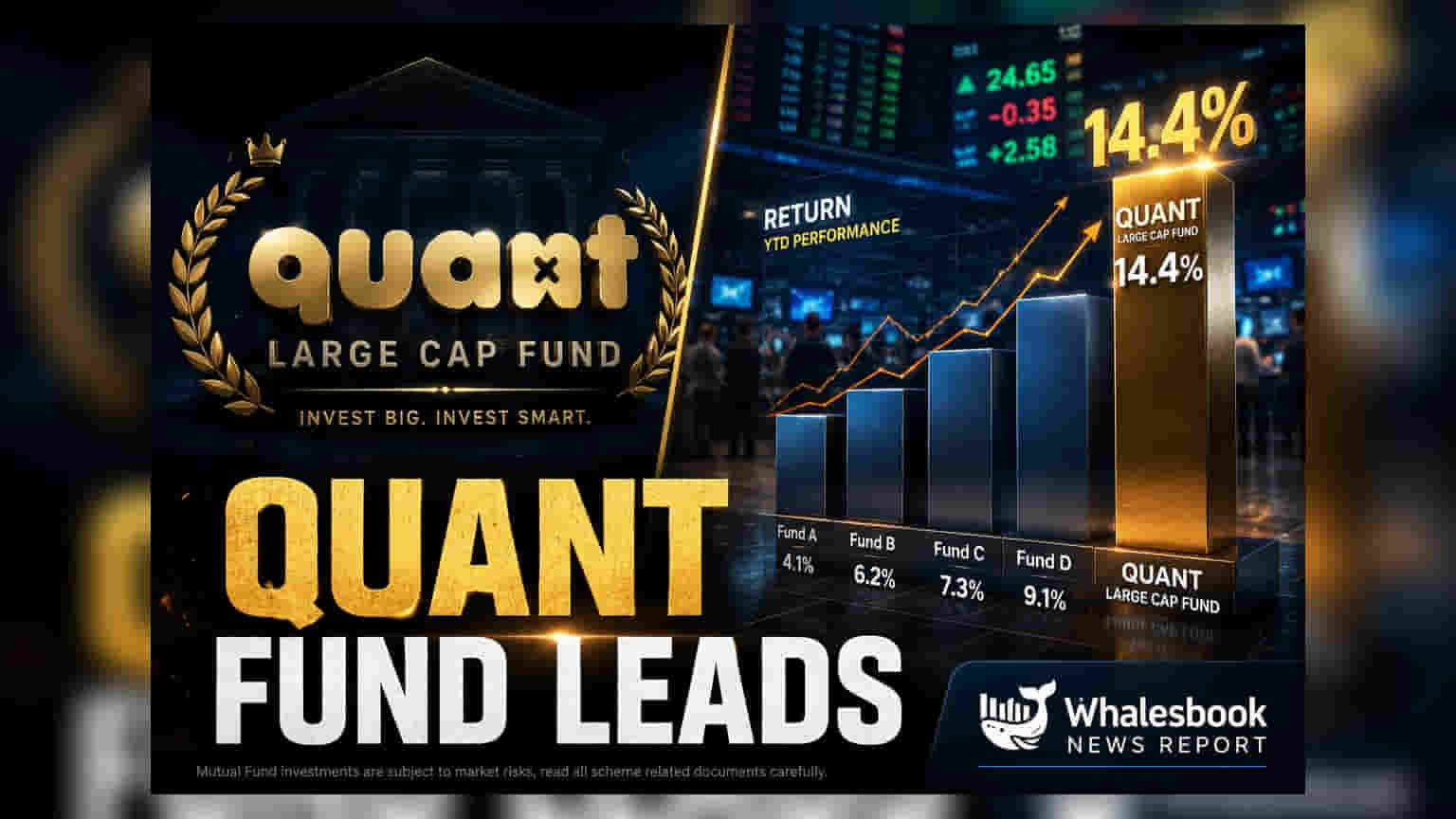
Quant Large Cap Fund has outperformed its benchmark index and peers with a 14.4% three-year annualized return as of July 2026. The fund also recorded strong gains over one-month and three-month periods, standing out in the large-cap category.
What Happened
Quant Large Cap Fund has emerged as the top performer within the large-cap mutual fund segment, according to recent data. As of July 2, 2026, the fund achieved a three-year compounded annual growth rate (CAGR) of 14.4%. This performance marks a significant lead over its benchmark index, which delivered a 9.2% return over the same timeframe. The fund's performance has been consistent across shorter periods as well, securing the leading position for both one-month and three-month return windows.
Performance Against Peers
The large-cap mutual fund category is highly competitive, with funds mandated to invest at least 80% of their assets in the top 100 companies by market capitalization. Data shows that Quant Large Cap Fund has outpaced several notable peers in the three-year category. For instance, Invesco India Largecap Fund and Nippon India Large Cap Fund reported returns of 14.0% and 13.5% respectively during the same period. While performance figures fluctuate, this data highlights the fund's current standing among established players.
Understanding Benchmark Outperformance
A key metric for mutual fund investors is "alpha," or the ability of a fund to beat its designated benchmark index. Quant Large Cap Fund demonstrated a lead of 5.1 percentage points over its benchmark's 9.2% return for the three-year period. This outperformance becomes even more pronounced in shorter timeframes; on a one-year basis, the fund delivered a 3.6% return, while its benchmark index recorded a negative return of -4.0%. This suggests that the fund's active management strategy has been effective in navigating recent market cycles.
Scale and Portfolio Context
When evaluating mutual funds, size or Assets Under Management (AUM) often provides context regarding the fund's operational capacity and liquidity. The current analysis focused on funds with a minimum AUM of Rs 1,500 crore. Within the broader large-cap space, funds like ICICI Pru Large Cap Fund manage significantly larger corpuses, reaching Rs 76,297 crore. Investors typically look at both returns and fund size to determine how easily a fund can deploy capital across large-cap stocks without disrupting market prices.
What Investors Should Track
Past performance is not a guarantee of future results, and large-cap funds are subject to broader market volatility. Investors may want to track the fund's portfolio turnover ratio, which indicates how frequently the fund manager buys and sells stocks. Additionally, checking the expense ratio and the consistency of the fund's investment style against its stated objective remains essential for a long-term view. Monitoring how the fund performs when market conditions shift from the current cycle will provide a clearer picture of its risk management capabilities.