

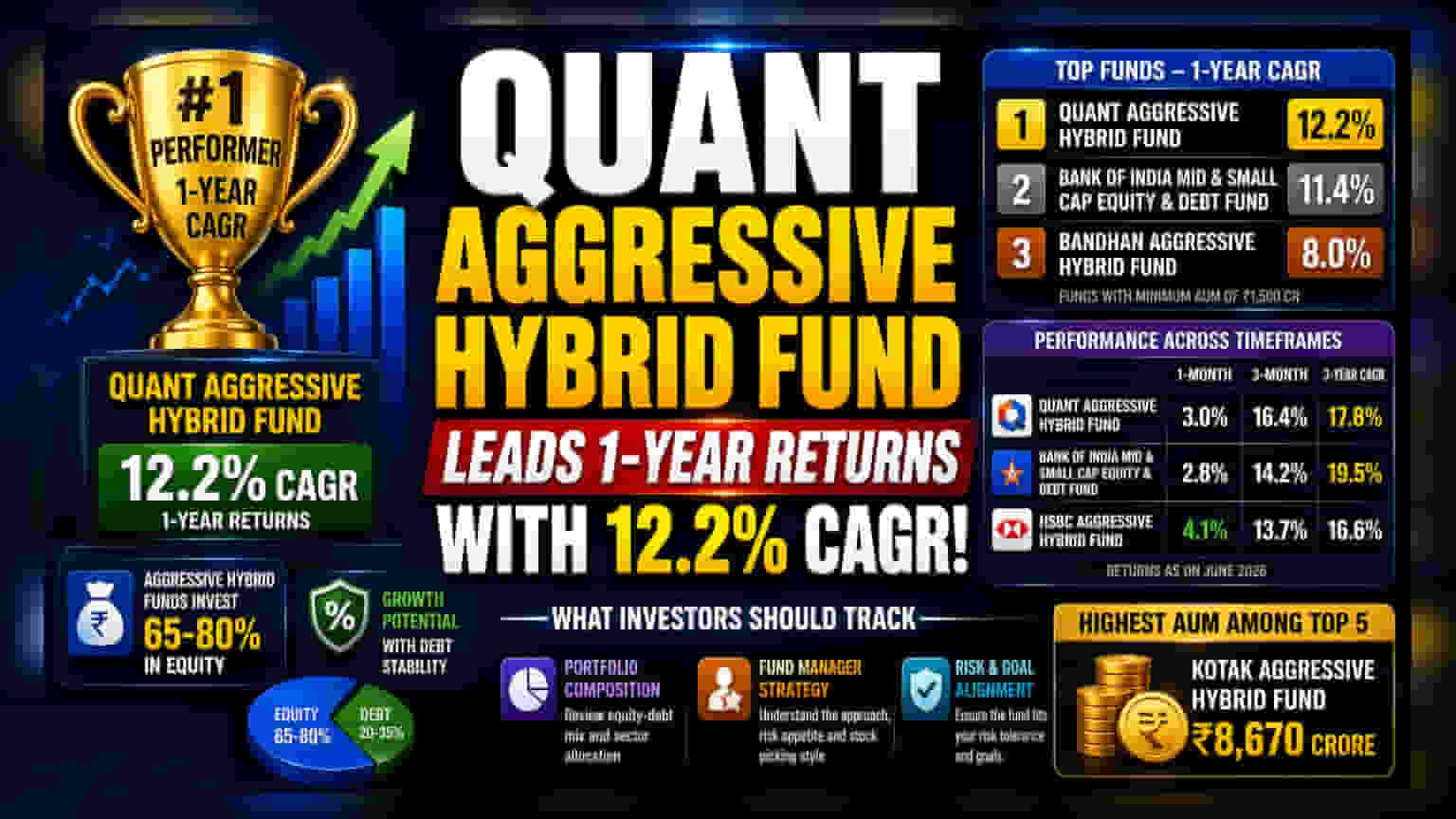
Quant Aggressive Hybrid Fund has recorded the highest one-year CAGR of 12.2% among aggressive hybrid mutual funds with over Rs 1,500 crore in assets. While this short-term performance highlights recent strategy effectiveness, investors should view these rankings with caution as performance fluctuates significantly across different time periods.
What Happened
Quant Aggressive Hybrid Fund has emerged as the top-performing scheme in its category over the past one-year period, delivering a compound annual growth rate (CAGR) of 12.2%. This performance ranks it ahead of other prominent funds in the aggressive hybrid segment, which are mandated to invest a significant portion of their corpus in equity markets while maintaining a debt component for stability.
Following Quant, the Bank of India Mid & Small Cap Equity & Debt Fund posted a 11.4% CAGR, while the Bandhan Aggressive Hybrid Fund reported an 8.0% return. These figures are based on funds with a minimum asset base of Rs 1,500 crore, providing a benchmark for comparison among larger, more established schemes.
Why Short-Term Rankings Can Be Misleading
While the 12.2% return captures attention, ranking lists often shift depending on the specific timeframe analyzed. For instance, the Quant Aggressive Hybrid Fund led the charts over the recent one-year and three-month periods, with a 16.4% gain in the latter. However, this lead does not persist over longer investment horizons. When looking at a three-year window, the Bank of India Mid & Small Cap Equity & Debt Fund outperformed, achieving a 19.5% CAGR.
Furthermore, monthly returns show even higher volatility. The HSBC Aggressive Hybrid Fund, for example, recorded the strongest one-month return of 4.1% among the top five funds. This variation highlights that relying solely on a one-year return metric provides an incomplete picture of a fund's actual performance history or consistency.
The Hybrid Fund Business Model
Aggressive hybrid funds are designed to blend the growth potential of equity markets with the relative safety of debt instruments. Because they hold a substantial equity allocation—typically 65% to 80% of the portfolio—their performance is closely tied to stock market movements. When equity markets are rallying, these funds tend to show higher returns compared to conservative debt-focused schemes. Conversely, when markets experience volatility, these funds may see sharper declines.
Investors also note the fund size, or Assets Under Management (AUM), when evaluating these options. Among the top five performers identified, Kotak Aggressive Hybrid Fund maintains the largest corpus at Rs 8,670 crore. Larger funds may offer more stability and liquidity, but smaller or mid-sized funds sometimes adopt more aggressive portfolio strategies that can lead to rapid performance shifts, both positive and negative.
What Investors Should Track Next
Investors evaluating hybrid funds should look beyond simple point-to-point returns. Important monitorables include rolling returns, which provide a better sense of how a fund performs across various market cycles, and the expense ratio, which directly impacts the net return delivered to the investor.
Additionally, understanding the fund manager’s strategy is vital. A fund that tops the charts in a short period might be taking higher risks or concentrating its portfolio in specific sectors, which could lead to underperformance if market trends reverse. Reviewing the portfolio composition regularly helps in determining whether the returns are aligned with one’s personal risk tolerance and investment goals.