

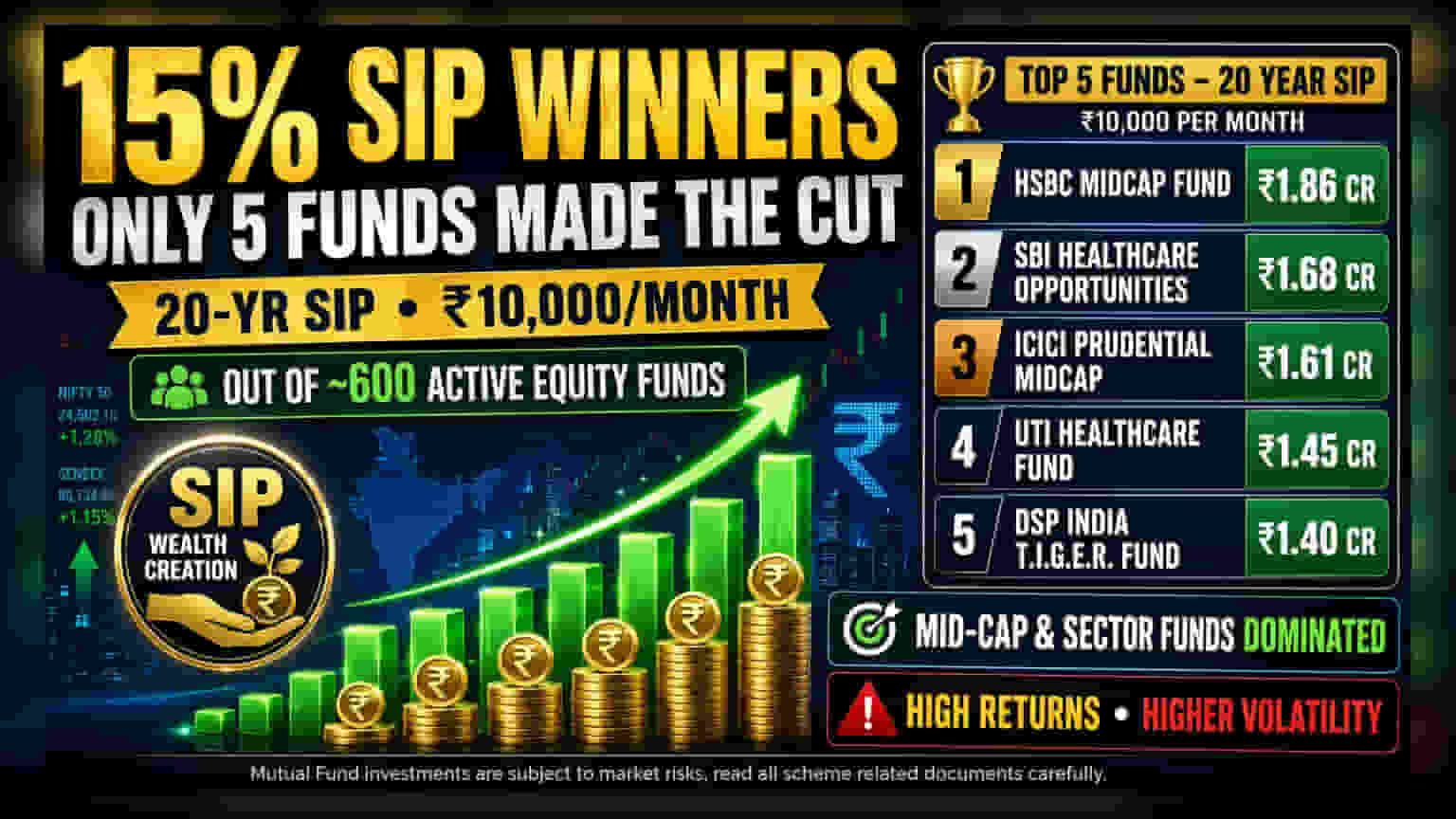
A study of 600 equity mutual funds found only five schemes consistently achieved 15% annualized SIP returns over two decades. These top performers are largely mid-cap and sector-specific funds, highlighting the significant risks and volatility required to chase high long-term returns in the Indian market.
What The Data Reveals
Achieving an annualized return of 15% through a Systematic Investment Plan (SIP) over a 20-year period is a rare achievement in the Indian mutual fund industry. A recent analysis covering roughly 600 active equity schemes indicates that only five funds have maintained such performance consistently across 3, 5, 10, 15, and 20-year timeframes. This study, which tracks long-term wealth creation, reveals that the vast majority of diversified equity funds did not sustain this 15% threshold over the full two-decade journey.
The Dominance Of Specific Themes
The list of these five consistent performers is notable for what it excludes. Broad-based large-cap and flexi-cap funds, which are often recommended for their stability, did not make this specific list. Instead, the winners are concentrated in two mid-cap funds and three sector-specific funds—specifically healthcare and infrastructure.
For a hypothetical ₹10,000 monthly SIP invested over 20 years, the HSBC Midcap Fund stood out, building a corpus of ₹1.86 crore. Other funds that met the criteria include the SBI Healthcare Opportunities Fund (₹1.68 crore), ICICI Prudential Midcap Fund (₹1.61 crore), UTI Healthcare Fund (₹1.45 crore), and DSP India T.I.G.E.R. Fund (₹1.40 crore).
Why These Categories Outperformed
The success of these funds largely stems from the nature of the sectors and market capitalizations they target. Mid-cap companies, by definition, have a longer runway for growth compared to established large-cap giants. When mid-cap companies successfully scale up, the appreciation in stock price is often significant, driving superior fund returns.
Similarly, thematic funds like healthcare and infrastructure have benefited from long-term secular growth trends in the Indian economy. However, investors should understand that these sectors are cyclical. Infrastructure, in particular, is highly dependent on government spending and economic cycles. While these funds provided high returns over 20 years, they likely experienced periods of sharp underperformance during economic downturns.
Risks And The Reality Of High Returns
It is vital for investors to distinguish between a historical track record and future expectation. The performance of these five funds does not imply that mid-cap or sector funds will always outperform. In fact, these categories come with higher volatility. Mid-cap funds can fall sharply during market corrections, and thematic funds are vulnerable if the specific sector faces regulatory hurdles or a demand slowdown.
Another point for investors to consider is the concentration risk. While a diversified flexi-cap fund spreads risk across various sectors and market capitalizations, these top-performing funds were concentrated in just one or two areas. This concentration is a double-edged sword; it leads to higher returns when the bet pays off, but it increases the risk of loss when the sector or segment falls out of favor.
What Investors Should Track
Rather than chasing funds based solely on past 20-year returns, investors should focus on the suitability of these funds for their own goals. Expense ratios, which range from 1.45% to 1.85% for these funds, play a role in long-term compounding. Investors should also review the current portfolio churn and management style of these funds to ensure they align with their current risk appetite. Ultimately, the 15% return threshold serves as a benchmark for excellence, but portfolio construction should prioritize diversification to manage the volatility inherent in high-growth funds.