

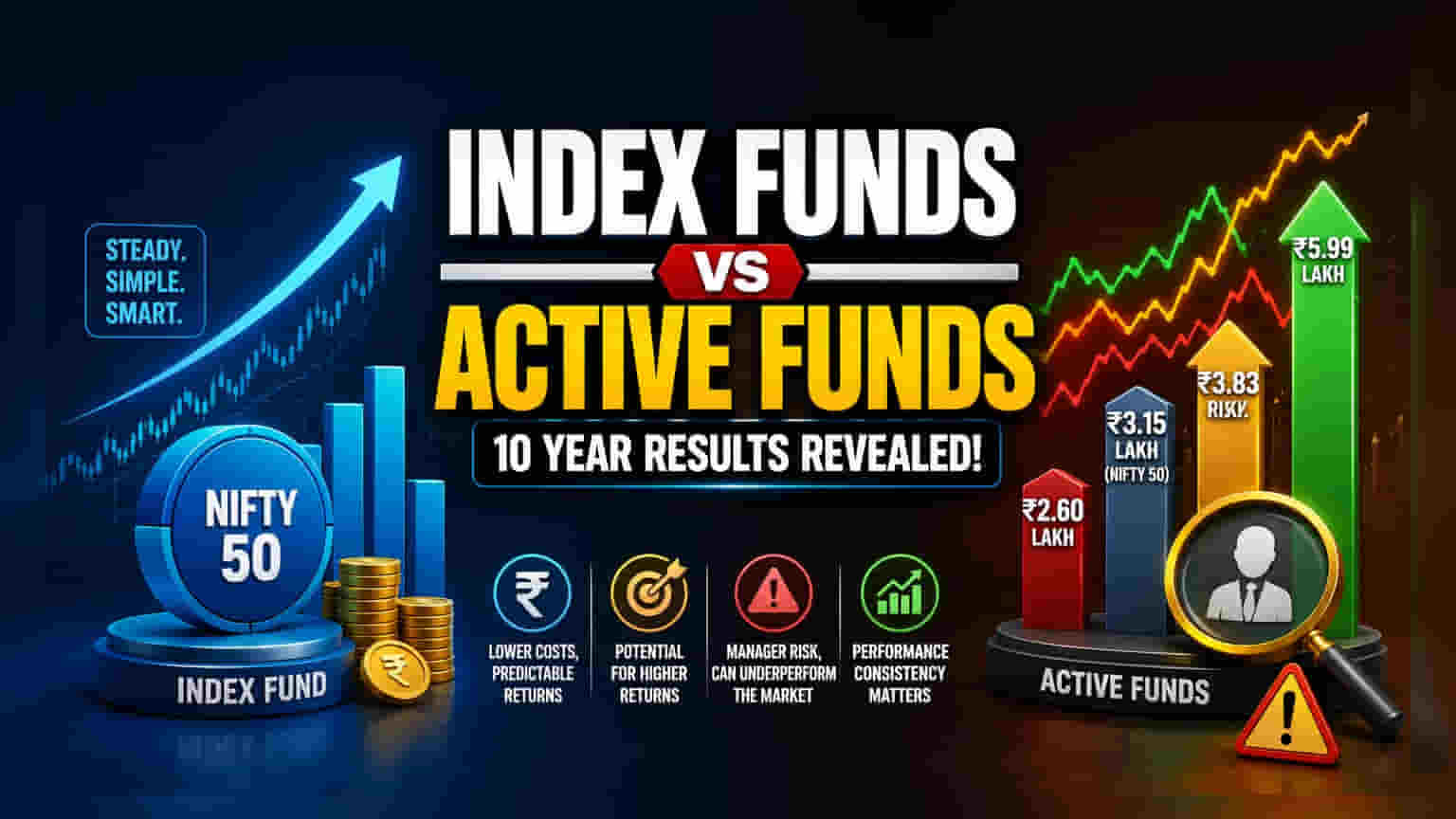
A Rs 1 lakh investment in a Nifty 50 index fund would have grown to Rs 3.15 lakh over the last decade. In contrast, active funds showed wide performance gaps, with some significantly beating the index while others lagged behind, underscoring the challenge of fund selection.
What The 10-Year Data Shows
When looking at a ten-year investment horizon, the difference between choosing a passive index fund and an actively managed fund becomes clear. A Rs 1 lakh investment in a Nifty 50 index fund, which simply tracks the top 50 companies in the index, would have grown to approximately Rs 3.15 lakh over the past decade.
In comparison, actively managed equity funds, where managers choose stocks to try and beat the market, produced a much wider range of outcomes. Some active large-cap funds grew to Rs 3.83 lakh, performing better than the index, while the weakest large-cap funds resulted in only Rs 2.60 lakh, trailing behind the Nifty 50.
The Index Fund Difference
Index funds are designed to mirror the performance of a specific market index, such as the Nifty 50. Because these funds do not rely on a manager to pick stocks or time the market, they are often cheaper to run. For investors, this means lower costs and a predictable outcome that matches the market's own movement. This simple, rule-based approach removes the risk that a specific manager might make poor investment decisions, but it also limits the possibility of generating returns that are significantly higher than the market index.
Understanding The Active Fund Range
Actively managed funds offer the potential for higher rewards because managers have the freedom to adjust sector exposure, move between large and small companies, and exit sectors they believe are overvalued. This strategy, however, introduces the risk of human error.
Flexi-cap funds, which have the most flexibility, showed the widest disparity in results. Over the same ten-year period, Rs 1 lakh invested in different flexi-cap funds could have grown to anywhere between Rs 2.53 lakh and an impressive Rs 5.99 lakh. This massive difference highlights that while the potential for outperformance exists, the success of the investment depends almost entirely on the manager’s ability to pick the right stocks.
How Investors May Read This
For investors, this data clarifies the trade-off between simplicity and the hunt for higher returns.
Those who prefer a straightforward path may find index funds useful as they avoid the stress of comparing fund managers or guessing which fund will perform well in the future. The lower cost structure of these funds is also a benefit that compounding helps over long periods.
Conversely, those who choose active management are effectively betting on the skill of the fund manager. When a manager performs well, the returns can be much higher than the market index. However, the data shows that this approach carries the real risk of underperforming the market, which can result in a lower final corpus compared to simply buying an index fund.
What Investors Should Track
When evaluating these options, investors may monitor two key areas: expense ratios and historical consistency.
For index funds, the focus is on the tracking error—how closely the fund follows the index—and the expense ratio. For active funds, investors may look at the fund's long-term performance consistency across different market cycles and whether the manager’s strategy aligns with their own risk appetite. As the data suggests, picking an active fund is not a guaranteed path to higher wealth, making the selection process critical to the final outcome.