

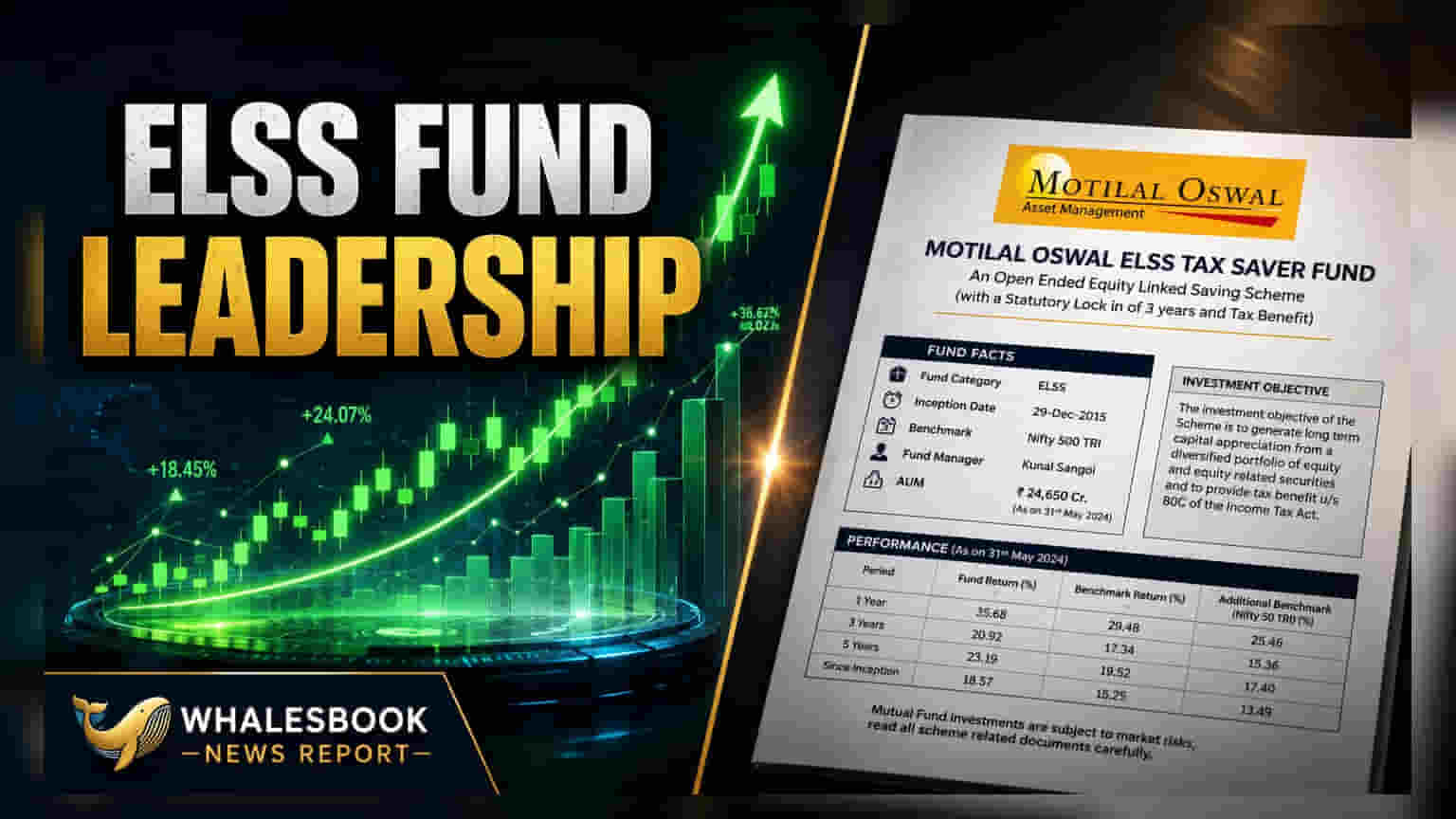
Motilal Oswal ELSS Tax Saver Fund has recorded a 19.5% return over the last three months, topping its category among funds with over ₹1,500 crore in assets. Investors often use these tax-saving schemes for both Section 80C benefits and equity market exposure, though performance can vary significantly across different time periods.
What Happened
Motilal Oswal ELSS Tax Saver Fund has emerged as the highest-performing scheme in the Equity-Linked Savings Scheme (ELSS) category based on returns over the past three months. According to data tracked as of July 2, 2026, the fund delivered a return of 19.5%. This ranking includes only those ELSS funds that manage at least ₹1,500 crore in assets under management. Other notable performers in this category include Quant ELSS Tax Saver Fund at 18.6% and Invesco India ELSS Tax Saver Fund at 15.8% for the same three-month period.
Performance Across Timeframes
While the recent three-month performance is noteworthy, mutual fund returns often shift depending on the time horizon. The Motilal Oswal fund also holds the lead in the six-month performance table with a 10.1% gain. However, the leadership changes when looking at one-year returns, where the Quant ELSS Tax Saver Fund has been reported as the leader with an 8.7% return. Over a three-year period, the Motilal Oswal fund has shown significant outperformance against its benchmark, exceeding it by 12.9 percentage points.
How Investors Read ELSS Performance
ELSS funds are unique because they combine tax planning with equity market investment. Under Section 80C of the Income Tax Act, investors can claim deductions on their investments in these funds, but they must commit to a mandatory three-year lock-in period. Because these funds invest primarily in stocks, their value fluctuates based on market conditions. A top-performing fund in a short period like three months does not guarantee similar results in the future, as equity markets are influenced by sector trends and broader economic changes.
Managing Expectations
Investors looking at fund rankings should consider that performance is often cyclical. A fund that leads in a short-term window might have a different strategy or sector allocation compared to peers that perform better over longer durations like five or ten years. When evaluating these funds, it is helpful to look beyond short-term percentage gains and assess a fund's consistency, the experience of the fund manager, and how it performs during market downturns versus market rallies. The expense ratio and the specific stocks held within the fund's portfolio are also vital factors that influence long-term wealth creation rather than just point-to-point returns.