 Whalesbook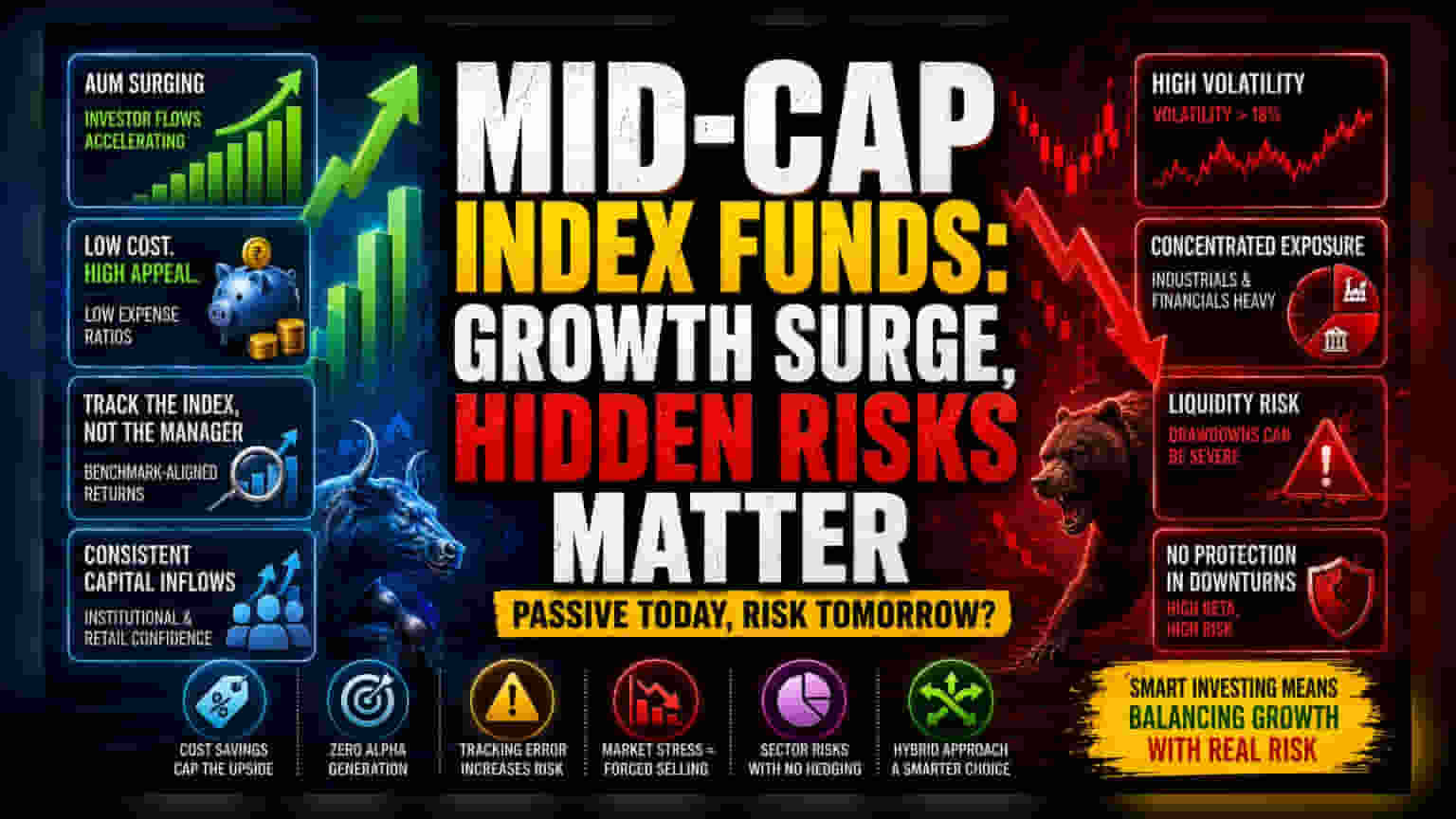


The Passive Growth Paradox
The narrative surrounding mid-cap index funds often centers on cost-efficiency, but the recent surge in assets under management suggests investors are increasingly prioritizing low expense ratios over the potential for alpha generation. Current AMFI data confirms a consistent appetite for these vehicles, with institutional and retail capital moving into Nifty Midcap 150 trackers at an accelerated pace. This transition signals a broader shift in behavior, where cost-conscious market participants are choosing to cap their upside in exchange for predictable, benchmark-aligned outcomes.
The Volatility Cost of Mid-Cap Tracking
Unlike large-cap index products, mid-cap index funds are structurally exposed to higher beta and wider standard deviations. The performance of funds managed by Motilal Oswal, Aditya Birla Sun Life, and Nippon India demonstrates that tracking the Nifty Midcap 150 necessitates accepting a significant volatility premium. While these funds report Sortino ratios hovering near 1.12, reflecting a disciplined attempt to mitigate downside risk, the inherent volatility remains above 18%. This exposes investors to severe drawdowns during market corrections, a factor that low expense ratios cannot mitigate. Furthermore, because these funds hold identical underlying assets—such as BSE, MCX, and various financial entities—there is zero product differentiation, leaving the investor exposed to concentrated sector risks in Industrials and Financials without any manager-led hedging capability.
The Forensic Bear Case
A critical structural weakness in the current mid-cap index boom is the illusion of safety provided by the 'passive' label. While institutional flows into these funds remain robust, the underlying holdings are increasingly subject to liquidity constraints common in mid-cap segments. If systemic market stress triggers institutional redemptions, these funds will be forced to sell shares in lower-liquidity mid-cap companies, potentially worsening the downward price movement. Additionally, management teams face a perpetual challenge in minimizing tracking error, especially when volatile market conditions cause constituent stocks to deviate from index weights. Investors should remain wary of the assumption that passive strategy equals defensive positioning; in reality, mid-cap index funds function as high-beta proxies that offer no protection during cyclical downturns.
Forward Expectations
Market consensus suggests that while index funds serve as functional building blocks for beginners, they lack the agility required to navigate a shifting macro environment. As liquidity dries up in certain mid-cap sectors, the reliance on passive replication may yield diminished returns compared to the previous five-year cycle. Industry analysts are increasingly pivoting toward a hybrid model, suggesting that participants maintain core positions in index products while utilizing actively managed equity funds to manage sector-specific risks more dynamically.