 Whalesbook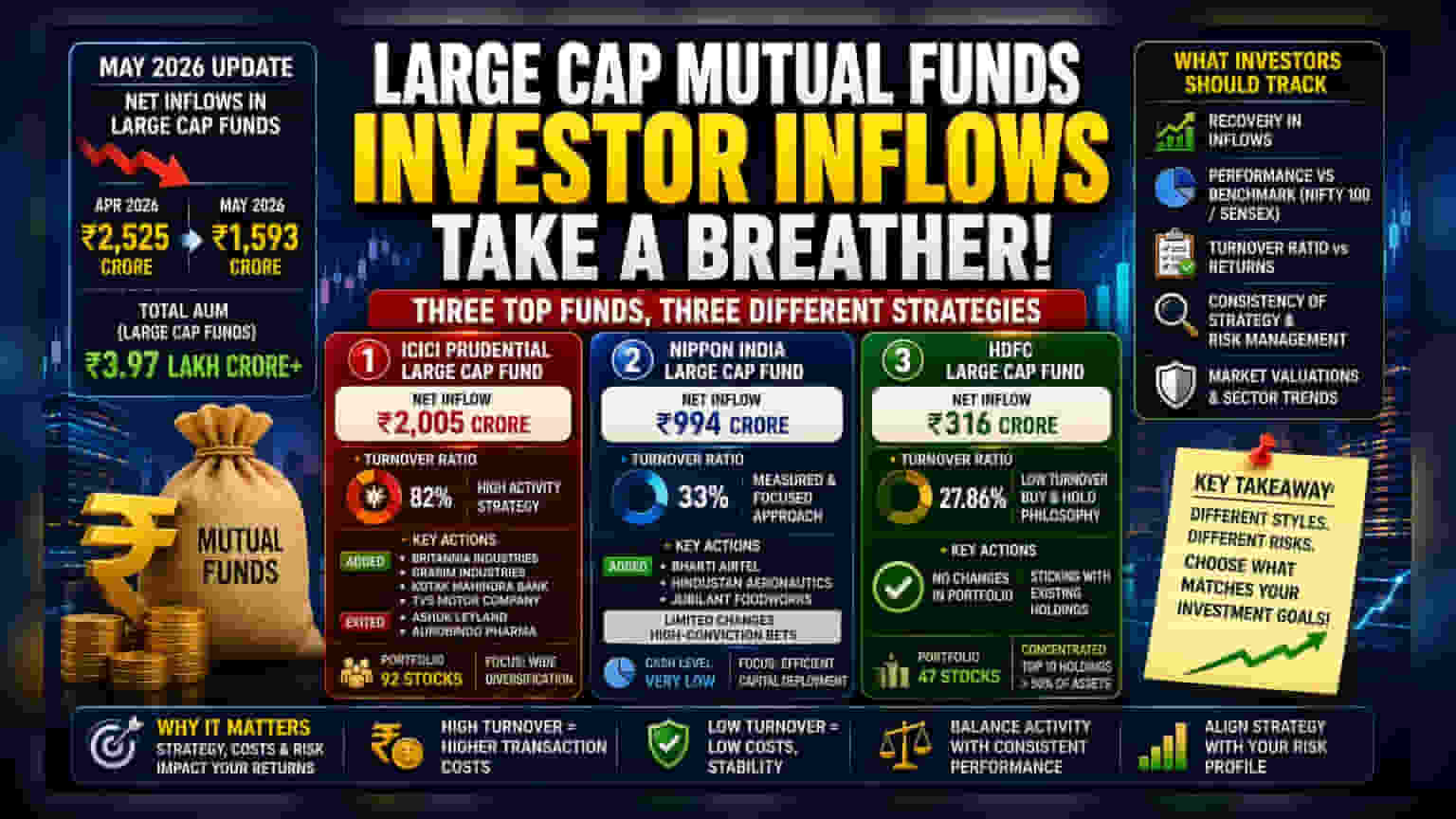


Investor interest in large-cap mutual funds slowed in May, with net inflows falling to ₹1,593 crore from ₹2,525 crore in April. As growth cools, fund managers are taking different paths, with some aggressively reshuffling portfolios while others prefer a 'buy-and-hold' strategy. Understanding these varying approaches is essential for investors looking at the risk and potential cost impact of their fund choices.
What Happened
May 2026 saw a notable shift in investor behavior regarding large-cap mutual funds. Net inflows into this category dropped to ₹1,593 crore, a significant decrease from the ₹2,525 crore recorded in April. Despite this cooling trend, the total assets under management for this segment remains substantial, exceeding ₹3.97 lakh crore. While the overall category saw a dip in new money, different fund managers responded in very distinct ways, showcasing a clear divide in how they navigate market conditions.
Comparing Three Distinct Management Styles
The strategies adopted by top funds reveal much about their view of the current market. The ICICI Prudential Large Cap Fund emerged as the largest recipient of new inflows, securing ₹2,005 crore. This fund’s management opted for high activity, with a turnover ratio of 82%. This means the fund frequently bought and sold stocks, adding names like Britannia Industries, Grasim Industries, Kotak Mahindra Bank, and TVS Motor Company while exiting others like Ashok Leyland and Aurobindo Pharma. With 92 stocks in its portfolio, this approach prioritizes wide diversification.
In contrast, the Nippon India Large Cap Fund took a more measured path. It attracted ₹994 crore in new inflows and kept its portfolio changes limited. By adding only a few specific bets like Bharti Airtel, Hindustan Aeronautics, and Jubilant FoodWorks, the fund focused on deploying capital into high-conviction areas without churning its entire portfolio. Its turnover ratio stood at 33%, and it kept very little cash, indicating that most of the incoming money was put straight into the market.
The HDFC Large Cap Fund followed the most conservative path among the three. Receiving ₹316 crore in inflows, the fund made no changes to its existing portfolio, sticking with 47 stocks. With a turnover ratio of just 27.86%, this strategy reflects a clear buy-and-hold philosophy. This fund is also more concentrated, with its top 10 holdings accounting for more than half of its total assets, meaning its performance is heavily tied to the success of these few top companies.
Understanding Portfolio Costs and Risks
For an investor, the turnover ratio is a key detail to watch. When a fund manager buys and sells stocks very frequently, as seen with the higher turnover in the ICICI Prudential fund, it can lead to higher transaction costs. These costs are ultimately borne by the fund, which can slightly impact the final returns over time. However, active reshuffling can also be a sign that the manager is quickly adapting to new information or changing market trends to protect or grow the portfolio.
On the other hand, a low turnover ratio, such as that seen in the HDFC fund, suggests that the manager believes in the long-term potential of the existing holdings. This approach usually incurs lower transaction costs. However, the risk here is that the fund may be slower to react if the prospects of those specific holdings change significantly. Investors looking for stability might prefer this approach, while those seeking active management to beat market volatility might favor funds that trade more frequently.
What Investors Should Track Next
The most important monitorable for investors is whether these inflow numbers recover in the coming months. A sustained drop could signal that investors are becoming more cautious about large-cap valuations or are rotating their money toward mid-cap or small-cap funds, which often offer higher growth potential but carry more risk. Investors should also pay attention to the fund’s quarterly performance relative to its benchmark, such as the Nifty 100 or Sensex. If a fund with a high turnover ratio consistently underperforms a fund with a low turnover ratio after accounting for costs, it may be worth reviewing whether the manager’s active trading strategy is delivering the expected results.