

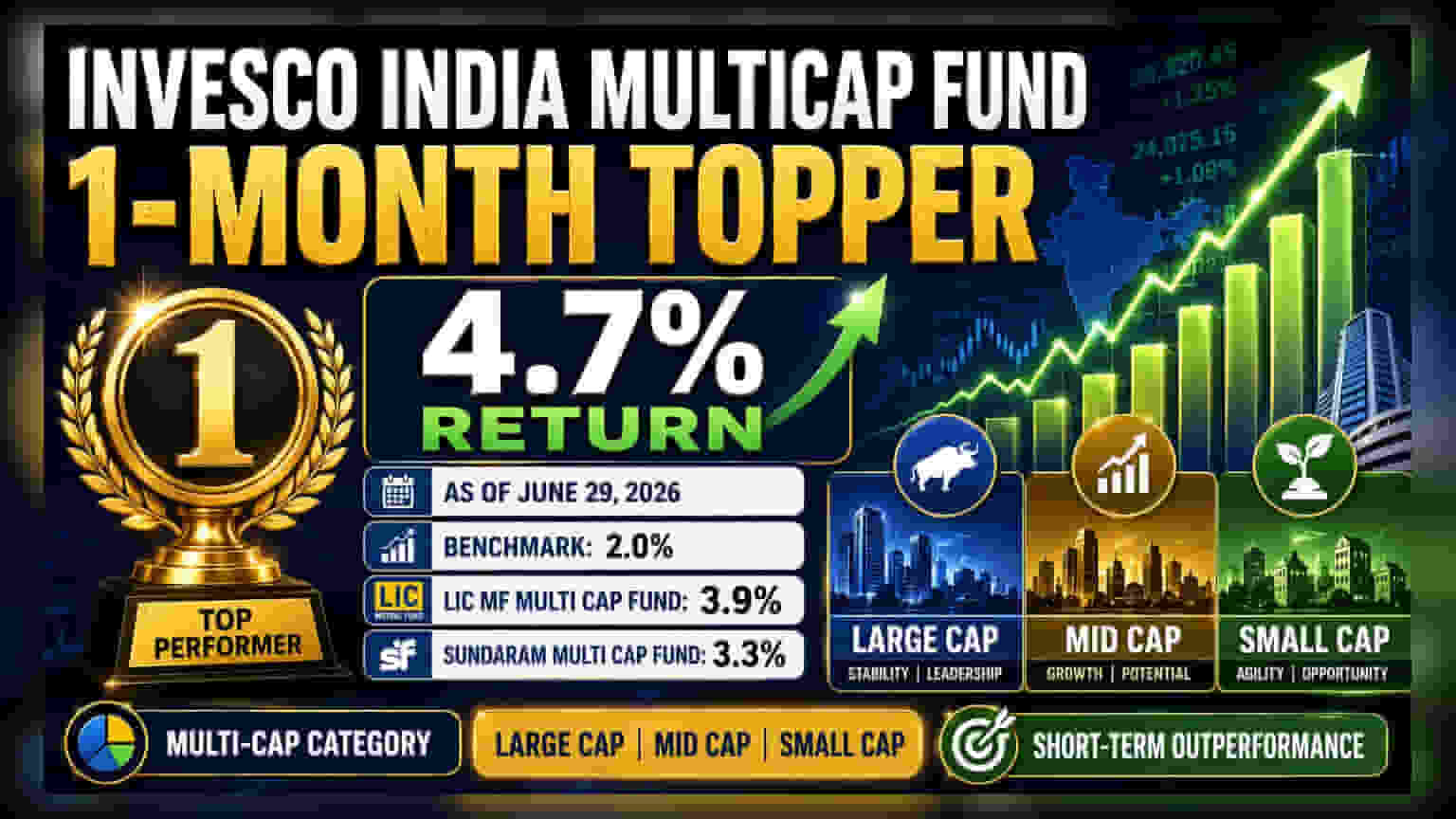
Invesco India Multicap Fund outperformed in the multi-cap category with a 4.7% return in June 2026, while LIC MF and Sundaram followed. Investors often notice that performance rankings change significantly depending on whether one looks at one-month, six-month, or three-year windows. Understanding the mandate to invest across large, mid, and small-cap stocks is essential for interpreting these performance fluctuations.
What Happened
Invesco India Multicap Fund recorded the highest return among multi-cap mutual funds for the one-month period ending June 29, 2026, delivering a gain of 4.7%. This performance placed it ahead of its peers, with LIC MF Multi Cap Fund and Sundaram Multi Cap Fund registering returns of 3.9% and 3.3%, respectively. These figures track funds that manage at least Rs 1,500 crore in assets under management. Over the same one-month period, the category benchmark returned 2.0%, highlighting the fund's short-term outperformance.
Why Rankings Shift Across Timeframes
It is common to see different funds leading the pack when the timeframe changes. While Invesco India Multicap Fund topped the list for the one-month window, other funds have demonstrated strength over longer periods. For example, data shows that LIC MF Multi Cap Fund led the rankings over the six-month and one-year periods, with returns of 4.3% and 4.6%, respectively. Looking at a longer three-year horizon, HSBC Multi Cap Fund emerged as a leader with a 20.2% return. These variances reflect the different internal allocations of each fund manager and how their specific portfolio picks behave during different market cycles.
Understanding the Multi-Cap Strategy
Multi-cap funds operate under a strict regulatory mandate in India. These funds are required to invest a minimum of 25% of their corpus in each of the three market capitalizations: large-cap, mid-cap, and small-cap stocks. This structure is designed to provide balanced exposure, but it also means that a fund’s performance is heavily influenced by which specific stocks a manager selects within those three categories. A fund that is overweight on mid-caps might outperform when the mid-cap segment rallies, while a fund with higher large-cap exposure might provide more stability during market downturns. This explains why rankings can fluctuate as market sentiment shifts between different company sizes.
Importance of Fund Size
For investors, the size of the fund, known as Assets Under Management (AUM), is a point of consideration. Among the top-performing funds, Axis Multicap Fund managed a corpus of Rs 9,937.6 crore, making it one of the larger schemes in this space. While a larger AUM can provide stability and liquidity, it can sometimes become challenging for fund managers to deploy capital as nimbly as they would in a smaller fund, particularly in the small-cap segment.
What Investors Should Track
When looking at these rankings, investors should remember that past performance is not a guarantee of future returns. Instead of chasing short-term leaders, it is helpful to look at the consistency of a fund over three to five years. Key factors to track include the expense ratio, which affects net returns, and the fund's portfolio turnover, which shows how frequently the manager buys and sells stocks. Checking the portfolio overlap between the fund and the benchmark can also help investors understand how much "active" management they are paying for, rather than simply tracking the broader market.