 Whalesbook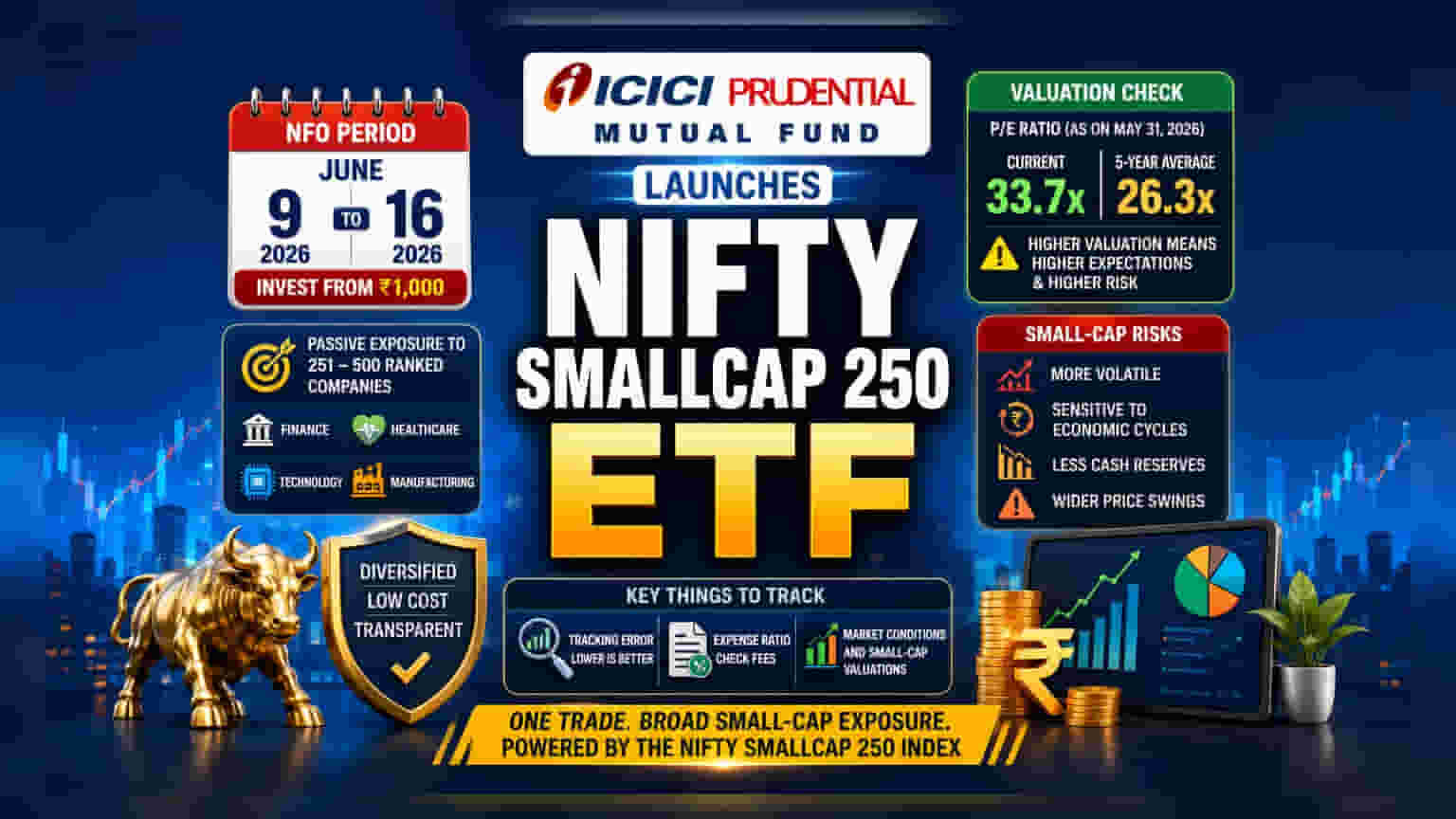


ICICI Prudential Mutual Fund has introduced a new Exchange Traded Fund (ETF) that tracks the Nifty Smallcap 250 Index. Open for subscription until June 16, the fund offers exposure to smaller Indian companies. While this segment has historically shown significant growth, investors should weigh the benefits of passive investing against the higher volatility and current valuations typical of small-cap stocks.
What Happened
ICICI Prudential Mutual Fund has launched the ICICI Prudential Nifty Smallcap 250 ETF. This is an exchange-traded fund, which means it is designed to mimic the performance of the Nifty Smallcap 250 Index rather than having a fund manager actively pick stocks. The New Fund Offering (NFO) opened on June 9, 2026, and will remain open for investors until June 16, 2026. After this period, the units of the ETF will be listed and traded on stock exchanges like regular shares. The minimum investment amount to participate in the NFO is ₹1,000.
Why This Matters For Investors
This ETF provides a low-cost, passive way to gain exposure to companies ranked from 251 to 500 by market capitalization in India. Unlike actively managed funds where a manager makes decisions, an ETF simply holds the same stocks as the index it tracks. For investors who believe in the growth potential of smaller companies but prefer a passive strategy, this structure offers a transparent and generally cheaper way to invest. The index covers a wide range of sectors including finance, healthcare, technology, and manufacturing, providing a basket of smaller stocks in one trade.
The Valuation Picture
When considering small-cap investments, valuation is a key monitorable. According to data as of May 31, 2026, the Nifty Smallcap 250 Index is trading at a price-to-earnings (P/E) ratio of 33.7 times. This is higher than its five-year average of 26.3 times. A higher P/E ratio suggests that investors are paying more for every rupee of earnings compared to the historical average. While this can reflect optimism about future growth, it also means there is less margin for error; if company earnings do not meet these high expectations, the stock prices can be more sensitive to corrections.
Understanding Small-Cap Risks
While the small-cap segment has seen significant growth in recent years, it is essential to understand the risks involved. Small companies are generally more sensitive to economic cycles than large, established businesses. They often have less cash reserves and can be more affected by rising costs or falling demand. Consequently, this segment tends to be more volatile, meaning prices can rise and fall more sharply than those of larger companies. Investors should be prepared for these wider price swings compared to large-cap or broad-market investments.
How Investors May Read This
Before investing, it is helpful to look beyond the launch excitement. Investors should consider how this ETF fits into their overall portfolio. If a portfolio is already heavily exposed to small-cap stocks, adding more may increase the risk of the entire portfolio. Furthermore, because ETFs trade on the exchange, liquidity is important. Investors should check the trading volume on the exchange after listing to ensure they can easily buy or sell their units without significant price impact.
What Investors Should Track
As the NFO progresses and the ETF eventually lists, there are a few important points to monitor. First, check the 'tracking error,' which measures how closely the fund’s performance matches the actual index. A good ETF has a low tracking error. Second, look at the expense ratio once it is disclosed, as this determines how much of the investment return is eaten up by fees. Finally, monitor the broader market conditions and the valuation of the small-cap index over time, as these will directly influence the returns of this passive fund.