

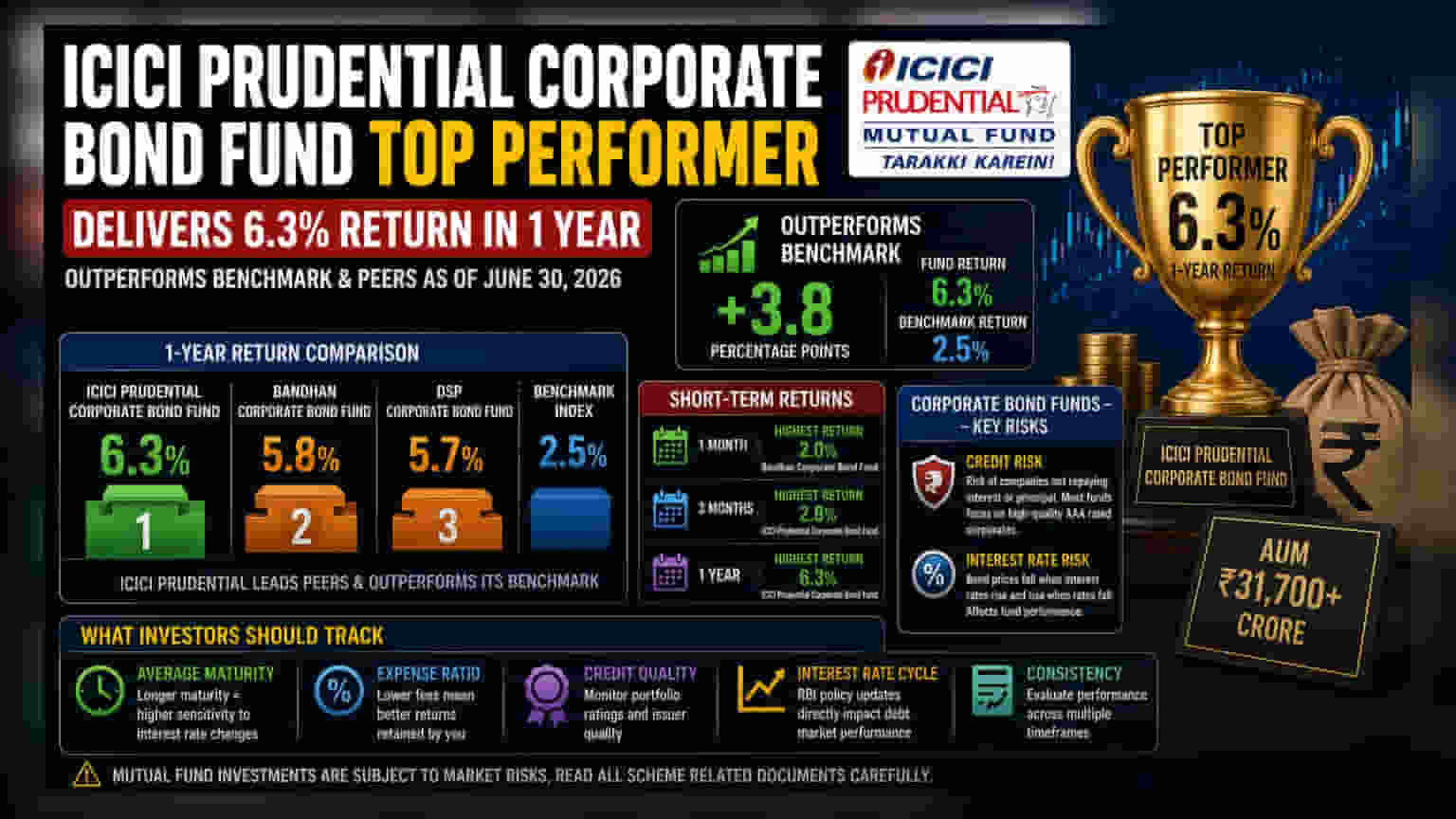
ICICI Prudential Corporate Bond Fund has delivered a 6.3% one-year return, outperforming its category peers. Managing assets of over Rs 31,700 crore, the fund beat its benchmark by a significant margin. This report looks at how it stacks up against competitors like Bandhan and DSP, and why tracking interest rate cycles remains vital for bond fund investors.
What Happened
ICICI Prudential Corporate Bond Fund has emerged as the top performer among its peer group, delivering a 6.3% one-year return. This performance highlights the fund's recent activity in the debt market, where it managed to outpace both its benchmark index and major competitors. As of June 30, 2026, the fund holds an asset base of over Rs 31,700 crore, making it one of the largest in this category for funds with comparable minimum asset sizes.
The Performance Gap
The fund’s return is notable for its lead over its benchmark index. According to performance data, the fund outperformed its benchmark by 3.8 percentage points, as the benchmark index itself returned 2.5% during the same one-year period. This difference indicates that the fund's management strategy—likely involving the selection of specific corporate debt papers—successfully added value compared to the broader market index.
Peer Comparison
When looking at the broader corporate bond fund segment, ICICI Prudential has maintained a competitive edge over the past year. Bandhan Corporate Bond Fund followed with a 5.8% return, while DSP Corporate Bond Fund posted a return of 5.7%.
It is important for investors to note that leadership can change depending on the timeframe. While ICICI Prudential held the top spot for the one-year period and the three-month window (with a 2.8% gain), different funds often take the lead over shorter terms. For instance, Bandhan Corporate Bond Fund recorded higher returns during the most recent one-month period, delivering 2.0%. This variation suggests that short-term performance numbers can fluctuate frequently.
Understanding Debt Fund Risks
Corporate bond funds are essentially collections of debt instruments, such as bonds and debentures, issued by companies. While they often aim to provide stability and income, they are not risk-free. The main factors affecting these funds are credit risk and interest rate risk.
Credit risk refers to the possibility that the companies issuing the bonds may struggle to pay back the interest or principal. Most corporate bond funds, including the ones mentioned, typically focus on high-quality, 'AAA' rated companies to lower this risk. Interest rate risk is the sensitivity of the fund to changes in central bank interest rates. When interest rates rise, bond prices generally fall, which can put pressure on the fund's performance. Conversely, when rates are expected to fall, bond prices may rise, supporting returns.
What Investors Should Track
Investors evaluating these funds should look beyond just the past year's returns. Key monitorables include the fund's average maturity, which tells you how sensitive the fund is to interest rate changes. A longer average maturity means the fund is more sensitive to interest rate swings. Additionally, monitoring the expense ratio—the fee charged to manage the fund—can provide clarity on how much of the returns are kept by the investor versus the fund house. Finally, keeping an eye on the broader interest rate cycle and policy updates from the Reserve Bank of India is essential for understanding the future environment for debt investments.