

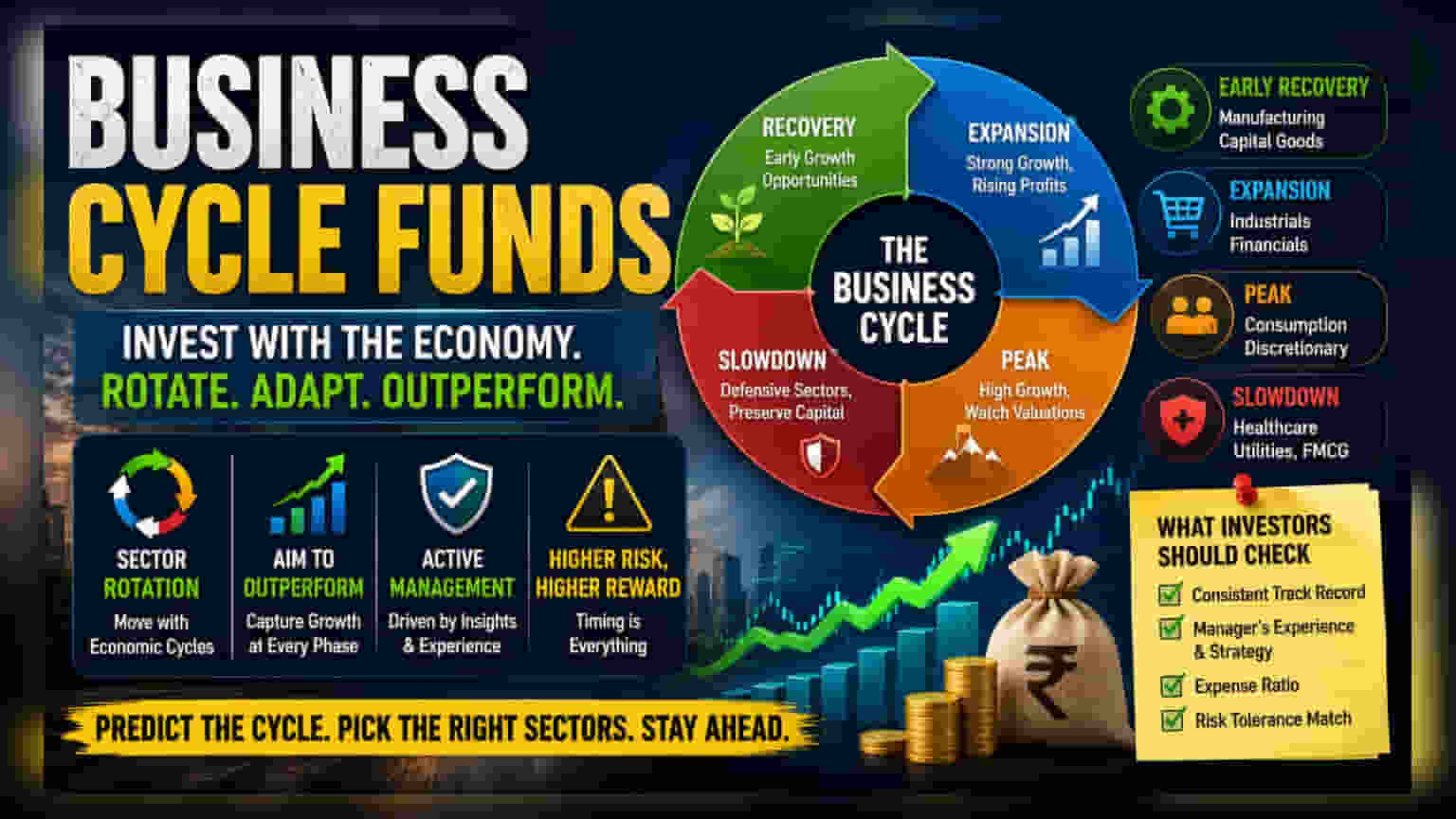
Business cycle mutual funds dynamically shift investments across different industries based on the state of the economy. Unlike fixed sector funds, they rely on active management to time market movements. This strategy aims to capture growth by rotating into sectors that are performing well, but it carries risks related to the fund manager's ability to predict economic shifts accurately.
What Are Business Cycle Funds
Business cycle funds are a specific type of equity mutual fund that adjusts its portfolio based on the current stage of the economy. Instead of sticking to one industry or a fixed investment style, these funds try to predict which sectors will perform best during different economic phases. For example, during an early economic recovery, the fund manager might increase exposure to sectors like manufacturing or capital goods, while moving toward consumption-driven stocks when consumer demand is strong.
These funds are classified under the 'Thematic' category by the Securities and Exchange Board of India (SEBI). This is a crucial distinction for investors, as thematic funds typically carry higher risks than diversified equity schemes because they rely on specific market trends rather than a broad, static approach.
The Strategy of Sector Rotation
The core idea behind these funds is 'sector rotation.' The fund manager monitors economic data, interest rate changes, government policies, and company earnings to decide where to invest. The theory is that market leadership is not permanent; different industries take the lead as the economy moves through expansion, peak, slowdown, and recovery phases.
By actively moving capital into the sectors expected to benefit next, these funds aim to generate returns that beat the broader market. However, this relies entirely on the fund manager's ability to time these shifts correctly. If the manager misjudges the economic cycle or moves into a sector too late, the fund's returns can suffer significantly.
Why Performance Varies
Performance in this category can be very different from one fund to another. Because these funds are actively managed, the experience and track record of the fund management team are vital. For instance, the Mahindra Manulife Business Cycle Fund has been noted for consistent performance in certain time periods, but such records depend on the manager's successful execution of sector rotation strategies at that specific time.
Investors will find various offerings in this space from major asset management companies like Kotak, Aditya Birla Sun Life, and Axis Mutual Fund. Each fund may have a different interpretation of the economic cycle, leading to varied portfolio compositions.
Risks and Investor Monitorables
The biggest risk for investors is the 'timing risk.' If the economy does not move as the manager predicted, or if the sectors selected do not perform as expected, the fund could face poor returns. Unlike index funds that simply track the market, business cycle funds have no guarantee of success.
Investors should also consider the cost factor. These funds are actively managed, which often leads to higher expense ratios compared to passive index funds or exchange-traded funds (ETFs). Before investing, it is important to check the fund's past performance consistency, the manager’s approach to sector selection, and whether the fund's investment style matches one's personal risk tolerance. Since these are thematic funds, they are generally not suitable for conservative investors looking for stable, long-term equity exposure.