

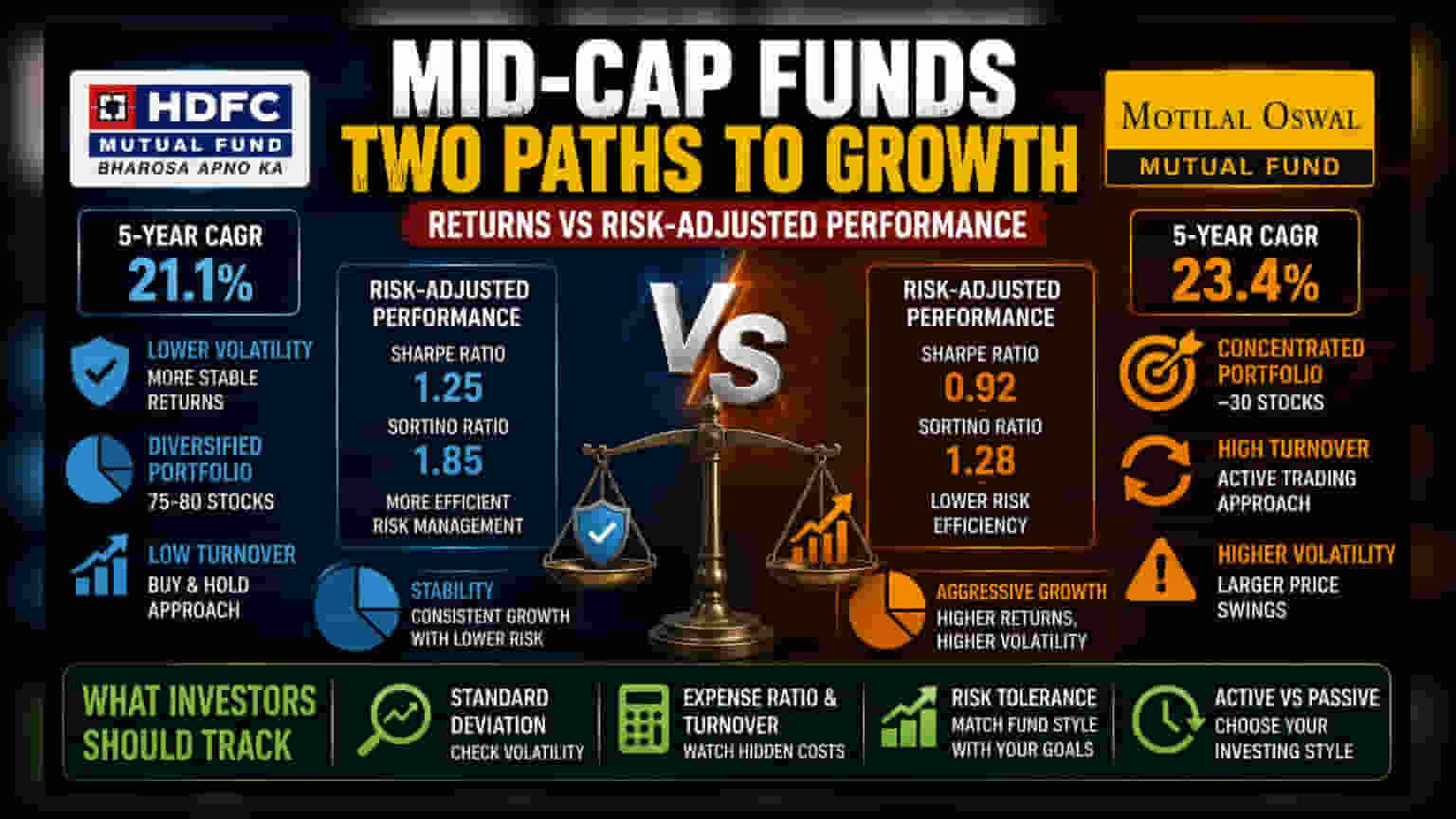
A recent analysis of two popular mid-cap funds shows that while Motilal Oswal Mid Cap Fund achieved higher raw returns, HDFC Mid Cap Fund delivered superior risk-adjusted performance. This highlights the trade-off between aggressive, concentrated strategies and more stable, diversified ones. Investors should understand their personal comfort with market swings before choosing between these different management styles.
What Happened
Recent performance analysis comparing the HDFC Mid Cap Fund and the Motilal Oswal Mid Cap Fund reveals two distinct approaches to investing in mid-sized companies. While both funds have outperformed their category averages, they have done so through very different methods. Motilal Oswal’s fund delivered higher historical returns, with a five-year CAGR of 23.4%. Meanwhile, the HDFC Mid Cap Fund trailed slightly with a 21.1% CAGR. However, when looking at risk-adjusted returns—how much growth a fund provides for every unit of risk taken—the HDFC Mid Cap Fund demonstrated more stability.
Understanding the Risk-Return Trade-Off
For investors, raw returns are only half the story. A fund that generates high profits but also experiences extreme price swings (volatility) may not be suitable for everyone. This is where metrics like the Sharpe and Sortino ratios become important. These numbers measure how efficiently a fund manager generates returns relative to the risk taken. The HDFC Mid Cap Fund showed lower volatility, meaning its share price was less likely to experience sharp, sudden drops compared to the Motilal Oswal Mid Cap Fund. This consistency allowed it to achieve higher risk-adjusted scores, signaling that its growth was generated with more predictable performance.
Portfolio Strategy: Concentrated vs. Diversified
The difference in performance stems largely from the funds' underlying strategies. The Motilal Oswal Mid Cap Fund uses a concentrated approach, holding only about 30 stocks. This means the fund relies heavily on the success of a few key bets. When these companies perform well, the fund sees significant growth. Additionally, the fund maintains high portfolio turnover, meaning the manager buys and sells stocks frequently to capture short-term gains. While this can lead to higher growth in favorable markets, it also exposes investors to more volatility and higher transaction costs.
In contrast, the HDFC Mid Cap Fund opts for a broader, diversified portfolio, typically holding 75 to 80 stocks. By spreading investments across more companies, the fund reduces the impact of any single stock failing. It also follows a low-turnover, "buy-and-hold" strategy, meaning the fund manager rarely trades, which helps keep transaction costs down and focuses on long-term value rather than short-term price movements.
How Investors May Read This
Investors should not view one fund as objectively "better" than the other; rather, the choice depends on personal financial goals and risk tolerance. An investor aiming for aggressive growth, who can stomach large price swings and believes in concentrated bets, might lean toward the Motilal Oswal style. Conversely, an investor who prioritizes long-term consistency and wants to avoid the stress of high volatility might prefer the HDFC Mid Cap Fund's approach.
What Investors Should Track
When evaluating these or any mid-cap funds, investors should look beyond just the 5-year return chart. Monitor the "standard deviation" of the fund, which reflects how much the price fluctuates over time. Also, keep an eye on the expense ratio and portfolio turnover; high turnover can act as a hidden cost that reduces your actual returns. Finally, consider whether you prefer a fund manager who actively trades to time the market or one who holds stocks for the long term through different economic cycles.