

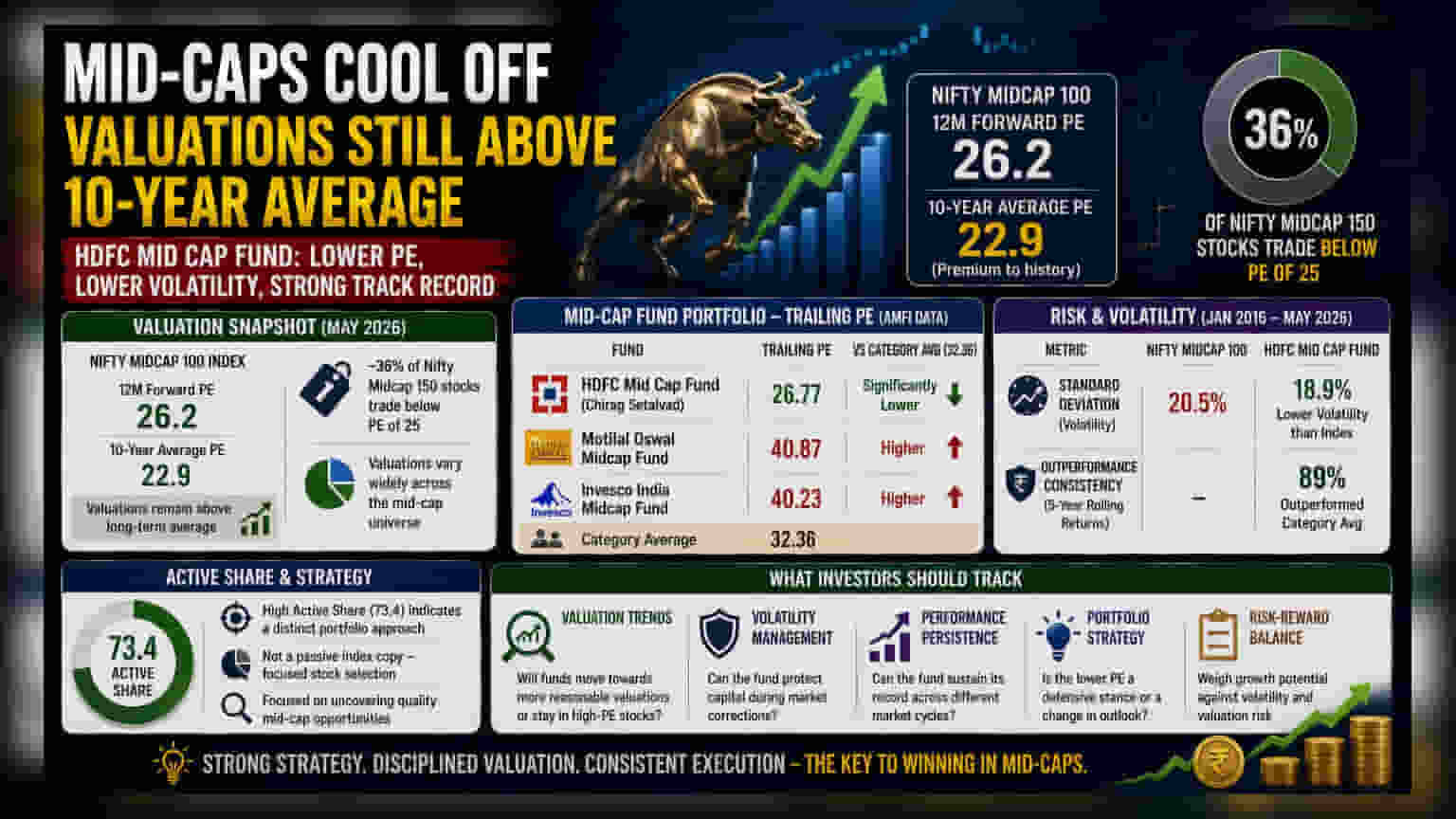
Mid-cap stocks are seeing valuations cool off after recent highs, with the Nifty Midcap 100 trading at a forward PE of 26.2. Amid this, the HDFC Mid Cap Fund has maintained a lower portfolio valuation and reduced volatility compared to its peers. This data highlights how different fund managers are navigating current market levels with varying approaches to risk and value.
What Happened
After a strong rally in 2022 and 2023, the mid-cap stock segment is experiencing a moderation in valuations. As of May 2026, the Nifty Midcap 100 Index is trading at a 12-month forward price-to-earnings (PE) ratio of 26.2. While this is lower than recent peaks, it remains above the 10-year average of 22.9, suggesting that investors are still paying a premium for these stocks compared to historical norms. Despite this, there is variance in the market, with approximately 36% of stocks within the Nifty Midcap 150 Index currently trading below a PE multiple of 25.
The Valuation Picture
Data from the Association of Mutual Funds in India (AMFI) highlights distinct differences in how various funds are positioned. The HDFC Mid Cap Fund, managed by Chirag Setalvad, reported a portfolio trailing PE of 26.77. This is notably lower than the category average of 32.36.
This gap indicates that different funds have different strategies. For instance, while some funds are currently holding portfolios with higher PE ratios—such as the Motilal Oswal Midcap Fund and Invesco India Midcap Fund, which reported PE ratios exceeding 40—others are more cautious regarding valuation. Investors should understand that a lower PE does not necessarily mean a fund is 'better'; rather, it shows a preference for stocks that may be cheaper or considered more 'value-oriented' versus those that are priced for very rapid growth.
Risk And Volatility Management
Mid-cap stocks are naturally more volatile than large-cap stocks. Between January 2016 and May 2026, the benchmark mid-cap index showed a standard deviation of 20.5%, which is a measure of how much the returns swing over time. A higher percentage means more instability.
The HDFC Mid Cap Fund recorded a lower standard deviation of 18.9% during this period. This suggests that the fund's strategy has historically resulted in smoother performance compared to the broader index. The fund has also shown a consistent ability to outperform the category average in approximately 89% of its five-year rolling return observations, which is a key metric for long-term investors.
Why Active Share Matters
The fund also reported an active share of 73.4. Active share is a simple percentage that shows how different a fund's portfolio is from its benchmark index. A score of 0 would mean the fund is identical to the index, while 100 would mean it holds no stocks in common with the index. A score of 73.4 suggests that the fund manager is taking a distinct approach, selecting stocks that are significantly different from the index composition, rather than just trying to mirror the benchmark.
What Investors Should Track
As mid-cap valuations remain elevated above historical averages, the focus for investors shifts to how these funds manage risk.
Investors may monitor these factors:
- Valuation Trends: Whether funds continue to hold high-PE stocks or shift toward more reasonably valued companies as market conditions change.
- Volatility Management: How funds handle potential market corrections, given that mid-caps are prone to sharper drops than large-caps.
- Performance Persistence: Whether a fund can maintain its long-term record of managing risk effectively in different market cycles.
- Portfolio Strategy: Understanding if a fund’s lower PE is a result of a defensive strategy or a change in the manager's outlook on the mid-cap sector.