

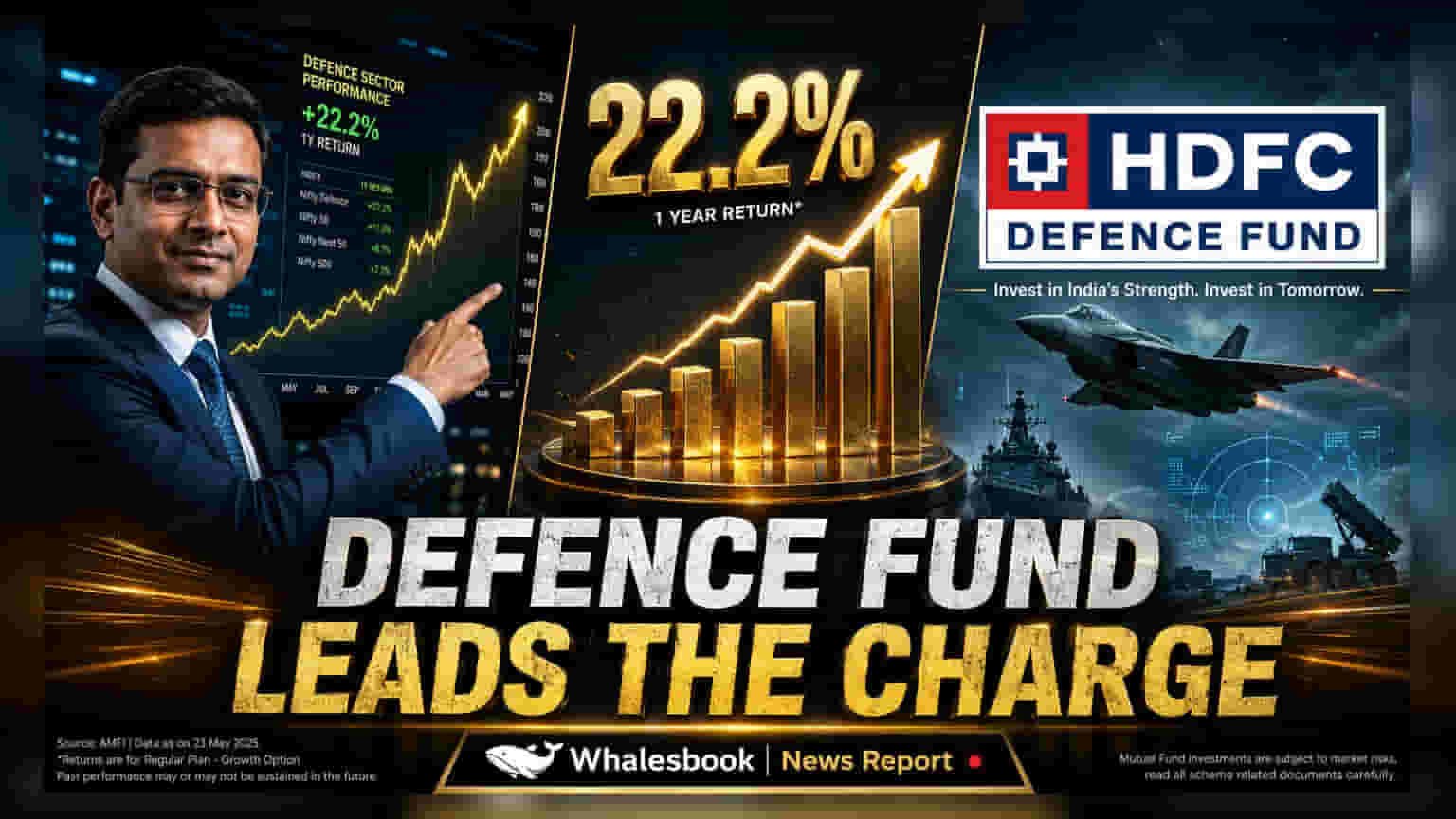
HDFC Defence Fund has delivered a 22.2% return over the last six months, outpacing peers like Kotak Pioneer and ICICI Pru Manufacturing. With assets totaling Rs 9,724 crore, the fund has demonstrated significant outperformance against its benchmark index.
The HDFC Defence Fund has maintained a strong performance trajectory within the thematic mutual fund category, recording a 22.2% return over the six-month period ending July 7, 2026. This performance places it at the forefront of its peer group, surpassing competitors such as the Kotak Pioneer Fund and the ICICI Pru Manufacturing Fund, which reported returns of 7.6% and 5.8% respectively during the same timeframe.
Fund Scale and Long-Term Performance
With assets under management (AUM) reaching Rs 9,724.3 crore, HDFC Defence Fund currently ranks as the largest thematic fund in its segment among those with an AUM exceeding Rs 1,500 crore. Beyond the recent six-month gain, the fund has shown consistent performance over longer periods. Data indicates that it has outperformed its benchmark index by 18.2 percentage points over the last year and 32.7 percentage points over the past three years. The fund's three-year compounded annual growth rate (CAGR) is reported at 42.0%, reflecting a period of sustained growth for the underlying companies in its portfolio.
Understanding Thematic Fund Volatility
While these returns highlight strong recent performance, investors should note that thematic funds carry specific risks that differ from diversified equity schemes. Because these funds concentrate investments in a single sector—in this case, defence—their performance is highly sensitive to sector-specific developments. These include government spending cycles, domestic manufacturing policy changes, export orders, and the execution capabilities of defence-related companies.
Historically, thematic funds tend to be more volatile than broad-market funds. Periods of outperformance are often driven by positive sector sentiment or specific policy support, such as indigenization mandates. Conversely, if sector growth slows or valuation levels in the defence space become stretched, the fund may face steeper corrections than the broader market index. Investors typically look at whether the fund manager's stock selection—often focused on companies benefiting from higher capital allocation in defence infrastructure—can sustain returns if the sector's growth momentum adjusts. The primary monitorables for shareholders moving forward will be the continuity of government defence procurement orders, the profit margins of the companies held within the portfolio, and how the fund manages volatility during sector-wide pricing or demand fluctuations.