

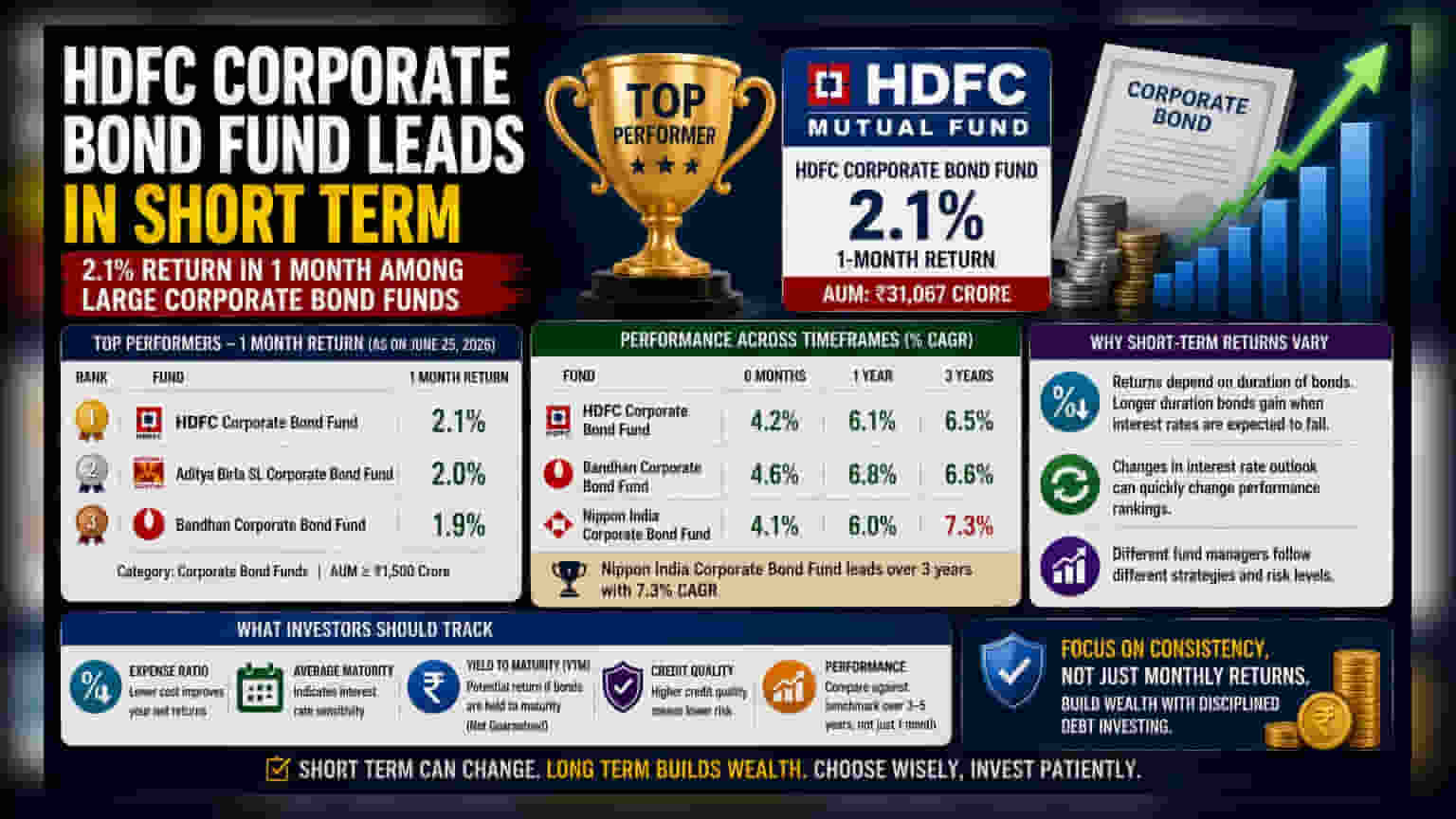
HDFC Corporate Bond Fund has outperformed its category peers with a 2.1% return over the past month. With Rs 31,067 crore in assets, it is one of the largest funds in the space. Investors should note that short-term performance often differs from long-term trends, as different fund managers use varied interest rate strategies.
What Happened
HDFC Corporate Bond Fund recently emerged as the top performer among large-scale corporate bond mutual funds, recording a 2.1% return over the past month. This fund, which manages assets worth Rs 31,067 crore, is one of the largest in its category, specifically among those managing over Rs 1,500 crore.
For context, other prominent funds in this segment, such as Aditya Birla SL Corporate Bond Fund and Bandhan Corporate Bond Fund, delivered returns of 2.0% and 1.9%, respectively, during the same one-month period. While the HDFC fund performed well in the short term, it is important for investors to understand that these rankings can fluctuate based on the time horizon being analyzed.
Why Short-Term Returns Vary
Corporate bond funds invest primarily in high-quality debt instruments issued by companies. Their returns are heavily influenced by the 'duration' of the bonds they hold. Simply put, if a fund manager holds bonds that mature in a longer time, the fund’s value can be more sensitive to changes in interest rates.
If the market expects interest rates to fall, funds holding longer-duration bonds tend to see their prices rise, boosting short-term returns. Conversely, if interest rate expectations shift, the performance rankings among funds can change quickly. This is why a fund that leads in a one-month window may not be the same fund that leads over one or three years.
The Long-Term Performance Picture
Performance leaders in the debt mutual fund space often change when looking at extended timelines. For example, while the HDFC Corporate Bond Fund showed strong one-month growth, data over longer periods tells a different story. The Bandhan Corporate Bond Fund, for instance, showed higher returns over a six-month and one-year horizon compared to others in this segment.
Furthermore, when looking at a three-year period, the Nippon India Corporate Bond Fund demonstrated strong performance with a 7.3% compound annual growth rate. This variation highlights a fundamental rule for bond fund investors: short-term spikes in performance do not guarantee consistent long-term success. Different managers follow different strategies—some may prefer higher credit quality with lower risk, while others may take on more duration risk to chase higher returns.
What Investors Should Track
When evaluating a corporate bond fund, investors may look beyond monthly return snapshots. Key monitorables include the fund's expense ratio, which directly impacts net returns, and the average maturity of the portfolio, which indicates interest rate risk.
It is also useful to check the 'Yield to Maturity' (YTM) of the fund's portfolio. This figure gives an idea of the potential return investors might earn if the bonds are held until maturity, though it is not a guaranteed figure. Ultimately, comparing a fund's performance against its specific benchmark over 3-to-5-year periods provides a much clearer view of a manager's ability to navigate different economic and interest rate cycles.