 Whalesbook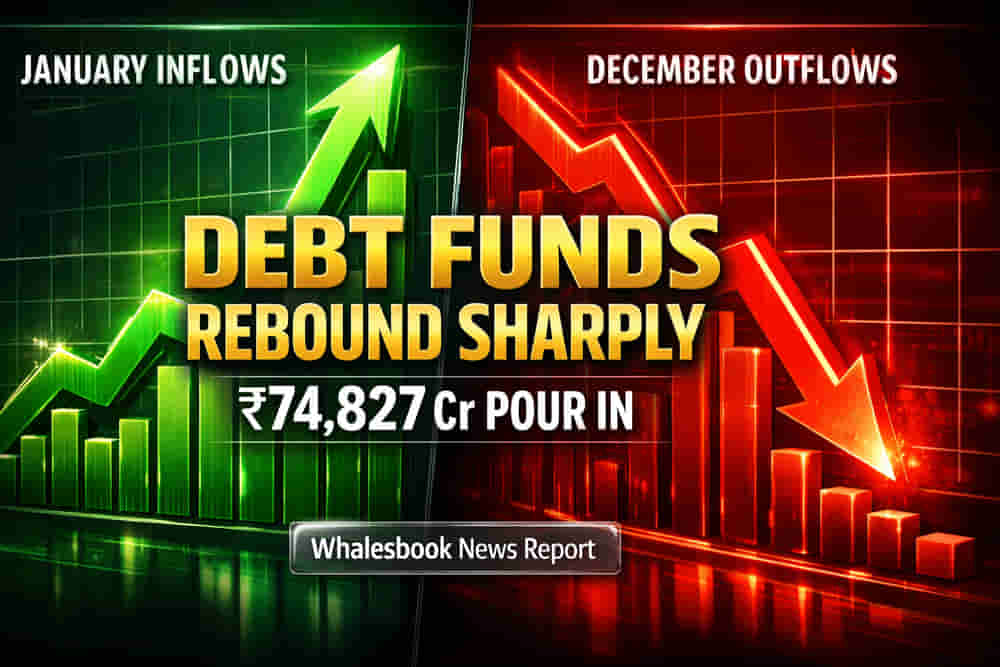
The Seamless Link
The substantial net inflows of ₹74,827 crore into Indian debt mutual funds in January 2026 marked a significant reversal from the preceding month's outflows. This recovery was predominantly fueled by liquidity-focused segments. Overnight funds attracted ₹46,280 crore, and liquid funds garnered ₹30,682 crore, indicating a strategic redeployment of corporate and institutional cash balances temporarily withdrawn for year-end activities. Money market funds also saw positive momentum, adding ₹12,763 crore, supported by attractive short-term yields. This surge reflects a normalization of treasury operations rather than a fundamental shift in investor strategy.
The Core Catalyst
The headline recovery in debt fund inflows masked a more complex market reality. While liquidity-oriented categories saw robust demand, other debt segments experienced outflows, highlighting a bifurcated investor sentiment. This suggests that the inflows are primarily tactical, driven by institutional reinvestment of year-end cash rather than a strategic reallocation towards riskier or longer-duration assets.
The Analytical Deep Dive
While debt funds experienced a headline recovery, broader market trends in January 2026 painted a picture of caution. The equity market saw broad-based negative returns, with the Nifty 50 declining 3.0%, and mid and small caps experiencing steeper drops, reflecting a general "risk-off" sentiment. In stark contrast to equity's struggles, Gold ETFs witnessed a significant surge, with inflows jumping 50% to approximately ₹24,040 crore, exceeding equity fund inflows and highlighting gold's appeal as a safe-haven asset. This divergence underscores investor preferences for perceived safety amidst market volatility. The Indian 10-year government bond yield hovered around 6.7% to 6.76% in early February 2026, exhibiting upward pressure from ongoing supply concerns and fiscal deficit fears, a trend that has seen yields creep up since late 2025. This persistent pressure on bond yields contrasts with the aggressive easing by central banks in other G10 economies, where long-term rates have remained elevated due to fundamental factors like growth and inflation expectations. The Reserve Bank of India maintained its repo rate at 5.25% in February 2026, retaining a neutral stance. While the GDP growth forecast for FY26 was revised upwards, inflation figures, though returning to the target band, are subject to new measurement methodologies that may obscure underlying pressures. This environment has historically led to similar year-end adjustments in debt funds, as observed with ₹1.28 lakh crore inflows in January 2025 following December 2024 outflows.
The Forensic Bear Case
Despite the headline inflow figures, a closer examination reveals persistent investor risk aversion and a reluctance to extend duration in debt portfolios. Outflows were evident in segments like corporate bond funds (₹11,473 crore), dynamic bond funds (₹1,435 crore), and long-duration funds (₹1,336 crore). This pattern strongly suggests that investors are prioritizing capital preservation and liquidity over chasing higher yields associated with longer maturities. The significant withdrawal of Foreign Portfolio Investors (FPIs) from Indian equities, amounting to $3.95 billion in January 2026 alone, further amplifies this risk-off sentiment. This continued selling, building on substantial outflows in 2025, points to foreign investors viewing Indian markets with caution due to geopolitical tensions, tariff threats, and concerns over corporate earnings and currency depreciation. The current inflows into debt funds appear to be a tactical, short-term redeployment rather than a strategic shift, indicating that deeper investment into longer-duration assets remains improbable until policy signals become unequivocally clearer and external risks subside.
The Future Outlook
Looking ahead, market participants expect bond yields to remain sensitive to supply pressures from government borrowing and fiscal deficit concerns. While the Reserve Bank of India has signaled a pause in rate cuts, its neutral stance implies a data-dependent approach, leaving room for tactical liquidity management but limited scope for aggressive easing unless inflation trends significantly deviate. The continued preference for liquidity and short-duration assets within debt funds, coupled with ongoing FPI caution towards Indian equities, suggests that a sustained reallocation into riskier or longer-dated debt instruments is unlikely in the immediate future. Investors are poised to remain measured, prioritizing stability until clearer macro-economic and policy guidance emerges.