

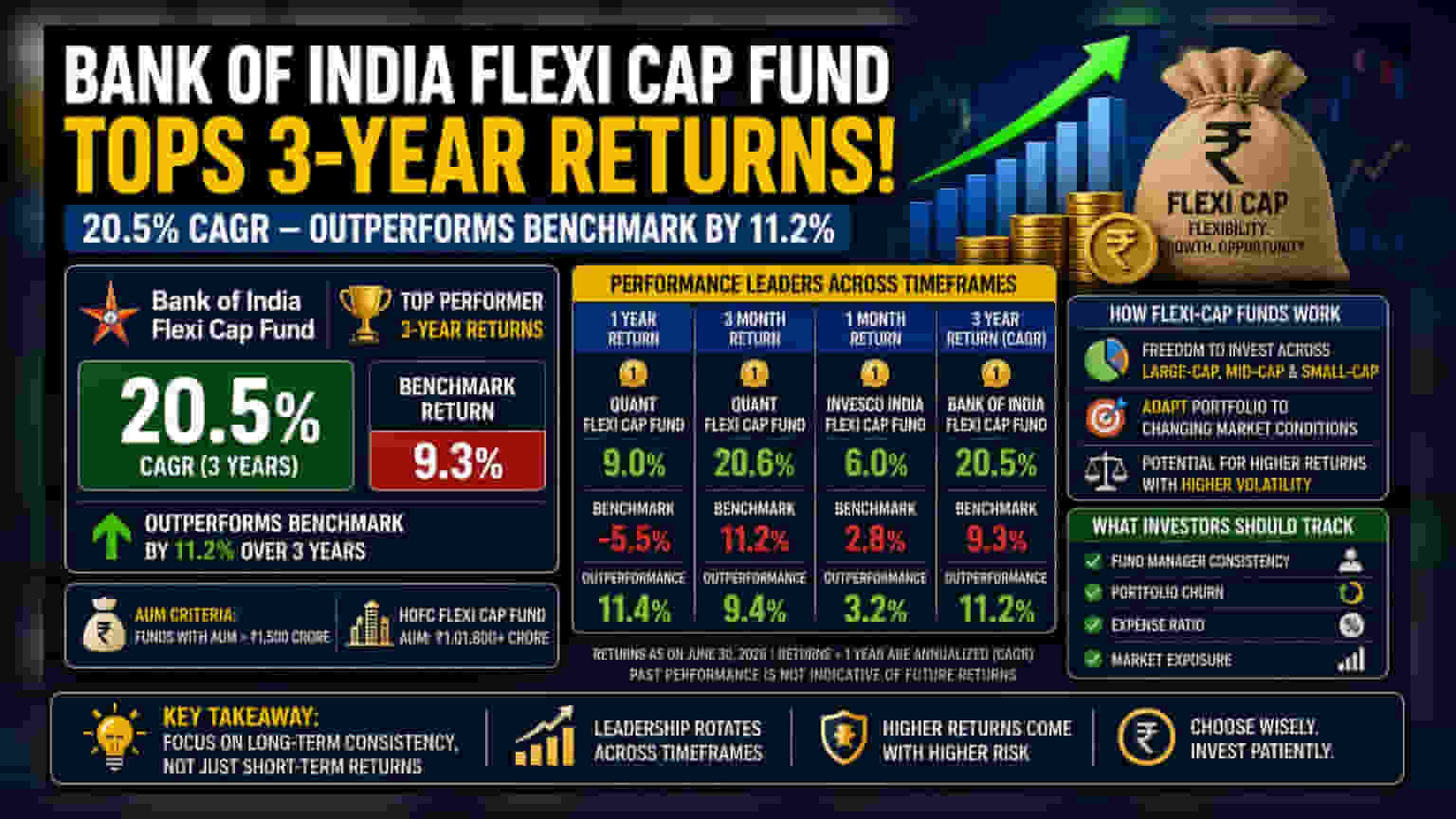
Bank of India Flexi Cap Fund has recorded a 20.5% annualized return over the last three years, outperforming its 9.3% benchmark. While it leads over this three-year period, other funds like Quant and Invesco have outperformed in the short term. Investors should understand that performance in flexible equity funds shifts based on market cycles and fund manager strategy.
What Happened
Bank of India Flexi Cap Fund has emerged as a top performer in its category, delivering a 20.5% annualized return (CAGR) over the past three years. This return significantly outpaced its benchmark, which stood at 9.3%. The fund's performance also highlights a strong one-year track record, beating its benchmark by 11.4 percentage points, despite broader market challenges where the benchmark recorded a negative return of 5.5%.
This analysis considers funds with assets under management (AUM) exceeding ₹1,500 crore, ensuring the comparison focuses on established schemes. For context, HDFC Flexi Cap Fund remains a major player in this category, managing over ₹1,01,800 crore in assets.
The Performance Shift Across Timeframes
While Bank of India Flexi Cap Fund leads the three-year performance metrics, the leadership board shifts significantly when looking at shorter timeframes. This is common in flexi-cap funds, where a manager's tactical decisions—such as increasing exposure to mid or small-cap stocks—can lead to different outcomes depending on the market cycle.
For instance, Quant Flexi Cap Fund has demonstrated strong performance in the one-year and three-month periods, delivering 9.0% and 20.6% returns, respectively. Similarly, Invesco India Flexi Cap Fund showed strong momentum over the one-month period with a 6.0% return. These variations underscore that no single fund consistently tops all timeframes.
How Flexi-Cap Funds Work
Flexi-cap funds are designed to give fund managers the freedom to invest across large-cap, mid-cap, and small-cap companies without strict allocation limits. This business model allows the fund to adapt its portfolio to changing market conditions.
However, this flexibility is a double-edged sword. While it allows for potentially higher returns when the manager correctly identifies opportunities in the mid or small-cap space, it also introduces higher volatility compared to pure large-cap funds. If the manager’s bets on specific market segments do not play out, the fund's returns can lag behind peers.
Understanding the Risks
Investors looking at past returns must remember that performance in equity markets is not static. A fund that outperforms over three years may not necessarily lead over a one-year or six-month period.
Furthermore, flexi-cap funds are subject to broader sector and market risks. When the overall market faces a downturn, the flexibility of the fund cannot always shield it from losses. Investors should focus on the fund’s long-term consistency rather than chasing short-term gains, as market leadership often rotates among different funds.
What Investors Should Track
When evaluating a flexi-cap fund, returns are only one part of the story. Investors may monitor several other factors:
- Fund Manager Consistency: Does the fund manager have a stable strategy, or is there frequent shifting of the portfolio?
- Portfolio Churn: High turnover in the portfolio can increase transaction costs, which may eat into investor returns.
- Expense Ratio: A lower expense ratio is generally better for long-term compounding, as it reduces the annual cost of managing the fund.
- Market Exposure: It is useful to check the fund's current split between large, mid, and small-cap stocks to understand the level of risk being taken to achieve those returns.