

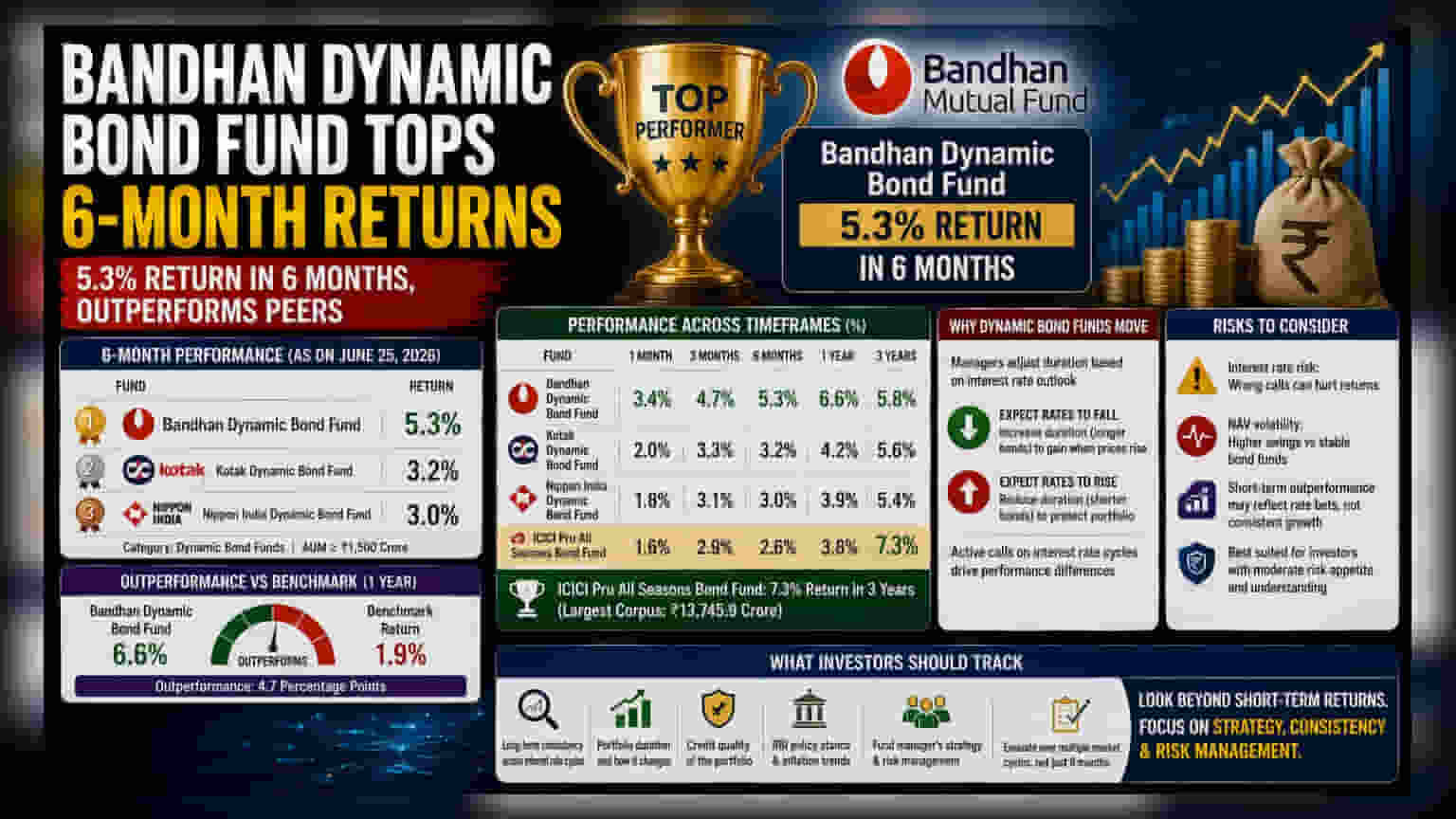
Bandhan Dynamic Bond Fund has outperformed its peers in the dynamic bond category, delivering a 5.3% return over the last six months. While this short-term performance currently tops the list, dynamic bond funds are highly sensitive to interest rate changes. Investors should note that rankings in this category can shift quickly, as seen when comparing short-term results against three-year performance data.
What Happened
Bandhan Dynamic Bond Fund has secured the top position among dynamic bond mutual funds, reporting a 5.3% return over the last six months. This performance data, based on records from ACE MF released on June 25, 2026, places the fund ahead of other major peers in the category. The rankings focus on funds with at least ₹1,500 crore in assets under management (AUM).
During the same six-month period, competitors Kotak Dynamic Bond Fund and Nippon India Dynamic Bond Fund followed with returns of 3.2% and 3.0%, respectively.
The Performance Context
The recent surge in returns for the Bandhan Dynamic Bond Fund highlights its active management style during the period. On a shorter timeframe, the fund also led its peers, posting a 3.4% return over one month and 4.7% over three months. When compared to its benchmark over a one-year period, the fund delivered 4.7 percentage points of outperformance, compared to the benchmark's 1.9% return.
However, it is vital for investors to look beyond six-month numbers. In the dynamic bond category, performance rankings often fluctuate significantly depending on the timeframe. For example, when looking at a three-year window, ICICI Prudential All Seasons Bond Fund—which holds the largest corpus among the top five funds at ₹13,745.9 crore—delivered a return of 7.3%, highlighting that different funds may lead over different cycles.
Why Dynamic Bond Funds Move
Dynamic bond funds are unique because they do not have a fixed investment strategy regarding the "duration" or maturity of the bonds they hold. The fund manager has the flexibility to change the portfolio mix based on their outlook on interest rates.
If the manager expects interest rates to fall, they may increase the duration of the fund (investing in longer-term bonds), which can boost returns when bond prices rise. Conversely, if they expect rates to rise, they may reduce the duration to protect the portfolio. This strategic movement is why the performance of these funds is closely tied to the fund manager's ability to predict interest rate cycles.
The Risk Factors
While outperformance is positive, dynamic bond funds come with specific risks that investors should understand. Because these funds bet on interest rate movements, their net asset value (NAV) can be volatile. If a fund manager's view on interest rates is incorrect, the fund can underperform compared to traditional, stable bond funds.
Investors must be aware that high returns in the short term often reflect a successful bet on rate trends rather than consistent long-term growth. This category is generally considered suitable for investors who have a moderate understanding of interest rate cycles and can tolerate the potential for short-term price swings.
What To Track Next
For those invested in or considering dynamic bond funds, the key monitorable is not just recent returns, but the fund manager's long-term consistency in navigating interest rate cycles. Investors may track the fund's portfolio duration, credit quality, and how the manager adjusts the strategy as RBI policies and inflation data evolve. Evaluating performance over multiple market cycles, rather than a six-month window, provides a clearer picture of the fund's risk management capabilities.