

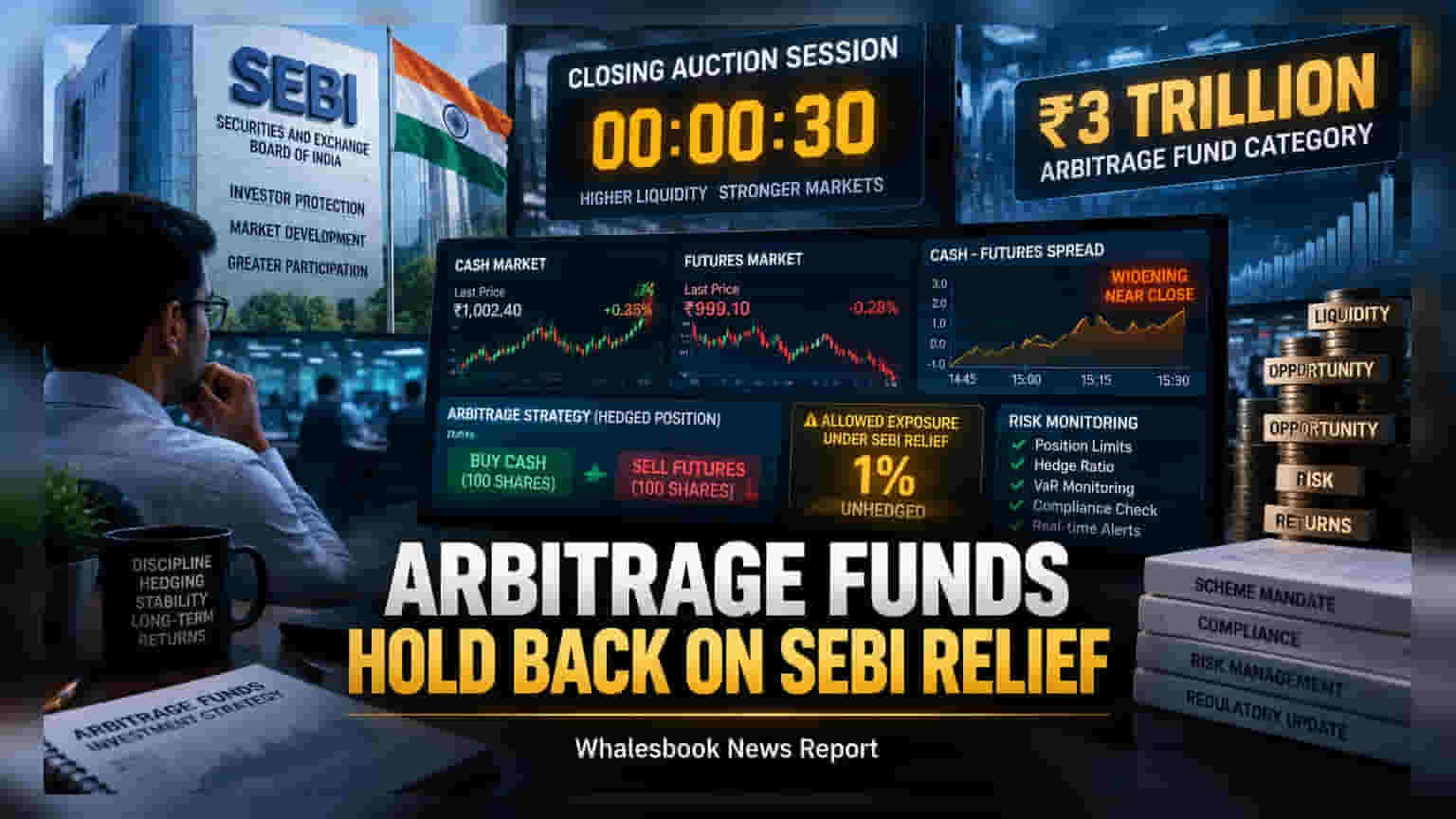
India’s largest arbitrage funds, managing roughly ₹3 trillion, have not adopted SEBI’s new 1% unhedged-exposure flexibility for the closing auction session. Fund managers are prioritizing their standard fully-hedged strategy over the new leeway to protect thin daily profit margins from market volatility.
The Securities and Exchange Board of India (SEBI) introduced a 1% flexibility allowance for arbitrage funds to encourage more participation in the newly launched closing auction session (CAS). However, the move has met with a cautious reception, as none of the 10 largest arbitrage schemes have yet amended their official mandates to utilize this provision. For a category managing approximately ₹3 trillion in assets, the reluctance highlights a fundamental conflict between regulatory goals for liquidity and the low-risk business model of these funds.
The Risk of Being Unhedged
Arbitrage funds operate on a simple principle: they buy stocks in the cash market while simultaneously selling equivalent positions in the futures market. This ensures the portfolio remains hedged, removing the risk of market direction. The primary goal is to capture the price difference between the cash and futures markets, which is usually small.
The closing auction session creates a structural hurdle for this strategy. If a fund attempts to execute trades in the closing auction, it may find that its cash-market order is partially filled while its futures trade is not, or vice versa. This leaves the fund with a temporary, unhedged position. While SEBI’s 1% leeway allows funds to hold this unhedged exposure, it forces fund managers to take on a risk they are explicitly designed to avoid.
For a strategy that typically earns daily returns measured in just 1.5 to 2 basis points, an unhedged position is significant. If the market moves against the fund before the position is closed in the next trading session, a 2% price shift on that 1% unhedged exposure could wipe out an entire day’s profit. Fund managers appear to be prioritizing capital protection and consistent, albeit small, returns over the potential for higher liquidity in the closing auction.
Operational Hurdles and Compliance
Beyond the investment risk, adopting the 1% flexibility requires significant operational changes. Arbitrage schemes have internal compliance and risk-management systems programmed to alert managers the moment a position deviates from the fully-hedged mandate. To use the new leeway, fund houses would need to recalibrate these systems, update internal policies, and formally amend their scheme documents through an addendum.
This creates a cost-benefit calculation that many asset managers are currently rejecting. The administrative work and the risk of straying from a proven, low-risk mandate currently outweigh the potential benefits of improved execution in the closing auction.
Investors in these funds may want to monitor whether their specific scheme makes any formal amendments to its investment mandate in the coming months. If large funds continue to stay on the sidelines, SEBI’s relaxation may have limited impact on the liquidity of the closing auction session, despite the large size of the arbitrage fund category.