

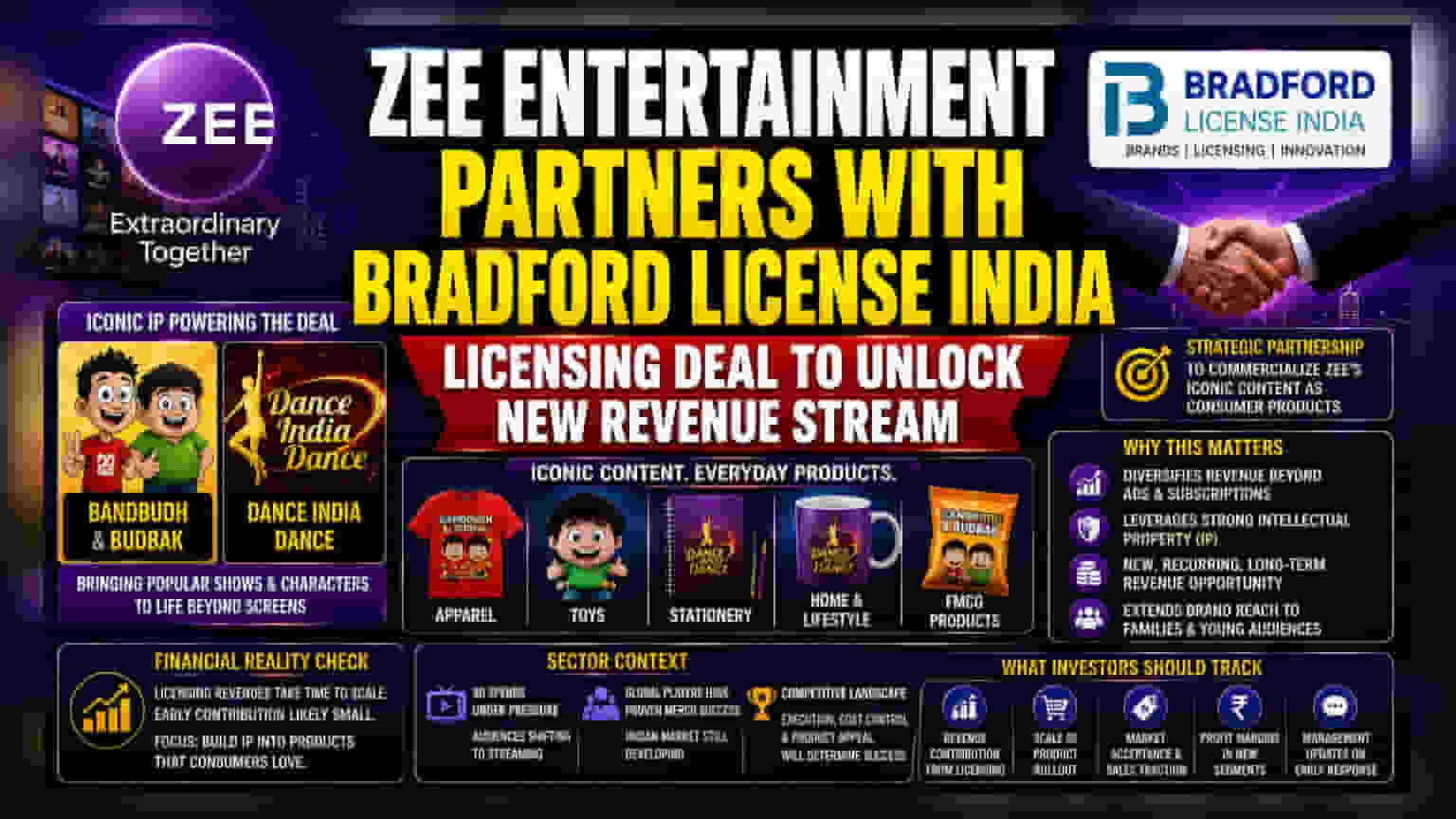
Zee Entertainment has partnered with Bradford License India to create consumer products like apparel, toys, and stationery based on its popular TV and digital shows. The move aims to generate revenue beyond traditional advertising and subscription fees. While this diversifies income, investors will watch whether these new categories can contribute meaningfully to the company's overall financial health in the long run.
What Happened
Zee Entertainment Enterprises Ltd. (ZEEL) has entered into a strategic partnership with Bradford License India. The goal is to commercialize the company’s vast library of entertainment content by launching consumer products. Under this arrangement, ZEEL’s popular shows and characters—including the animated series "Bandbudh & Budbak" and the reality show "Dance India Dance"—will be adapted into merchandise such as apparel, toys, stationery, and fast-moving consumer goods (FMCG).
Why This Matters For The Business
For a media company, relying solely on advertising and subscription fees can be risky, as these revenues are often sensitive to economic cycles and viewer habits. By moving into licensing, ZEEL is attempting to create a new, recurring revenue stream that is less dependent on daily television ratings. The strategy involves leveraging the intellectual property (IP) it already owns. Instead of the content being used only for broadcasting, it is being transformed into a brand that can be sold in physical stores or online, potentially extending the life and value of the company’s creative assets.
The Financial Reality Check
While the expansion into licensing is a new growth avenue, investors should understand the nature of this business. Licensing revenues generally take time to scale and are often small compared to the core broadcasting business in the early stages. The primary challenge for the company will be to build a supply chain and distribution network that can turn these digital and TV properties into physical products that consumers actually want to buy. This move is not a quick fix for current financial pressures, but rather a long-term effort to diversify how the company makes money.
Sector Context And Competition
India’s media and entertainment sector has been under pressure as traditional ad spending fluctuates and audiences migrate to streaming platforms. Companies are now looking for ways to extract more value from their existing content. While global media giants like Disney have successfully used character merchandising for decades, the Indian market for such products is still developing. ZEEL is competing with other major players who are also trying to find ways to keep viewers engaged across different formats. The success of this move will depend on how well the company can manage costs while building these new categories.
What Investors Should Track
Moving forward, investors may look for updates on how much this licensing business contributes to total revenue. Key things to watch include the scale of the product rollout, the acceptance of these products in the market, and whether the company can maintain profit margins in these new segments. The management's commentary on the initial response to these products will be essential to understanding if this strategy will become a significant part of the company's future earnings or remain a minor experimental project.