 Whalesbook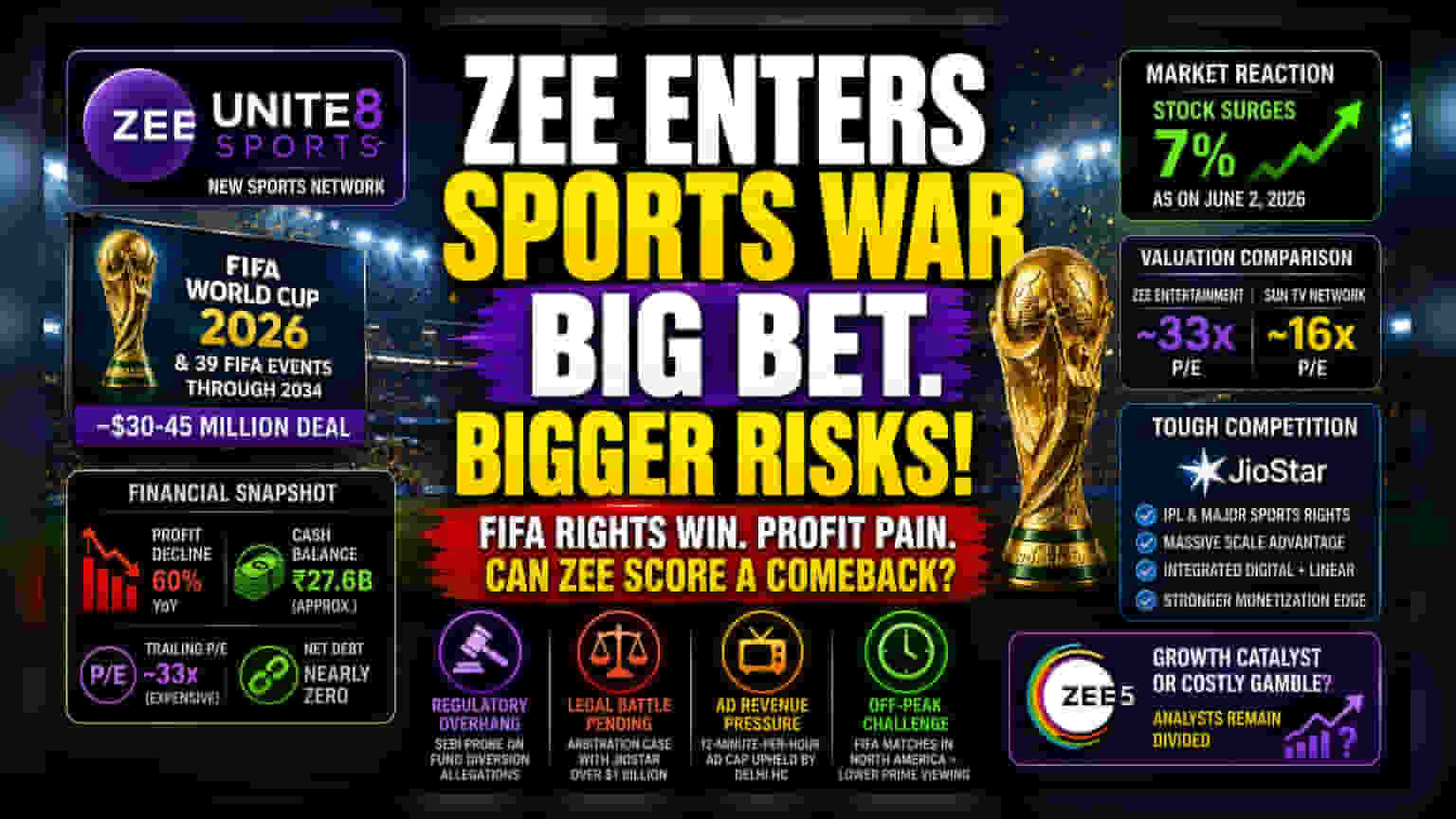


The Strategic Pivot to Sports
Zee Entertainment’s launch of the Unite8 Sports network arrives at a critical juncture for the broadcaster, which has struggled with a 60% decline in annual profits and increased competition. By securing the rights to the 2026 FIFA World Cup and 39 other FIFA properties through 2034, the company is attempting to carve out a permanent niche in the premium live sports sector. This acquisition, reportedly valued at roughly $30-45 million, provides a much-needed content pipeline but shifts the company’s focus toward a volatile revenue model that requires deep audience engagement in a market where cricket traditionally dominates.
The Valuation and Market Reality
The market initially responded with optimism, fueling a 7% surge in the stock price as of June 2, 2026. Despite this, investors remain wary of the company’s valuation. Trading at a trailing P/E ratio of approximately 33x, ZEEL is significantly more expensive than regional peers like Sun TV Network, which trades at a lower multiple. Furthermore, while the company maintains a cash balance of roughly ₹27.6 billion and a nearly debt-free profile, its recent quarterly financial performance and dwindling margins underscore the high cost of re-entering a sports segment that previously saw the company exit in 2016.
Structural and Regulatory Risks
Beyond operational execution, Zee faces an intensifying regulatory and legal environment. The company continues to navigate ongoing investigations by the Securities and Exchange Board of India (SEBI) regarding past allegations of fund diversion, which have historically weighed on shareholder sentiment and restricted corporate flexibility. Moreover, a pending arbitration case with the Reliance-Disney joint venture, JioStar, involving claims exceeding $1 billion, creates a lingering legal overhang. The broader industry is also grappling with a recent Delhi High Court ruling upholding a 12-minute-per-hour advertising cap, a regulation that could further squeeze advertising revenue for all linear broadcasters, including Zee.
The Competitive Outlook
Zee’s entry into sports comes as JioStar dominates the domestic landscape with rights to the Indian Premier League and other premier sporting assets. Unlike its competitors, who benefit from massive scale and integrated digital-linear ecosystems, Zee must maximize monetization during a FIFA World Cup where time-zone differences between North America and India mean most matches will occur during off-peak hours. Analysts remain sharply divided; some believe the FIFA rights provide a necessary growth catalyst for the company’s streaming platform, ZEE5, while others maintain a cautious outlook, citing the limited upside for subscription growth and the inherent risks of aggressive content spending during a period of financial stabilization.