 Whalesbook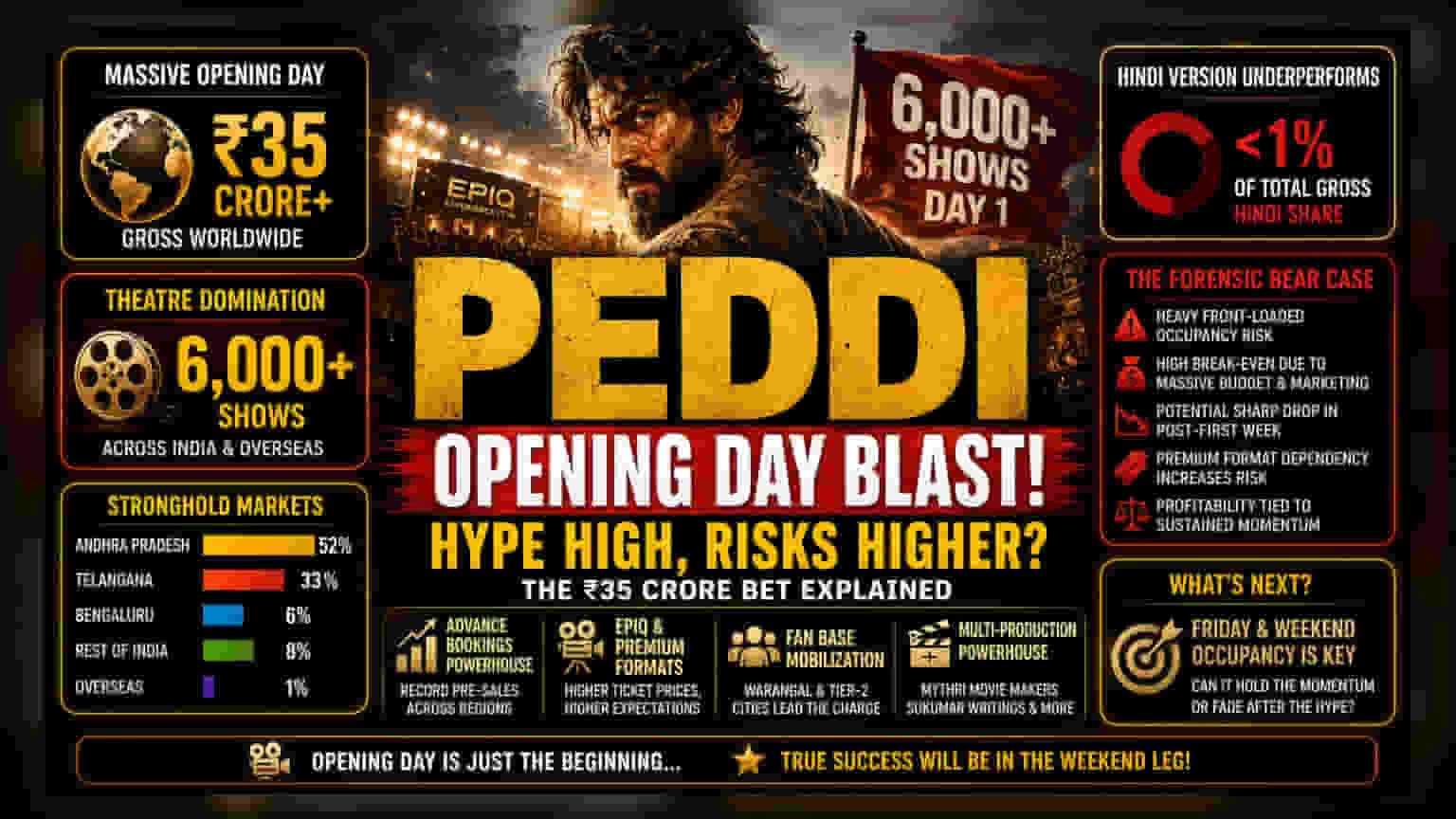


The Capital Intensity of Regional Superstardom
The financial profile of 'Peddi' reflects an aggressive saturation strategy typical of modern Telugu blockbusters. By securing over 6,000 shows on opening day, the production houses are betting heavily on front-loaded occupancy to recoup substantial production and marketing costs. This volume-driven approach forces high break-even thresholds, where the difference between a regional success and a global commercial winner lies in the sustainability of ticket velocity beyond the initial 48-hour window.
The Geographic Concentration Risk
While the headline numbers emphasize a ₹35 crore global footprint, the underlying distribution reveals a heavy tilt toward Andhra Pradesh and Telangana. Bengaluru stands out as the primary secondary market, yet the underperformance of the Hindi-language version—contributing less than 1% of total gross revenue—highlights a structural challenge in crossing over to broader domestic audiences. Unlike recent pan-Indian successes that leveraged mass appeal in North India, 'Peddi' appears tethered to its home territory. The high occupancy rates in cities like Warangal suggest significant fan-base mobilization, but reliance on these specific micro-markets creates vulnerability to localized market saturation once the first-day demand is exhausted.
The Forensic Bear Case: Profitability Hurdles
Investors and industry analysts often look at the conversion rate from pre-sales to long-term theater legs. In the current cinematic environment, hyper-concentrated advance bookings frequently correlate with a sharper drop-off in post-release occupancy. If the critical reception fails to match the pre-release hype, the high theater count could become a liability, leading to increased overhead costs for distributors without a corresponding rise in seat utilization. Furthermore, the reliance on premium formats like EPIQ screens for high-margin revenue means that any technical or distribution bottleneck in these specific cinemas could disproportionately impact the final return on investment. The production involvement of multiple entities—Mythri Movie Makers, Sukumar Writings, and others—also suggests a risk-sharing model that may indicate higher-than-average production budgets that require a massive global haul to justify the capital allocation.
Outlook and Market Expectations
Market participants will be monitoring the Friday occupancy figures closely to gauge the film's 'tail'—the ability to maintain momentum after the initial fan rush. Should the film fail to maintain a steady revenue slope throughout its opening weekend, it could signal a cooling period for high-budget Telugu productions attempting to navigate the volatile landscape of the summer release cycle. Success here is not merely about the opening day total, but the cost-to-earnings efficiency against the massive marketing spend required to achieve this level of advance exposure.