 Whalesbook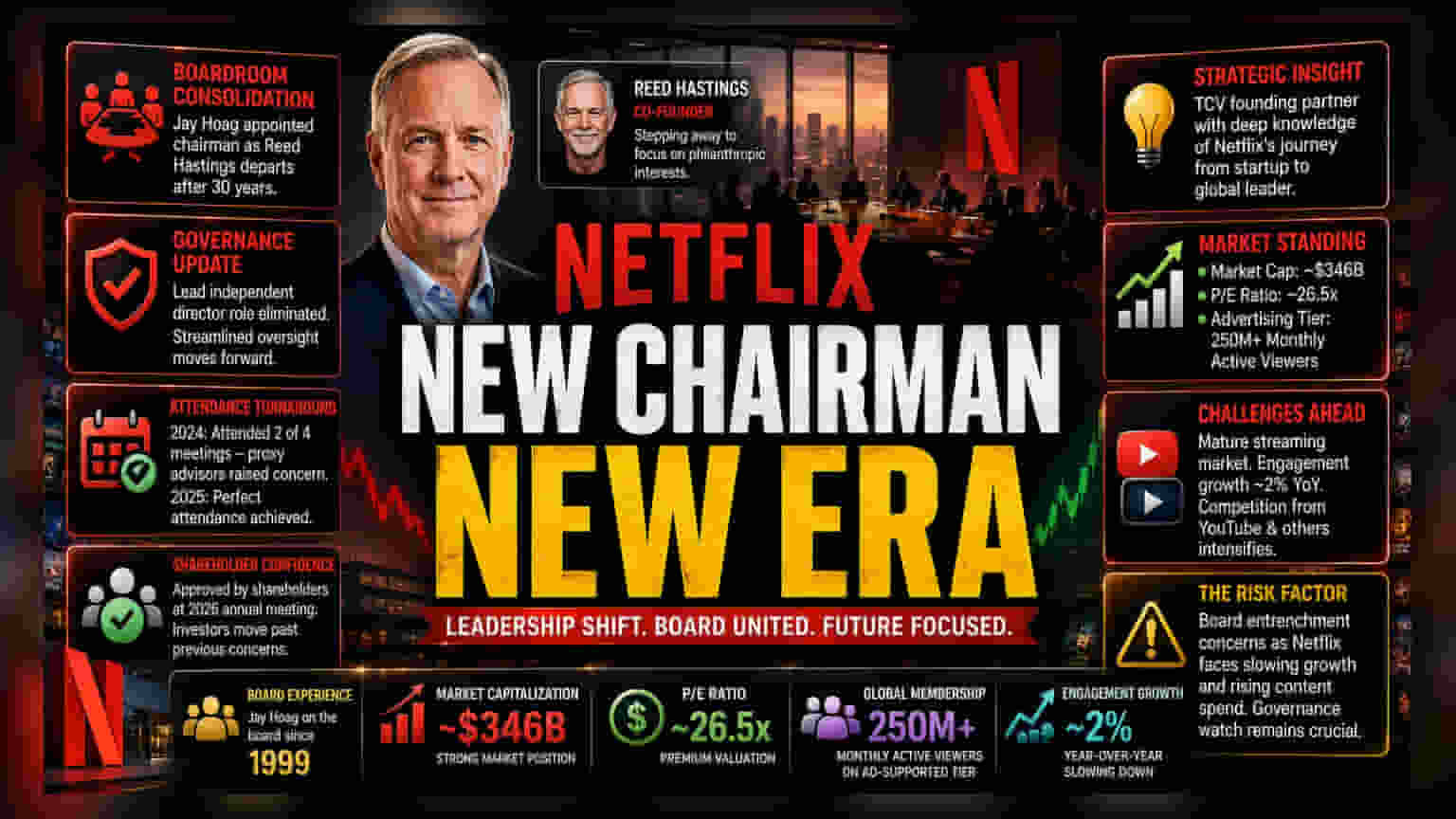


The Boardroom Consolidation
Netflix has officially transitioned its leadership structure, appointing Jay Hoag as chairman following the departure of co-founder Reed Hastings. Hoag, who has served on the board since 1999 and previously held the lead independent director role for over a decade, assumes the chairmanship immediately. This consolidation effectively eliminates the need for a separate lead independent director position, a structural change that aligns with the board’s current push for streamlined oversight. The transition marks the final chapter of Hastings’ nearly three-decade tenure, as the co-founder steps away from board duties to focus on his philanthropic interests.
Governance and Historical Context
The appointment arrives after a period of intense scrutiny regarding board attendance. In 2024, institutional proxy advisors flagged Hoag’s participation in board meetings, which fell to two out of four sessions, prompting a recommendation to vote against his re-election. The company confirmed that Hoag subsequently corrected this performance, achieving perfect attendance throughout 2025. Shareholder approval at the 2026 annual meeting suggests that investors have largely moved past the controversy, viewing Hoag as a consistent, if long-tenured, steward of the company’s growth trajectory since its pre-IPO days.
Strategic Implications and Market Standing
Hoag’s background as a founding partner at TCV—a firm that served as a “crossover” investor for Netflix—provides him with deep institutional knowledge of the firm’s evolution from a DVD-by-mail service to a global streaming powerhouse. With a market capitalization hovering near $346 billion and the company currently trading at a P/E ratio of roughly 26.5x, Hoag steps into the role at a point of stabilization. Netflix faces a mature streaming market where engagement growth has cooled to approximately 2% year-over-year. The company has successfully pivoted to a high-margin advertising tier, which now boasts over 250 million monthly active viewers, yet it faces aggressive competition from the likes of YouTube, which continues to dominate total viewing time on connected televisions.
The Risk Factor: The 'Legacy' Problem
While the market has reacted with a degree of cautious optimism, the bear case centers on the risk of "board entrenchment." Critics of long-tenured directors argue that such deep familiarity can sometimes diminish the board's objective challenge to management’s strategic direction. As Netflix moves into a phase of decelerating subscriber growth and intensified content spending, the effectiveness of the board will be tested. Moreover, the board’s decision to consolidate leadership roles rather than maintain a separate lead independent director may be viewed by some governance purists as a step toward reduced checks and balances, despite the company's commitment to maintaining a predominantly independent board composition.