

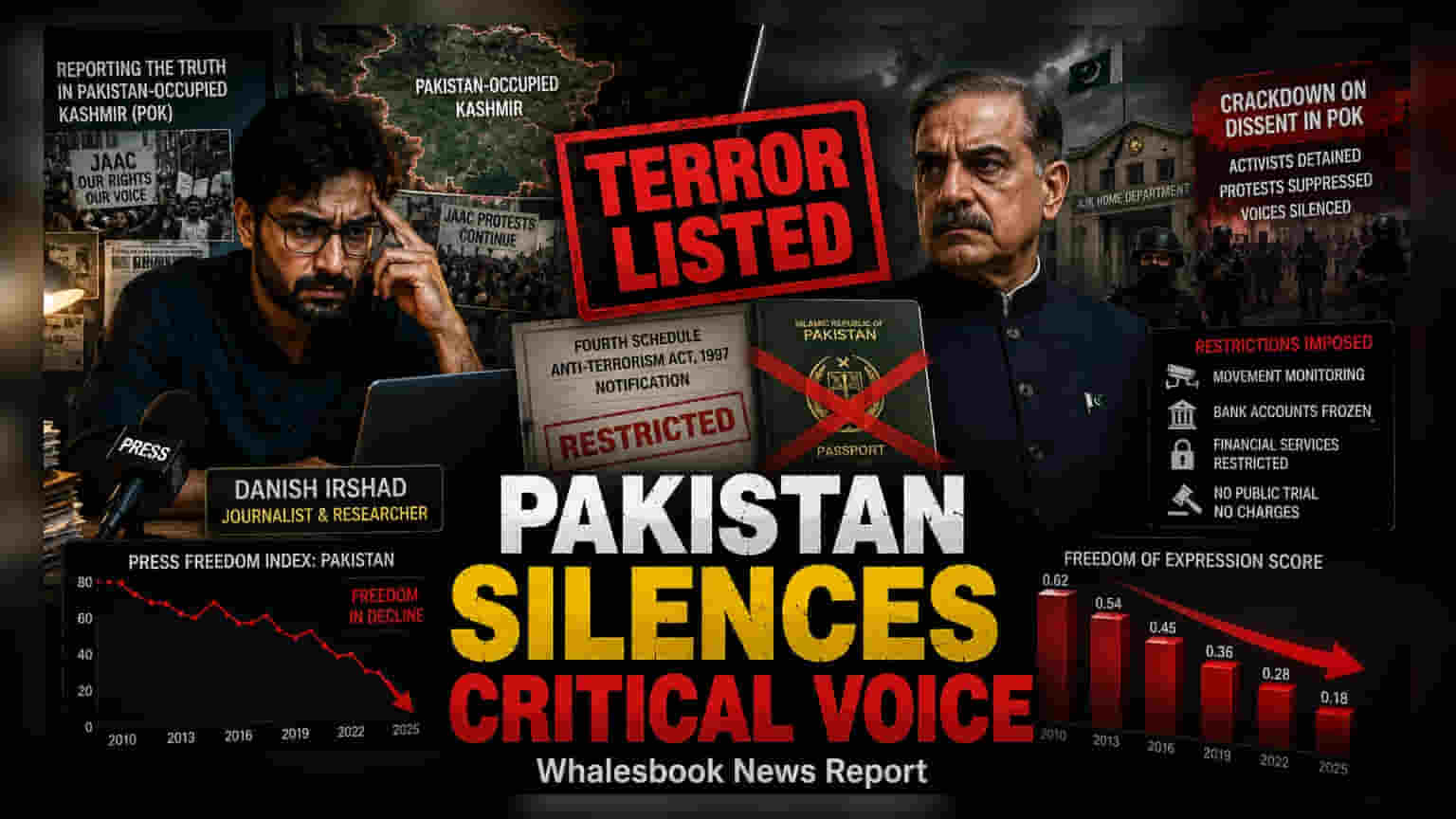
Journalist Danish Irshad has been added to Pakistan’s Fourth Schedule, an administrative watchlist, following his coverage of protests in Pakistan-occupied Kashmir. This designation restricts his travel and financial activities without a criminal trial, drawing sharp criticism from media freedom advocates regarding the safety of independent reporting in the region.
The Azad Jammu and Kashmir (AJK) Home Department has placed journalist and researcher Danish Irshad on the Fourth Schedule of Pakistan’s Anti-Terrorism Act. The notification, reportedly dated July 29, 2026, marks an administrative action that imposes significant restrictions on the individual without requiring a formal criminal conviction or public trial.
Under the Fourth Schedule, authorities have the power to monitor an individual's movement, freeze bank accounts, and restrict access to financial services. The designation follows years of reporting by Irshad on political and social developments in Pakistan-occupied Kashmir (PoK), specifically his detailed coverage of recent agitations led by the Jammu and Kashmir Joint Awami Action Committee (JAAC).
Since the JAAC was proscribed by the government on June 5, 2026, the region has witnessed sustained protests over governance, economic grievances, and local political representation. The government's decision to place Irshad on this list is part of a broader security crackdown that has targeted various activists and protestors in the area. Official notifications provided no specific criminal charges or public evidence justifying the designation, leading human rights organizations and press freedom advocates to characterize the move as an attempt to curb independent journalism and suppress critical voices in the region.
For media professionals and regional analysts, the development highlights the growing operational risks of covering volatile political zones. The use of counter-terrorism administrative tools against members of the press creates an environment where independent reporting on human rights and political governance becomes increasingly difficult. Observers note that such measures can have a chilling effect, discouraging transparency and public discourse on regional issues. The matter remains a focal point for international media watchdogs monitoring the narrowing space for dissent in Pakistan's administrative and conflict-prone areas.